
The dusty face of the Eagle Nebula and its surroundings are revealed in this image based on data from NASA's Wide Field Survey Explorer (WISE). WISE detects infrared light, or a range of wavelengths longer than what the human eye can see. This large star forming region is about 5,700 light years away from Earth and is most famous for being home to the the "Pillars of Creation," a region famously imaged by NASA's Hubble and James Webb space telescopes. The WISE data reveals the entire structure of the nebula surrounding the pillars, which themselves can be seen as a faint yellow-green feature inside the white circle.
While the WISE view of the "Pillars" is not as sharp as those taken by Webb and Hubble, the telescope's wide field of view allows us to explore the extended nebula around it. When viewed in visible light, the dust is dark and opaque. In these infrared wavelengths, the dust becomes more translucent, and emits infrared light, shown in green, yellow, and red in this image. The data used in this image came from WISE's primary mission which ran from 2009 to 2011.
In 2013, NASA took the spacecraft out of hibernation and began using it to track and study near-Earth objects. The mission and the spacecraft were renamed NEOWISE. However, the data is still being used by astronomers to study objects and regions outside our solar system. Blue and cyan are used to represent infrared light at wavelengths of 3.4 and 4.6 microns, while green and red display longer wavelengths of 12 and 22 microns, respectively.
Animation available at https://photojournal.jpl.nasa.gov/catalog/PIA25433
Where this page came from
This page was imported from NASA. NASA material is generally not copyrighted and is in the public domain.
Nobody has written it yet — it is the source material at a new address, which is why search engines are asked to skip it and why no one earns from it. It is up for grabs: take it on, and it is yours to rewrite and to earn from.
이용 허락: CC0 1.0 (퍼블릭 도메인) · 출처 images.nasa.gov
1
0
0
0

코멘트
이어서 읽기
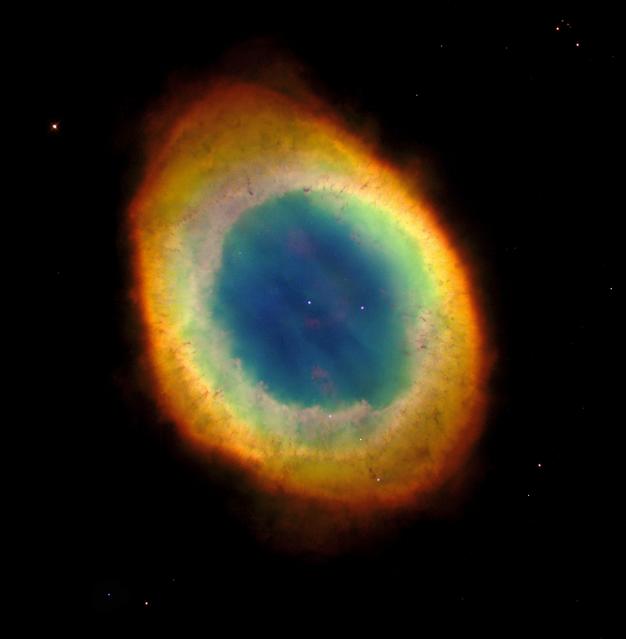
- Planetary NebulaThe Ring Nebula's distinctive shape makes it a popular illustration for astronomy books. But new observations by NASA's Hubble Space Telescope of the glowing gas shroud around an old, dying, sun-like star reveal a new twist. "The nebula is not like a bagel, but rather, it's like a jelly doughnut, be
- Doradus NebulaA panoramic view of a vast, sculpted area of gas and dust where thousands of stars are being born has been captured by NASA's Hubble Space Telescope. The image, taken by Hubble's Wide Field and Planetary Camera 2, is online at The camera was designed and built by NASA's Jet Propulsion Laboratory, Pa

- The Tarantula NebulaNASA Spitzer Space Telescope, formerly known as the Space Infrared Telescope Facility, has captured in stunning detail the spidery filaments and newborn stars of theTarantula Nebula, a rich star-forming region also known as 30 Doradus. This cloud of glowing dust and gas is located in the Large Magel


