
Introduction
Most people spend years studying inefficiently.
They reread textbooks, highlight pages, watch endless videos, and take large amounts of notes, yet still forget most of what they learn. The problem is rarely intelligence or effort. The real issue is that most people were never taught how learning actually works.
Modern research in neuroscience, cognitive science, and performance psychology consistently shows that effective learning depends less on information consumption and more on how information is processed, practiced, retrieved, and applied.
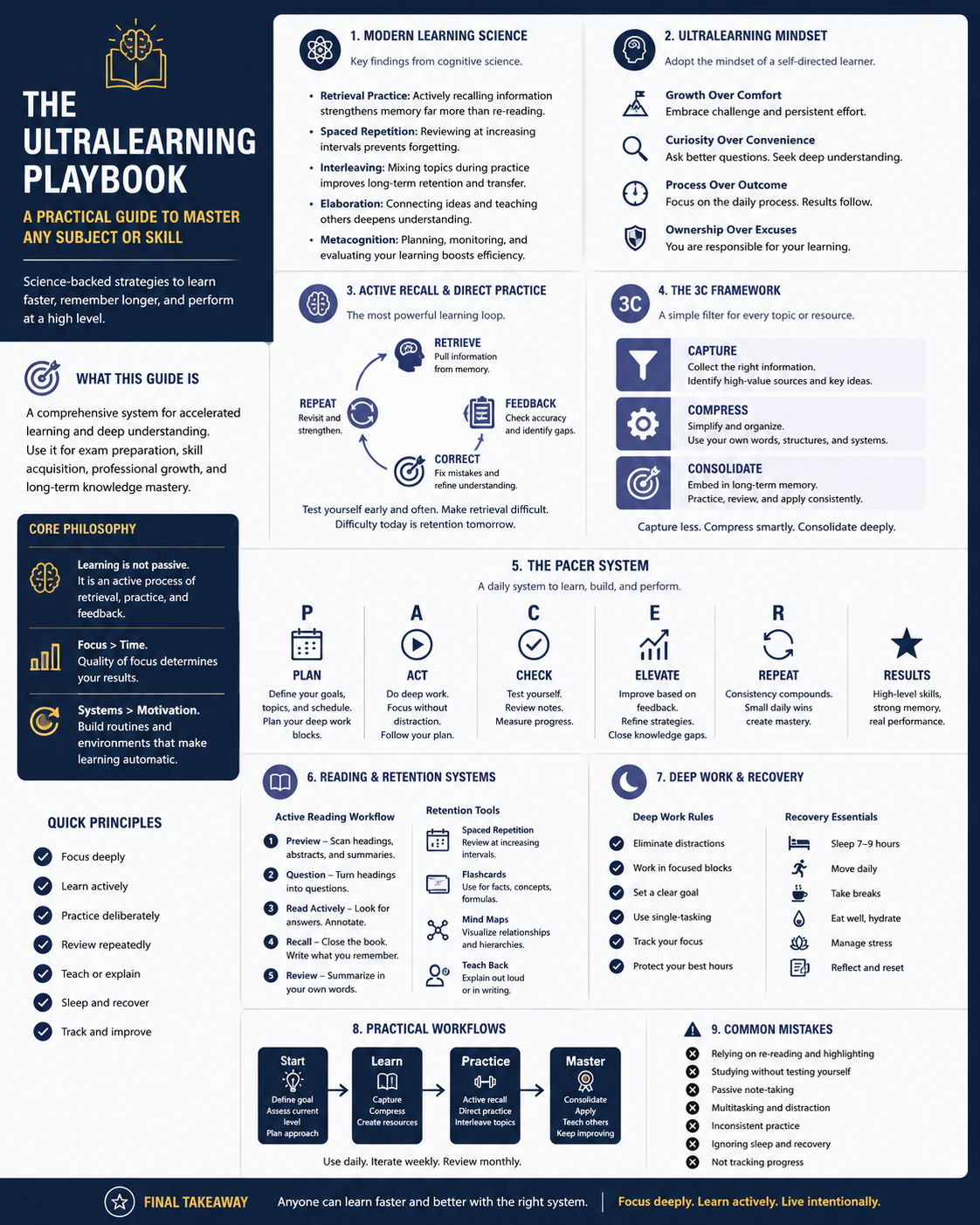
This guide consolidates the core ideas from multiple learning systems and frameworks into a single professional reference.
The central idea is simple:
Learning is not about consuming more information.
Learning is about retaining and applying the right information effectively.
This guide covers:
- How the brain learns
- Why most study methods fail
- The principles of ultralearning
- Active recall and direct practice
- The 3C Learning Framework
- The PACER Information System
- Reading and retention strategies
- Deep work and recovery cycles
- Practical systems for exams, skill building, and professional growth
Part I — Understanding How Learning Actually Works
1. Why Most Learning Fails
Most traditional study methods are passive.
Examples include:
- Rereading notes
- Highlighting textbooks
- Watching lectures repeatedly
- Copying information into notebooks
- Reviewing summaries without testing understanding
These methods feel productive because they are familiar and mentally comfortable. However, comfort is often mistaken for learning.
The major problem is that passive review creates recognition, not mastery.
When students reread material, the brain recognizes the content and interprets that familiarity as understanding. But recognition is not the same as recall or application.
This explains why many students:
- Feel confident while studying
- Forget material during exams
- Struggle to apply knowledge in real situations
- Need to relearn the same information repeatedly
Real learning requires effortful retrieval, application, and restructuring of information.
2. The Brain’s Biological Constraints
The human brain is powerful but limited.
Key constraints include:
Limited Working Memory
Research suggests humans can actively manage only a small number of independent concepts simultaneously.
When too much information is introduced at once:
- Cognitive overload occurs
- Retention drops sharply
- Understanding becomes shallow
- Mental fatigue increases
This is why cramming is inefficient.
Serial Processing
Unlike computers, the brain does not process unlimited streams of information in parallel.
Human learning works best sequentially:
- Learn
- Practice
- Retrieve
- Rest
- Consolidate
Trying to consume large amounts of information continuously without processing leads to forgetting.
Energy Demands
The prefrontal cortex — responsible for reasoning, focus, and learning — consumes significant energy.
Deep learning requires:
- Attention
- Glucose
- Oxygen
- Recovery
This explains why intense concentration is mentally exhausting.
Part II — The Foundations of Effective Learning
3. Metalearning: Learning How to Learn
Metalearning means understanding:
- How a subject is structured
- Which methods work best
- What skills are required
- How experts learn the material
Before beginning any learning project, effective learners ask:
- What exactly do I need to learn?
- What is the fastest way to practice this?
- Which methods produce the best retention?
- How will this knowledge actually be used?
This preparation dramatically increases efficiency.
4. Active Learning vs Passive Learning
Passive Learning
Passive learning includes:
- Reading
- Watching
- Listening
- Highlighting
Passive methods help expose you to information but produce relatively weak long-term retention.
Active Learning
Active learning forces the brain to retrieve, manipulate, and apply information.
Examples:
- Practice tests
- Flashcards
- Explaining concepts aloud
- Teaching others
- Solving problems
- Writing from memory
- Building projects
Active learning feels harder because it reveals gaps in understanding.
However:
Difficulty during retrieval strengthens memory.
This principle is known as the generation effect.
5. Directness: Learn in the Context of Use
One of the strongest principles in ultralearning is directness.
Directness means:
Practice the skill in the same environment where it will actually be used.
Examples:
| Goal | Weak Approach | Direct Approach |
|---|---|---|
| Learn Japanese | Grammar apps only | Conversing with native speakers |
| Improve coding | Watching tutorials | Building software |
| Pass exams | Reading notes repeatedly | Doing practice exams |
| Public speaking | Reading communication books | Giving presentations |
| Learn guitar | Reading theory only | Playing songs repeatedly |
Direct practice often feels uncomfortable.
However, discomfort is frequently a sign of effective learning.
Part III — The 3C Learning Framework
The 3C Framework consists of:
- Compress
- Compile
- Consolidate
Together, these stages form a complete learning cycle.
6. Compress — Simplify and Organize Information
Compression means reducing complexity into manageable mental structures.
Experts do not memorize isolated facts.
Instead, they recognize:
- Patterns
- Relationships
- Systems
- Repeated structures
Chess grandmasters, for example, recognize thousands of patterns rather than memorizing individual moves.
Techniques for Compression
A. The 80/20 Principle
Most books and subjects contain:
- 20% core concepts
- 80% supporting detail
Focus first on:
- Foundational ideas
- High-yield concepts
- Frequently tested material
- Core frameworks
B. Association
Connect new information to existing knowledge.
Questions to ask:
- What does this remind me of?
- Where have I seen this pattern before?
- How does this connect to what I already know?
Association improves retention because the brain stores information in networks.
C. Chunking
Group multiple ideas into single meaningful units.
Examples:
- Acronyms
- Mental models
- Diagrams
- Analogies
- Frameworks
- Concept maps
Chunking reduces cognitive load.
7. Compile — Convert Knowledge Into Skill
Compilation transforms information into usable ability.
The major principle is:
Learn → Test → Learn → Test
Not:
Learn for weeks → Test once.
A. Deliberate Practice
Deliberate practice involves:
- Focused repetition
- Immediate feedback
- Correction of mistakes
- Working near the edge of ability
B. Slow Practice
For procedural skills:
- Practice slowly
- Focus on precision
- Pay attention to micro-errors
Examples:
- Music
- Sports
- Coding
- Clinical skills
- Public speaking
Slow practice builds correct neural patterns.
C. Teaching as Learning
Teaching forces:
- Retrieval
- Reorganization
- Simplification
- Deeper understanding
Methods:
- Explain concepts aloud
- Teach another person
- Pretend to lecture
- Write tutorials
If you cannot explain something simply, you likely do not understand it deeply.
D. Immersion
Real environments expose weaknesses quickly.
Examples:
- Speaking with native speakers
- Performing live
- Coding real projects
- Mock interviews
- Timed practice exams
Immersion accelerates adaptation.
8. Consolidate — Retain Knowledge Long-Term
Learning does not end when studying stops.
Memory consolidation occurs during:
- Rest
- Reflection
- Sleep
- Recovery
A. Ultradian Cycles
The brain works optimally in approximately:
- 90 minutes of focused work
- Followed by 20 minutes of rest
Protect deep work sessions carefully.
B. Micro Breaks
Short pauses after intense focus help the brain replay information rapidly.
Even 10–20 second pauses can improve retention.
C. Sleep
Sleep is essential for:
- Memory consolidation
- Pattern integration
- Cognitive recovery
- Skill retention
Poor sleep severely reduces learning quality.
D. Non-Sleep Deep Rest (NSDR)
NSDR includes:
- Meditation
- Yoga nidra
- Quiet rest
- Relaxed walks
The purpose is reducing cognitive stimulation and allowing recovery.
Part IV — The PACER Information Framework
Different information types require different learning strategies.
The PACER system divides information into five categories.
9. P — Procedural Information
Procedural information explains how to perform actions.
Examples:
- Coding
- Languages
- Surgery
- Playing instruments
- Sports techniques
Best Method: Immediate Practice
Procedural information should be applied as soon as possible.
Avoid:
- Excessive note taking
- Memorization without execution
- Delaying practice
Learning procedural skills without practice is ineffective.
10. A — Analogous Information
Analogous information connects new concepts to existing knowledge.
Examples:
- Comparing muscle contraction to swimming mechanics
- Relating programming patterns to real-world systems
- Connecting new math concepts to older ones
Best Method: Analogy + Critique
After forming an analogy, ask:
- How are these concepts similar?
- Where does the analogy break down?
- Can the analogy be improved?
Critiquing analogies deepens understanding.
11. C — Conceptual Information
Conceptual information includes:
- Theories
- Principles
- Relationships
- Systems
- Explanations
This is the foundation of deep understanding.
Best Method: Mapping
Conceptual learning works best through network thinking.
Useful tools:
- Mind maps
- Concept maps
- Diagrams
- System models
The goal is understanding relationships, not memorizing sequences.
Experts think in interconnected networks.
12. E — Evidence Information
Evidence information supports conceptual understanding.
Examples:
- Statistics
- Case studies
- Dates
- Examples
- Research findings
Best Method: Store and Rehearse
Store information using:
- Notes
- Flashcards
- Databases
- Knowledge systems
Then rehearse by:
- Applying examples
- Solving problems
- Writing explanations
- Teaching concepts
13. R — Reference Information
Reference information consists of isolated details.
Examples:
- Formulas
- Definitions
- Constants
- Gene names
- Syntax rules
Best Method: Spaced Repetition
Reference material benefits from:
- Flashcards
- Active recall
- Spaced repetition systems
Applications such as Anki are effective.
Part V — Reading Faster and Retaining More
14. Reading Speed Principles
Reading speed matters only if comprehension remains high.
A. Reduce Subvocalization
Subvocalization is the internal voice reading words silently.
Reducing subvocalization can improve speed.
Techniques:
- Word grouping
- Visual pacing tools
- Speed reading software
B. Use a Visual Tracker
Using a finger or pen reduces:
- Backtracking
- Eye jitter
- Inconsistent pacing
This improves reading flow.
C. Adaptive Reading Speed
Not all content deserves equal attention.
High-value concepts:
- Slow down
- Analyze carefully
- Reflect deeply
Low-value sections:
- Skim quickly
- Move on efficiently
15. Summarization and Consolidation
At the end of each section, summarize:
- Key idea
- Main principle
- Actionable insight
Even a one-sentence summary dramatically improves engagement and retention.
Action-Based Consolidation
Knowledge becomes meaningful through behavior change.
Examples:
- After reading about habits → track habits
- After learning coding → build projects
- After studying communication → practice presentations
If behavior does not change, learning remains incomplete.
Part VI — Practical Implementation
16. A High-Performance Study Workflow
Step 1 — Define the Goal
Clarify:
- What exactly must be learned?
- How will success be measured?
- What format will the skill be used in?
Step 2 — Identify Information Type
Use PACER:
- Procedural
- Analogous
- Conceptual
- Evidence
- Reference
Step 3 — Match the Correct Learning Method
| Information Type | Best Learning Method |
|---|---|
| Procedural | Practice |
| Analogous | Analogy + critique |
| Conceptual | Mapping |
| Evidence | Store + rehearse |
| Reference | Flashcards + spaced repetition |
Step 4 — Practice Retrieval
Use:
- Practice tests
- Flashcards
- Teaching
- Writing from memory
- Problem solving
Step 5 — Rest and Consolidate
Prioritize:
- Sleep
- Breaks
- Recovery
- Reflection
17. Common Learning Mistakes
Mistake 1 — Consuming Too Much
More input does not equal more learning.
Mistake 2 — Avoiding Difficulty
Easy study methods often produce weak retention.
Mistake 3 — Delaying Practice
Skills must be applied early.
Mistake 4 — Memorizing Without Understanding
Understanding systems and relationships matters more than isolated facts.
Mistake 5 — Ignoring Recovery
Burnout reduces learning quality dramatically.
18. Final Principles
Principle 1 — Learning Is Active
You learn through retrieval, application, and reconstruction.
Principle 2 — Difficulty Is Often Productive
Struggle strengthens memory.
Principle 3 — Retention Matters More Than Consumption
What stays in your brain matters more than what enters it.
Principle 4 — Knowledge Must Be Used
Application creates mastery.
Principle 5 — Rest Is Part of Learning
Recovery is not separate from learning.
It is a fundamental component of it.
Final Takeaway
The highest-performing learners are not necessarily the smartest.
They are the people who:
- Learn directly
- Practice consistently
- Retrieve actively
- Compress complexity
- Connect ideas deeply
- Apply knowledge immediately
- Rest strategically
- Build systems instead of relying on motivation
The ultimate goal is not memorizing everything.
The goal is:
Understanding what matters deeply enough to use it effectively.
1
0
0
0

코멘트