
노드의 콘텐츠를 개선하고 싶으십니까? 편집 요청을 해보세요.
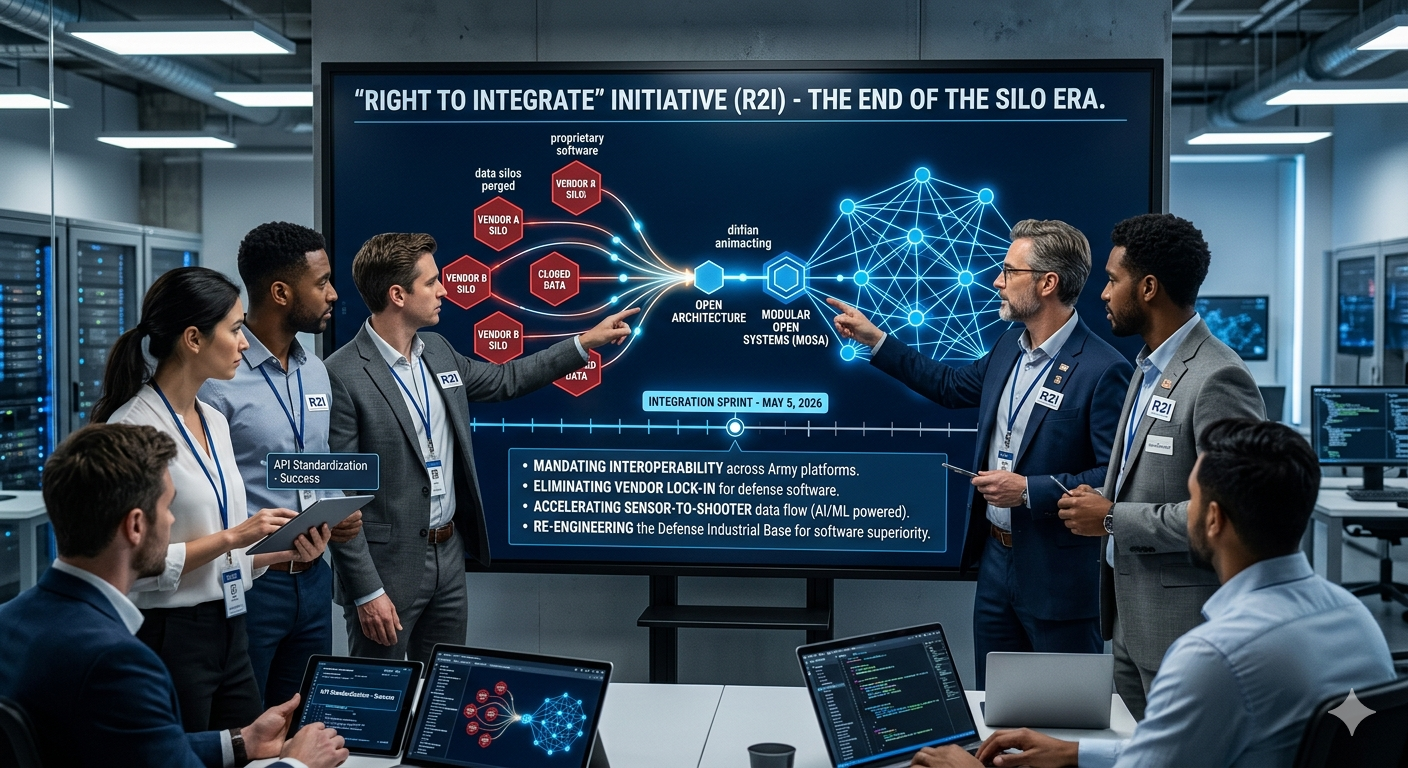
In a potentially transformative move for the global defense industrial base, the United States Army, alongside a coalition of industry titans—including Anduril, Boeing, Lockheed Martin, Palantir, and RTX—announced today the launch of the "Right to Integrate" (R2I) initiative. This massive, collaborative "hackathon sprint" marks a definitive shift in the defense sector’s strategy: an acknowledgment that the era of proprietary, closed-loop military software is effectively over. The initiative is not merely a tactical exercise but a structural pivot toward open architecture, forcing disparate weapon systems and business platforms to communicate, share data, and interoperate seamlessly. Historically, the US defense apparatus has struggled with systemic "vendor lock-in," where hardware and software from different contractors could not communicate, leading to costly delays and operational inefficiencies. By mandating a collective, zero-cost integration sprint, the Army is effectively demanding that the industry prioritize interoperability over proprietary control. This transition is not only essential for maintaining technological superiority against near-peer adversaries but also reflects a broader industry-wide transition toward software-defined defense. The R2I initiative signals that the primary bottleneck in modern warfare is no longer the kinetic capability of a platform—such as a missile or a drone—but rather the ability to integrate that platform into a unified data ecosystem. For investors, policymakers, and technologists, the significance of this event cannot be overstated. It represents the formalization of "open-source" principles within the highest levels of the defense supply chain. As the Army moves to enforce data-sharing and system compatibility, the market landscape will likely shift toward companies that can innovate within an open-architecture framework, while potentially punishing those that rely on restrictive, siloed business models. This is the beginning of a fundamental re-engineering of the defense industrial base.
The Strategic Imperative of Open Systems
The announcement of the "Right to Integrate" (R2I) hackathon on May 5, 2026, serves as a watershed moment for the intersection of technology and national security. While the public often focuses on the physical capabilities of advanced hardware, the real battle in 21st-century conflict—and the primary challenge facing the defense industrial base—is the "software-defined" nature of modern systems.
The Problem: The "Siloed" Legacy
For decades, the defense sector operated under a model where contractors delivered "black boxes." A radar system from one manufacturer and a missile system from another were rarely designed to communicate with each other natively. This approach, while incentivized by existing procurement contracts and intellectual property protections, created "data silos." When the Army needed to deploy an integrated response, it often required manual, expensive, and time-consuming custom integration—what engineers refer to as "middleware hell."
In a battlefield environment where decision-making speeds are increasingly dictated by algorithms (AI/ML), these delays are unacceptable. If a sensor cannot instantaneously feed target data to a shooter because the two systems lack a common language, the advantage is lost. The R2I initiative is the Army's way of forcing a solution to this problem at scale.^^
The Coalition of the Willing (and the Forced)
The participation list for this hackathon is significant. It includes both legacy primes (Boeing, Lockheed Martin, Northrop Grumman, General Dynamics) and agile, software-first entrants (Anduril, Palantir, Perennial Autonomy).^^ The presence of both groups suggests a consensus that the current procurement and engineering model is no longer sustainable.
By gathering these entities to sprint on integration, the Army is signaling that the barrier to entry for new technologies is being lowered. If a startup can prove its software "plugs in" to the existing ecosystem, it can now be deployed alongside the legacy giants’ hardware. This levels the playing field, shifting the value proposition from "who has the best closed-source system" to "who has the most interoperable system."
The "Right to Integrate" Philosophy
The naming of the initiative—"Right to Integrate"—is intentional. It implies a legal and technical shift. It suggests that integration is not a luxury provided by the vendor, but a requirement for the buyer.
We are seeing a move toward the Modular Open Systems Approach (MOSA), which has been discussed in academic and policy circles for years, now being put into practice at the largest possible scale. This means standardizing APIs (Application Programming Interfaces) across the fleet. It allows the military to swap out a failing component or upgrade a software module without having to scrap an entire platform.
Analytical Outlook: Implications for the Tech Sector
The fallout from today’s announcement will ripple through several sectors:
- Software-Defined Everything: The defense industry is finally catching up to the "cloud-native" revolution. Companies that prioritize open APIs and containerized applications (using technologies like Kubernetes for edge-deployed defense assets) will become the preferred vendors.
- The End of Vendor Lock-In: Investors should expect margins for companies that rely heavily on proprietary, non-interoperable software ecosystems to face pressure. The "walled garden" approach in defense is becoming a liability.
- The Acceleration of AI Integration: The most critical aspect of this integration is enabling AI to ingest data from across the entire network. An AI model that only sees data from one type of sensor is limited. By forcing integration, the Army is creating the "data lake" necessary to train and deploy more effective AI agents at the tactical edge.
A New Baseline
The R2I hackathon is more than a PR event; it is a declaration of the new rules of engagement for defense technology. The US Army is effectively forcing the industry to build a "standardized operating system" for warfighting. This shift will likely accelerate the speed of deployment for new capabilities, lower long-term sustainment costs, and fundamentally alter which companies succeed in the defense market.
As we move forward, the metric of success for a defense company will no longer be solely defined by performance in a vacuum. It will be defined by integration velocity—the speed and ease with which a product can become part of the greater whole. Today, that integration became a requirement rather than an option.
1
0
0
0

코멘트