
GEOLOGICAL SURVEY CIRCULAR United States Department of the Interior


TABLES
ANOMALOUS CONCENTRATIONS OF GOLD, SILVER, AND OTHER METALS IN THE MILL CANYON AREA, CORTEZ QUADRANGLE, EUREKA AND LANDER COUNTIES, NEVADA
BY JAMES E. ELLIOTT and JOHN D. WELLS
The Mill Canyon area is in the eastern part of the Cortez window of the Roberts Mountains thrust belt in the Cortez quadrangle, north-central Nevada. Gold and silver ores have been mined from fissure veins in Jurassic quartz monzonite and in the bordering Wenban Limestone of Devonian age. Geochemical data show anomalies of gold, silver, lead, zinc, copper, arsenic, antimony, mercury, and tellm·ium. Geologic and geochemical studies indicate that a formation favorable for gold deposition, the Roberts Mountains Limestone of Silurian age, may be found at depth near the mouth of Mill Canyon.
Many of the metallic ore deposits of north-central Nevada occur in regional alinements or mineral belts. One of the most economically and geologically important, and also one of the most conspicuous, of these mineral belts is the northwest-trending Battle Mountain-Eureka belt (Roberts, 1966, p. 61), which includes the Cortez quadrangle. The dominant structural feature of north-central Nevada is the Roberts Mountains overthrust which juxtaposes Paleozoic siliceous and carbonate rocks of equivalent age. Many metallic mineral deposits are in lower plate carbonate rocks exposed in erosional windows of the Roberts Mountains thrust, such as the Cortez window. Several gold deposits occur in these lower plate carbonate rocks, particularly the Roberts Mountains Limestone of Silurian age, and in the breccia zones of the thrust. Examples of such deposits are the Carlin, Cortez, and Gold Acres mines (fig. 1) and the Bootstrap mine.
The U.S. Geological Survey has been conducting geologic and geochemical investigations under its Heavy Metals program in the Cortez quadrangle since July 1966. This report pertains to the Mill Canyon area in the northeastern part of the Cortez quadrangle (fig. 1) in T. 27 N., R. 48 E., where lower plate Pal~ozoic carbonate rocks are intruded by Jurassic quartz monzonite. Preliminary results indicate that the relationships among gold and silver deposits, geochemical anomalies, and geologic features in the Mill Canyon area are favorable enough to warrant further investigation. The Roberts Mountains Limestone of Silurian age, present at a moderate depth below the surface near the mouth of Mill Canyon, and the z0ne of altered Wenban Limestone of Devonian age that borders the Mill Canyon stock are favorable hosts for gold deposits.
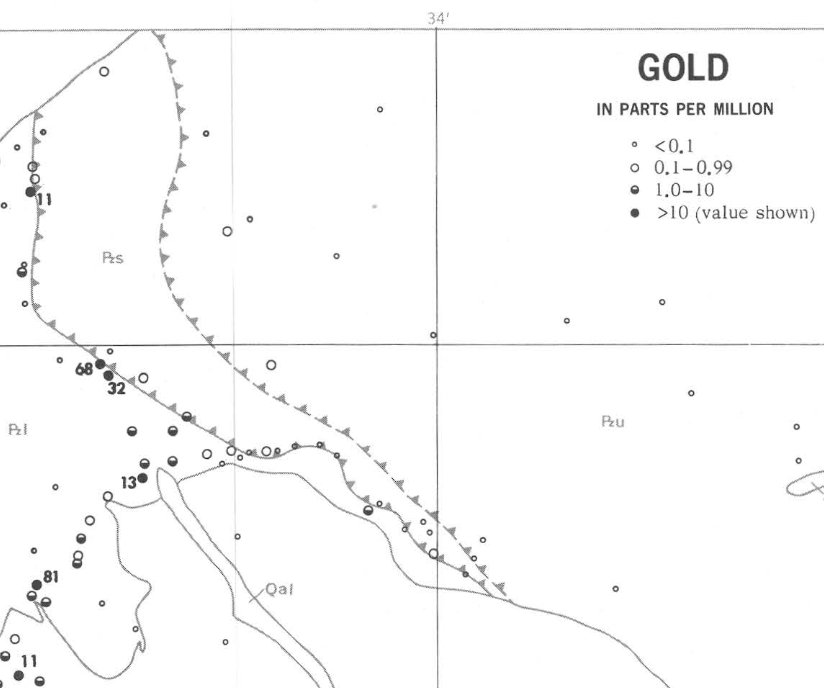
Geochemical investigations included collection and analysis of more than 300 rock samples. Sample localities are shown in the geochemical maps (figs. 4-12). All samples were from fault zones, veins, mine dumps, or outcrops of altered rock. More than one s!:tmple was collected from many of the localities shown, but only the highest value for each element from a given locality is plotted on the maps.
All samples were analyzed in the field in mobile laboratories of the U.S. Geological Survey. Gold and tellurium were determined by a wet chemical method using atomic absorption spectrophotometry. Mercury was deter'llined instrumentally by an atomic absorption technique. Thirty elements were determined semiquantitatively on the emission spectrograph.
The authors acknowledge the assistarce, in analytical work, of G. H. VanSickle, D. J. Grimes, T. G. Ging, Jr., E. L. Mosier, and c
c
s
The mineralogy and mineral associationf of the gold-silver ores were studied in 38 polished sections of ore specimens. The specimens were obtained mainly frorri unoxidized vein material on mine dumps. The predominant primary sulare pyrite, arsenopyrite, fide minerals sphalerite, and galena. Boulangerite, bournonite, argentian tetrahedrite, chalcopyrite, pyrargyrite-proustite, gold, and stibnite commonly occur in minor amounts. Vanderburg (1938, p. 27) noted the occurrence of argentite and stephanite also. Arsenic and antimony are generally abundant in the ores. Tellurium and mercury are present in anomalous concentrations.
One of the main purposes of this study Fas to determine the sites and modes of occurre~ce of the gold and silver. Most of the silver i~· in argentian tetrahedrite; some occurs as ruby silver minerals. Silver-rich samples usu~.lly contain abundant sulfosalts of lead, copr~r, silver, and antimony, such as boulanger;te, bournonite, tetrahedrite, and ruby silver miner-
The Mill Canyon area contains anomalous amounts of gold, silver, lead, zinc, copr~r, arsenic, antimony, mercury, and tellurium (figs. 4-12). Locally, anomalous amounts of other elements are present. The highest ancmalies lie in a northwest-trending belt and occur in the quartz monzonite and the adjoining Wenban Limestone of Devonian age. The anomaJ~es in the quartz monzonite are concentrated alcng north-trending fissure veins where the east lobe and the west part of the stock join. The anom.alies in the Wen ban Limestone are concentrated in faults and altered zones. Although most of the mineralized Wenban Limestone is near the contact of the quartz monzonite, some of the mineralized limestone occurs near the Roberts Mountains thrust near the mouth of Mill Canyon.
A summary of data (table 1) shows the range of values and median values for most of the samples from the Mill Canyon area. Table 2 presents analyses of samples selected in the Cortez quadrangle from apparently unaltered country rocks to obtain background values for gold, silver, lead, zinc, copper, arsenic, antimony, and mercury. No background data are available for tellurium. Of the background samples, 11 were from quartz monozite and alaskite, 38 from lower plate rocks, and 20 from upper plate rocks. The high concentration of all metals in the Mill Canyon area is striking when compared to the background values.
The analytical results pertaining to the Mill Canyon samples were treated statistically. A most valuable statistical treatment, for the purposes of this study, is that of correlation analysis, which measures the degree of similarity between different pairs of variables, such as between gold and silver or between lead and and zinc. The correlation coefficient may range from -1.0, a perfect negative correlation, to + 1.0, a perfect positive correlation. A high negative correlation signifies that as one element (for example, gold) increases, another element (for example, silver) decreases proportionately or vice versa. A high positive correlation indicates that both elements increase or decrease proportionately. A low positive or negative correlation coefficient-one that ap-
------------ <200 Cu ------------ ------------ <200 ------------
proaches zero-shows that the t~vo elements act fairly independently of each other.
Correlation analysis was applied to geochemical samples collected in the Mill Canyon area to test the relations among anomahus elements and to test the use of certain elements as indicators of mineralization.
As a first test, 106 samples from veins and fault zones in the quartz monzonite stock were compared. The results showed strong positive correlations between the element pairs: goldlead, gold-copper, gold-antimony, gold-iron, silver-lead, silver-antimony, silver-copper, silver-iron, lead-copper, lead-antimory, lead-iron, copper-antimony, copper-iron, and antimonyiron. The element pair gold-silver had a low positive correlation. Little or no correlation was indicated ·for all other possible ele'"tlent pairs.
In a second test, 273 samples cdlected from all rock units in the Mill Canyon area were compared. Relalionships established for samples from the quartz monzonite sto~k thus were tested for the area as a whole. E'~ment pairs showing strong positive correlatior.;; were goldarsenic, silver-lead, silver-copper, silver-antimony, lead-copper, lead-antimony, and copper-antimony. The element pair gold-silver had a very low positive correlation. All other element pairs showed little or no correlation.
The strong positive correlations for samples from the quartz monzonite stock involving gold as one element of the element pair did not hold true for the area as a whole, whereas most of the strong correlations involving silver did hold true. The results of the stat~stical treatment support the geologic evidence from the study of polished sections. The conclusions are:
- Silver is found in sulfosalt suites of silver-, lead-, antimony-, ·and copper-b-:l.aring minerals, such as tetrahedrite, }~')ulangerite, bournonite, and ruby silvers or oxidized equivalents of these suites, both in the Mill Canyon stock and in the bordering rocks.
- In the igneous rocks, gold also occurs with the sulfosalt suite of minerals and is associated with iron in pyrite. However, the behavior of gold with respect to silv€r is erratic.
- In samples taken from all rock types, gold is somewhat erratic and shows a preference only for arsenic, perhaps reflecting an association with arsenopyrite. Geochemically the best indicator elements for
The most favorable area for exploration is a roughly rectangular block of Wen ban Limestone. locally mineralized and altered, near the mouth of Mill Canyon. The area is bordered on the west and south by quartz monzonite, on the east by the Roberts Mountains thrust, and on the northwest by the Crescent Valley fault (fig. 3). Lithologically this block of limestone is similar to the lower 1,000 feet of Wenban Limestone at the type section, 4 miles to the southwest in Cortez Canyon. Early Devonian fossils have been collected from the upper part of this block near the mouth of Mill Canyon (Gilluly and 1;Iasursky, 1965, p. 32). The limestone has been bleached and partly silicified for as much as 1,000 feet fron1 the intrusive contact. The bleaching has changed the normal medi urn gray or dark gray of the limestone to a light buff. Locally, extreme silicification has resulted in the forn1ation of dense brown jasperiod. Geochemically this area is anomalous in gold, silver, lead, zinc, copper, arsenic, antimony, mercury, and tellurium, especially near the instrusive contact.
Inasmuch as some of the major gold deposits in north-central Nevada occur in the Roberts Mountains Limestone, the same rocks should be considered in the Mill Canyon area as a favorable host for gold deposits. The new Cortez gold discovery is only 11;2 miles to the west of Mill Canyon. The gold at this locality is concentrated in the Roberts Mountains Limestone just below the Wenban Limestone and is associated with anomalies of mercury, arsenic, antimony, and tu~gsten (Wells and others, 1967). These elements, with the exception of tungsten, also occur in anomalous concentrations in the northwestern part of the Mill Canyon area.
The Roberts Mountains Limestone is not exposed at the surface near the mouth of Mill Canyon but would be expected to occur at a shallow depth. Cross sections in figure 3 show the interpreted subsurface geology near the mouth of Mill Canyon. From these cross sections, the Roberts Mountains Limestone if estinlated to be 300-1,500 feet below the surface. Favorable zones for gold deposits may be present near the intersection of projected vein structures and the Roberts Mountains-Wenban contact.
The geochemical association of metals in the zone of alteration in the Wen ban Lime~ tone adjacent to the Mill Canyon stock is also similar to that in the Cortez deposit. This similarity suggests that physical exploration for ar economic evaluation of this area is justified.
Geologic studies show the Mill Canyon area to be mineralized and to have a geochemic:d association of metals that is similar to th~ associations in the Cortez, Carlin, and other gold mines in north-central Nevada. Potential mineralized rock is untested at depth, but on the basis of this evidence some exploration vrould appear justified. In particular, the Ro"">erts Mountains Limestone is favorable to test and sample because of its known association with gold deposits in this area.
Emmons, W. H., 1910, A reconnaissan<'~ of some mining camps in Elko, Lander, and Eureka counties, Nevada: U.S. Geol. Survey Bull. 408, 130 p. Gilluly, James, and Masursky, Harold, 1965, Geology of the Cortez quadrangle, Nevada, 'With a section on Gravity and aeromagnetic surveys, by D. R. Mabey: U.S. Geol. Survey Bull. 1175, 117 p. Roberts, R. J., 1966, Metallogenic provincef and mineral belts in Nevada, in AIME Pacific Southwest Mineral Industry Conf., Sparks, Nev., 1965: Nevada Bur. Mines Rept:. 13, Papers, pt. A, p. 47-72. U.S. Bureau of Mines, 1938-59, Minerals yearbook [annual volumes for years 1937-58]: Washington, U.S. Govt. Printing Office. Wells, J.D., Erickson, Ralph, and Ptoiser, L. R., Vanderburg, W. 0., 1938, Reconnaissance of mining districts in Eureka County, N evada: U.S. Bur. Mines Inf. Circ. 7022, 66 p. 1967, Geology and mineralogy of the Cortez gold deposit, Nevada [abs.]: Mining Eng., v. 19, no. 12, p. 40. oooz

~jDWij



0

·2~ 1.25 LEAD


FIGURE 5.-Silver distribution, maximum concentration in all samples at each locality. Geologic symbols explained in figure 2.

rl
ZINC
oo e ~


j
ARSENIC

FIGURE 9.--Arsenic distribution, maximum concentration in all samples at each locality. Geologic SyJ"lbols explained in figure 2.
ANTIMONY

FIGURE 10.--Antimony distribution, maximum co:q.centration in all samples at each locality. Ge.ologic symbols expl~ined in figure 2.


" " " TELLURIUM
j I
Where this page came from
This page was imported from U.S. Geological Survey. Published by the U.S. Geological Survey and, as a work of the United States government, in the public domain.
Nobody has written it yet — it is the source material at a new address, which is why search engines are asked to skip it and why no one earns from it. It is up for grabs: take it on, and it is yours to rewrite and to earn from.
Licence: CC0 1.0 (public domain) · Adapted from pubs.usgs.gov
1
0
0
0

Comments


