Hub Nexus
Updated

AuthorNo author yetClaim it

See something to improve? Propose a change.

Support

Bidloo, Govard. Ontleding des menschelyken lichaams. (Amsterdam: By de weduwe van Joannes van Someren, de erfgenaamen van Joannes van Dyk, Hendrik en de weduwe van Dirk Boom, 1690).

Govard Bidloo was born in Amsterdam in 1649 and became professor of anatomy at The Hague from 1688 to 1694, when he took the same position at Leyden. He was later appointed the physician of William III of England, who was originally Dutch, until the King's death in 1702. In that year, Bidloo returned to Leyden to take his old position until his death there in 1713.

Best known as an anatomist, Govard Bidloo's most famous work was his monumental Anatomia humani corporis published in Amsterdam in 1685, containing 107 copperplate engravings. Like so many large and expensive anatomical atlases of the time, the work was not a financial success, and in 1690 he published a Dutch translation entitled, Ontleding des menschelyken lichaams, using the same plates.

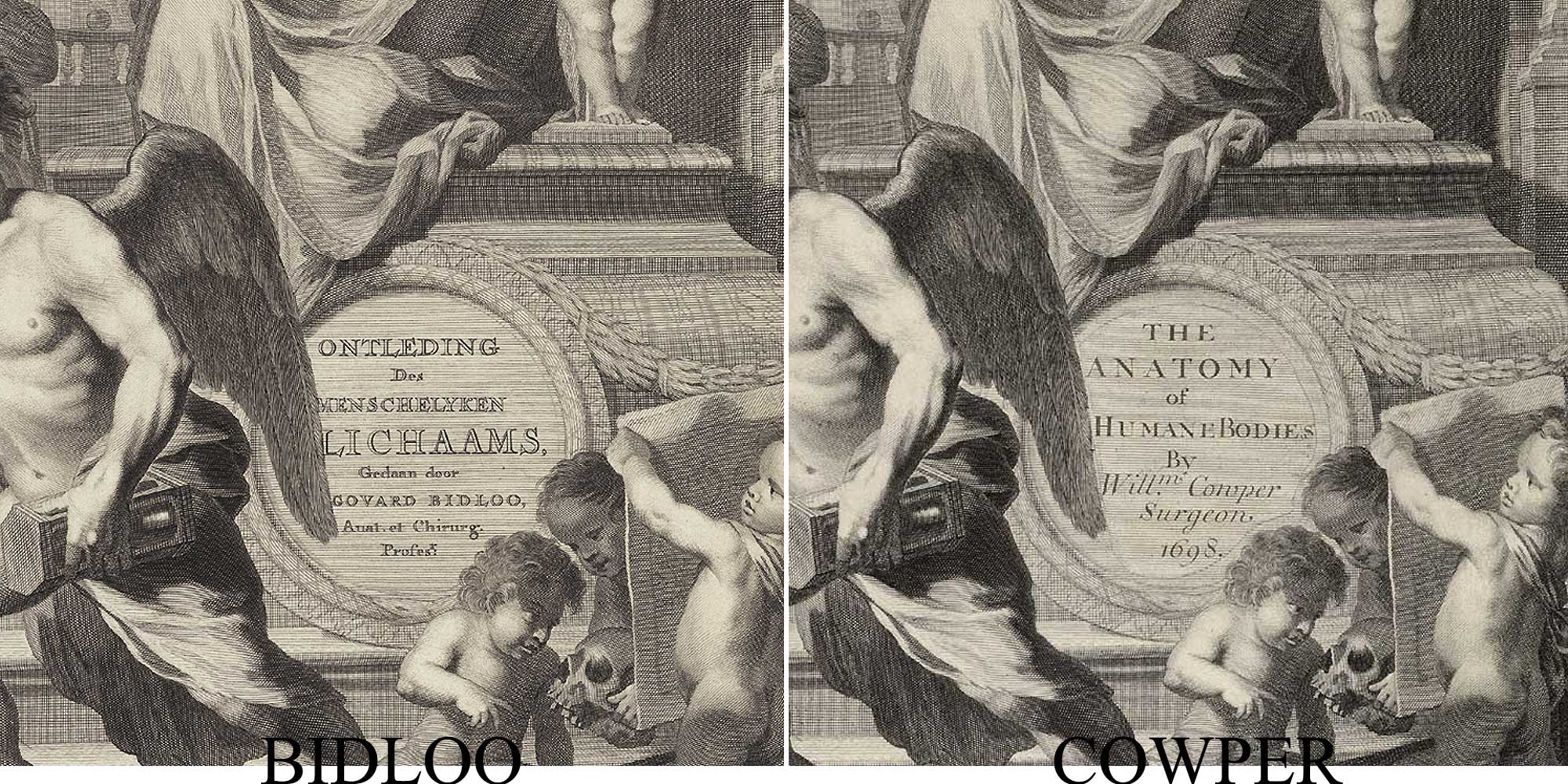
When this edition did not sell well either, Bidloo's publisher sold 300 of the extra printed plates to William Cowper, a noted English anatomist. Cowper published the plates with his own, English language text in Oxford in 1698 under the title, Anatomy of the humane bodies, without mentioning Bidloo or the artists of the original plates. Cowper went so far as to use Bidloo's engraved allegorical title page, amended with an irregular piece of paper lettered: "The anatomy of the humane bodies ...," which fits over the Dutch title (see a comparison here).

A number of vitriolic exchanges took place between Bidloo and Cowper, including several pamphlets published in each anatomist's defense. Cowper claimed, without much evidence presented, that the plates were not Bidloo's at all, but that they were commissioned by Jan Swammerdam (1637–1680) and that after his death Swammerdam's widow had sold them to Bidloo.

The illustrations in Bidloos' work were drawn by Gérard de Lairesse (1640–1711) and engraved by Abraham Blooteling (1640–1690) and Peter van Gunst (1659?–1724?).

Further reading

Choulant, L. History and bibliography of anatomic illustration. Trans. and annotated by Mortimer Frank. (New York: Hafner, 1962). Pp. 250-253.

Russell, K. F. British anatomy, 1525–1800: a bibliography of works published in Britain, America and on the Continent. 2nd ed. (Winchester, Hampshire: St. Paul's Bibliographies, 1987). Introduction and nos. 211-214.

Plates

Engraved title page with allegorical scene featuring a goddess of wisdom seated on a throne with an angel above her blowing a horn, the throne engraved with the books title, and to the left underneath is an older bearded angel holding a scientific instrument in his left had, and in the bottom right corner are three babies looking at a skull and dissected arm; in the background is a Greek temple and two skeletons conversing, from Govard Bidloo’s Ontleding Des Menschelyken Lichaams, Amsterdam, 1690, NLM Call no. WZ 250 B5855anDu 1690.

Engraved, Allegorical Titlepage.

Printed title page with large woodcut printer’s device at the bottom showing mythological figures with scythe and club on either side of an armillary sphere, with the Latin motto 'Indefessus Agendo' (Indefatigable Agenda), from Govard Bidloo’s Ontleding Des Menschelyken Lichaams, Amsterdam, 1690, NLM Call no. WZ 250 B5855anDu 1690.

Titlepage.

Engraved portrait of Govard Bidloo showing the author facing forward in 17th-century wig and garb holding a dissecting tool in his left hand, in an oval frame with his name and title in Dutch below by the artist Gerard de Lairesse, from his Des Menschelyken Lichaams, Amsterdam, 1690, NLM Call no. WZ 250 B5855anDu 1690.

Portrait.

Male nude figure, from Govard Bidloo’s Ontleding Des Menschelyken Lichaams, Amsterdam, 1690, NLM Call no. WZ 250 B5855anDu 1690.

Table 1.

Engraved facing female nude figure, standing in Classical pose looking to the left holding a veil behind her back in both hands, with large Classical urn and temple friezes behind her, with index letters pointing to different parts of the body, from Govard Bidloo’s Ontleding Des Menschelyken Lichaams, Amsterdam, 1690, NLM Call no. WZ 250 B5855anDu 1690.

Table 2.

Engraved rear-facing female nude figure, standing in Classical pose looking to the right with her right hand on top of a large urn and left on a Classical pediment, with index letters pointing to different parts of the body, from Govard Bidloo’s Ontleding Des Menschelyken Lichaams, Amsterdam, 1690, NLM Call no. WZ 250 B5855anDu 1690.

Table 3.

Engraving of 14 detail images of the skin, including skin surface, thumb with fingerprint visible, sebaceous glands, capillaries, and hair follicles, sometimes laid out with pins against the background, which is presumably a dissecting table, from Govard Bidloo’s Ontleding Des Menschelyken Lichaams, Amsterdam, 1690, NLM Call no. WZ 250 B5855anDu 1690.

Table 4.

Engraving of two images of male heads with the skull and brain exposed; the top image shows the scalp peeled away from the skull to show muscles of the head and sutures; the bottom image shows the skull cut away and cerebral cortex exposed with dura mater peeled back; from Govard Bidloo’s Ontleding Des Menschelyken Lichaams, Amsterdam, 1690, NLM Call no. WZ 250 B5855anDu 1690.

Table 5.

Engraving of a dissected brain and spinal column spread out on a dissecting table using pins; the brain, at the top of the long vertical image, is entire and cut in half down the middle with each half spread to the left and right exposing the interior; the spinal column is without the vertebrae, exposing the nerves and thin protective membranes surrounding them; from Govard Bidloo’s Ontleding Des Menschelyken Lichaams, Amsterdam, 1690, NLM Call no. WZ 250 B5855anDu 1690.

Table 10.

Engraving of a dissected male head with mouth wide open showing tongue, palate, and teeth and uvula, surrounded by flesh samples of the tong in cross section at bottom center and six examples of mucous membranes shown close up to capture the textures in detail; from Govard Bidloo’s Ontleding Des Menschelyken Lichaams, Amsterdam, 1690, NLM Call no. WZ 250 B5855anDu 1690.

Table 13.

Engraving of an exposed thoracic cavity, probably male, with the sternum detached at the bottom and lifted up, exposing the diaphragm, lungs, heart, and pericardium; the lower portion of the cadaver’s abdomen is covered with a sheet with the legs descending below out of sight; from Govard Bidloo’s Ontleding Des Menschelyken Lichaams, Amsterdam, 1690, NLM Call no. WZ 250 B5855anDu 1690.

Table 21.

Engraving showing detail of the exposed muscles of the back with skin peeled away; the back is that of a female cadaver with kerchief sitting upright on the dissection table with a noose holding the body up by the neck; from Govard Bidloo’s Ontleding Des Menschelyken Lichaams, Amsterdam, 1690, NLM Call no. WZ 250 B5855anDu 1690.

Table 27.

Engraving showing detail of the exposed muscles of the back with emphasis on the muscles surrounding the vertebral column with skin peeled away; the back is that of a female cadaver with sheet over her head sitting upright on the dissection table with a noose holding the body up by the neck, with her hand tied behind her back; from Govard Bidloo’s Ontleding Des Menschelyken Lichaams, Amsterdam, 1690, NLM Call no. WZ 250 B5855anDu 1690.

Table 30.

Engraving showing detail of a pair of kidneys removed from the body along with accompanying vascular system, bladder, testicles, and adrenal glands laid out on a dissection table, from Govard Bidloo’s Ontleding Des Menschelyken Lichaams, Amsterdam, 1690, NLM Call no. WZ 250 B5855anDu 1690.

Table 42.

Engraving of a pregnant woman’s abdomen opened showing a well-developed fetus in utero with its amniotic sac and umbilical cord lying to the left; a sheet is draped around the edges of the open cavity; from Govard Bidloo’s Ontleding Des Menschelyken Lichaams, Amsterdam, 1690, NLM Call no. WZ 250 B5855anDu 1690.

Table 56.

Engraving of four fetuses in various stages of development laying on a dissection table; the largest in the center takes up about three-quarters of the page, a male child laying on its back with a large umbilical cord leading to a fully developed placenta laying at its feet; the other fetuses are small and less developed in the upper left corner, with a small placenta and smaller clusters of cells forming the earliest stages of life; from Govard Bidloo’s Ontleding Des Menschelyken Lichaams, Amsterdam, 1690, NLM Call no. WZ 250 B5855anDu 1690.

Table 57.

Engraving of a dissected hand with muscles and sinews of the front forearm and palm separated for a detailed view; the forearm and had are laying in a downward direction and leaning against a wooden box; from Govard Bidloo’s Ontleding Des Menschelyken Lichaams, Amsterdam, 1690, NLM Call no. WZ 250 B5855anDu 1690.

Table 67.

Engraving of a dissected hand with muscles and sinews of the back of the forearm and hand separated with dissecting tools for a detailed view; the forearm and hand are laying in a downward direction and pinned to a wooden board; from Govard Bidloo’s Ontleding Des Menschelyken Lichaams, Amsterdam, 1690, NLM Call no. WZ 250 B5855anDu 1690.

Table 70.

Engraving of a dissected hand with muscles and sinews of the back of the forearm and hand separated with dissecting tools for a detailed view; the forearm and had are laying in a downward direction and pinned to a wooden board; from Govard Bidloo’s Ontleding Des Menschelyken Lichaams, Amsterdam, 1690, NLM Call no. WZ 250 B5855anDu 1690.

Table 71.

Engraving of a dissected foot and shin with muscles and sinews of the front of the shin and top of the foot separated for a detailed view; leg and foot are presented as if the subject is standing with a draped sheet and wooden box just to the left; from Govard Bidloo’s Ontleding Des Menschelyken Lichaams, Amsterdam, 1690, NLM Call no. WZ 250 B5855anDu 1690.

Table 80.

Engraving of a dissected foot and shin with muscles and sinews of the front of the shin and top of the foot separated by dissecting instruments for a detailed view; leg and foot are presented as if the subject is standing with a draped sheet behind it and tools affixing the flesh to a wooden board underneath; from Govard Bidloo’s Ontleding Des Menschelyken Lichaams, Amsterdam, 1690, NLM Call no. WZ 250 B5855anDu 1690.

Leaf 71 recto.

Engraving of a dissected foot and shin with muscles and sinews of the front of the shin and top of the foot separated by dissecting instruments for a detailed view; leg and foot are presented as if the subject is standing with a tools affixing the flesh to a wooden board underneath and to right and left; from Govard Bidloo’s Ontleding Des Menschelyken Lichaams, Amsterdam, 1690, NLM Call no. WZ 250 B5855anDu 1690.

Table 82.

Engraving of a “memento mori” scene of a standing facing skeleton holding an hourglass in his left hand up in the air with an opened coffin behind him with a loose shroud tumbling out; Classical ruins are shown in the back with a wisp of a pastoral scene; from Govard Bidloo’s Ontleding Des Menschelyken Lichaams, Amsterdam, 1690, NLM Call no. WZ 250 B5855anDu 1690.

Table 87.

Engraving of a “memento mori” scene of a standing skeleton with its back to the viewer holding a slowing shroud in his left hand up in the air as it tumbles into a crypt from which he is emerging or descending; Classical ruins are shown in the background including an urn and what may be a temple; from Govard Bidloo’s Ontleding Des Menschelyken Lichaams, Amsterdam, 1690, NLM Call no. WZ 250 B5855anDu 1690.

Table 88.

Engraving of a “memento mori” scene of two skull fragments: the first is the frontal bone and maxilla of the skull including forehead, eye sockets, nasal cavities, and upper jaw, facing toward the viewer on top of a writing tablet with a loose sheet of paper behind the skull and an inkwell and pen to the left; in the lower half of the image is the back (parietal bone) of the skull viewed from the inside, including impressions of blood vessels, leaning back against a writing tablet with a manuscript leaf of music laying loose underneath the bones; from Govard Bidloo’s Ontleding Des Menschelyken Lichaams, Amsterdam, 1690, NLM Call no. WZ 250 B5855anDu 1690.

Table 89.

Engraving of two skulls with jaw bone fragments and teeth separated; the first skull above is complete including the mandible and teeth, facing the viewer leaning on a closed book behind it; the second skull below is upside down and lacking the mandible with a view of the foramen magnum, parietal bone, and hard palate; to the bottom right are two views of a detatched mandible and a hyoid bone; at the bottom left are ten small bones from the inner ear; in the upper left of the image are 16 teeth with their roots laid out in order from molars to incisors; from Govard Bidloo’s Ontleding Des Menschelyken Lichaams, Amsterdam, 1690, NLM Call no. WZ 250 B5855anDu 1690.

Table 92.

Engraving of the bones of the left and right hands at the top of the page positioned on a wooden board in proper order and attached with string; in the lower have of the image are eight smaller bones of the hand laid out on a wooden board; from Govard Bidloo’s Ontleding Des Menschelyken Lichaams, Amsterdam, 1690, NLM Call no. WZ 250 B5855anDu 1690.

Table 97.

Engraving of a full facing fetal skeleton standing on a wooden plank in an alcove with a rounded top; from Govard Bidloo’s Ontleding Des Menschelyken Lichaams, Amsterdam, 1690, NLM Call no. WZ 250 B5855anDu 1690.

Table 101.

Engraving of a full fetal skeleton with its back to the viewer standing on a wooden plank in an alcove with a rounded top; from Govard Bidloo’s Ontleding Des Menschelyken Lichaams, Amsterdam, 1690, NLM Call no. WZ 250 B5855anDu 1690.

Table 102.

Details of engraved title pages of Govard Bidloo’s Ontleding Des Menschelyken Lichaams (Amsterdam, 1690) and William Cowper’s Anatomy of the Humane Bodies (Oxford, 1698), showing how Cowper altered the page to make it appear to be his own original work; the English and Dutch titles appear in the same round medallion amidst an allegorical scene with angels to the left and down below.

Bidloo & Cowper Comparison.

Where this page came from

This page was imported from National Library of Medicine. From the National Library of Medicine's Historical Anatomies on the Web; the essay is a work of the United States government and the plates, photographed by the library from books centuries old, are in the public domain.

Nobody has written it yet — it is the source material at a new address, which is why search engines are asked to skip it and why no one earns from it. It is up for grabs: take it on, and it is yours to rewrite and to earn from.

LanguagesEnglish

Licence: CC0 1.0 (public domain) · Adapted from www.nlm.nih.gov

1

0

0

0

Spinner Logo

Comments

Spinner Logo
Version: 2CC0 1.0 — public domain
The runaway star that left the Tarantula Nebula
Version: 2CC0 1.0 — public domain
The Blackwell School, where segregation had no law behind it
Version: 2CC0 1.0 — public domain
The Eagle Nebula, seen in the infrared
Version: 2CC0 1.0 — public domain
The house where the Equal Rights Amendment was written
Version: 2CC0 1.0 — public domain
The Aleutians, the forgotten front of the Second World War
Version: 2CC0 1.0 — public domain
The Cosmic Cliffs are not cliffs