

A Montreal canoe is six feet across at its widest. NPS photo
Most visitors reach Grand Portage National Monument today by car. But picture arriving around 1797, at the height of the fur trade, when Grand Portage was its focal point.
Two canoes, two directions
| From the east | From the west | |
|---|---|---|
| Canoe | the canot du maître — master or Montreal canoe, 36 feet — or a sailing schooner | the canot du nord — North canoe, 24 feet |
| Route | from Sault Ste. Marie along Lake Superior's north shore; a stop on the north side of Hat Point to clean up, then into Grand Portage Bay and through the lakeside gates | from the interior pays d'en haut ("up-country") of Canada, down the Pigeon River from South Fowl Lake to Fort Charlotte, then nine miles on foot over Gichi Onigaming, the Great Carrying Place, to the stockade's back gate |
| Cargo in | trade goods from around the world | furs gathered over the winter |
As the trade pushed deeper into western Canada, a single round trip from Montreal in one season became impossible. The answer was a rendezvous in the middle. The big lake canoes, built for the trade, brought goods to the depot; the smaller river canoes brought furs to Fort Charlotte; and voyageurs carried the bales of furs and goods across the Grand Portage trail. Each canoe went home with the other's cargo — so both halves of the business met in one season at the North West Company's summer headquarters on Lake Superior.
Jiimaan: the birchbark canoe
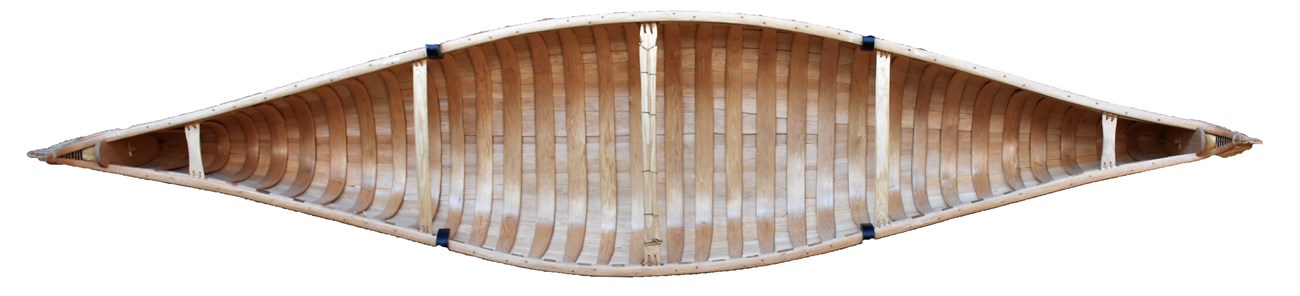
A replica traditional birchbark canoe. NPS photo by G. M. Spoto
The jiimaan, or birchbark canoe, is one of the most recognizable symbols of Native American and First Nations cultures.
- Materials, all from the boreal forest: birch bark, cedar, spruce root, and a seam sealant of spruce pitch, bear grease and soot.
- Knowledge passed down by word and demonstration, producing canoes that were durable, functional and elegant.
- Work was divided: men made the wooden parts and assembled the canoe; women lashed and gummed it.
- Shapes fit the purpose — ricing canoes, for example, are flatter for shallow water and are poled, to protect the fragile rice plants.
Anishinaabe/Ojibwe people built birchbark canoes for the fur trade; a North canoe was worth about 25 beaver hides in trade goods.
See them today
The reconstructed depot warehouse at Grand Portage displays fur trade and Anishinaabe canoes with their raw materials — birch bark, split cedar, spruce root and sealant — all gathered locally by staff. Often a canoe is being built over the summer.
Sources
Based on "Canoes of Grand Portage," National Park Service, Grand Portage National Monument; a work of the United States government in the public domain.
In these publicationsGrand Portage National Monument
Licence: CC0 1.0 (public domain) · Adapted from www.nps.gov
1
0
0
0

Comments


