
By Daniel Chmill, PhD.

Postcard of the Levi Memorial Hospital. Hot Springs National Park Archives.
In 1902, B'nai B'rith District Grand Lodge No. 7 — one of the regional branches of B'nai B'rith, then the oldest and largest Jewish philanthropic organisation in the United States — met in Little Rock, Arkansas. Delegates urged it to look at Hot Springs, where large numbers of poor Jewish people came seeking health, and where a new hospital was badly needed. After a decade of advocacy, B'nai B'rith, working with Hot Springs Reservation (later Hot Springs National Park), built the Leo N. Levi Memorial Hospital. The charity hospital opened in 1914 and is still open today.
"A national Jewish sanitarium"
Jewish visitors came to Hot Springs from the reservation's earliest days. Jacob Mitchell and his wife, who came from Van Buren, Arkansas, built a hotel for the thousands arriving to take the waters, and hotels and restaurants served kosher meals to Jewish tourists.
The flow of visitors strained the town's small Jewish community. Rabbi Abraham Benedict Rhine of Hot Springs wrote that it had long hoped for a national Jewish sanitarium to treat the sick poor, but was too small to build one alone, so he and others turned to B'nai B'rith.
- 1911: with the backing of Rabbi Rhine and Rabbi F. L. Rosenthal, B'nai B'rith formed the Leo N. Levi Memorial Hospital Association to pool money and resources.
- The Department of the Interior set aside a small part of the reservation, at the foot of West Mountain.
- Eugene Stern, a Jewish architect from Little Rock whose firm designed other well-known Hot Springs bathhouses, drew up a state-of-the-art hospital.
- Work began in March 1913, and the hospital opened on 1 November 1914.
- In 1915 the reservation's superintendent, Dr. William P. Parks, called it "modern in every detail"; it gave 1,670 baths in its first year.

Postcard of the Levi Memorial Hospital. Hot Springs National Park Archives.
"Restored to health and strength"
The park's thermal water was central to the Levi. Regina Kaplan, its superintendent for more than 30 years, wrote in 1922 that the hospital was built in Hot Springs because of the water's therapeutic value. Its hydrotherapy department had two bath halls, vapour baths, pack rooms and cooling rooms — treatments that rivalled many on the elegant, world-famous Bathhouse Row. Jewish publications across the Midwest spread the word. The hospital admitted its thousandth patient in January 1920 and roughly 1,500 patients in 1924, spending nearly $45,000 on charity care every year.
B'nai B'rith saw the Levi as part of a national health mission. In 1916 it appropriated $80,000 to the Levi along with its National Jewish Hospital for Consumptives in Denver and an orphanage in Cleveland; its president, Dr. Haim I. Davis, told members that all their hopes for the Levi had been realised.
Open to everyone. The hospital was founded to relieve Hot Springs' Jewish community, but it took patients whether Jewish or not, and its funding came to include local and regional groups around the state. Rhine observed that many non-Jewish patients first met Jews and Jewish philanthropy there. The Levi's doctors also saw thousands of patients who needed prescriptions to bathe at the park's Government Free Bathhouse. Jewish leaders saw this as a way to counter the antisemitism common in the United States.
Growth through hard times. The hospital gave 5,068 baths in 1920 and 14,586 in 1938, as Americans reeled from the Great Depression. Writing for its twenty-fifth anniversary in 1939, Rhine said that its numbers, usually lifeless, here stood for men, women and children who left restored in health and hope.
One of them was Jerry Marx Bernstein, who arrived in 1935 almost entirely paralysed. He slowly recovered, began a career in radio, and later credited the red-brick hospital on West Mountain with giving hope to the hopeless and healing mind as well as body.

The therapeutic pool at the Levi, around the 1970s. Hot Springs National Park Archives.
"It's a great partnership"
World War II. Once the United States entered the war in 1941, supporters presented the Levi as war work. Martin Perley, writing in the Wisconsin Jewish Chronicle, called arthritis and rheumatism saboteurs on the home front, costing 97,200,000 work days a year, and said the Levi was salvaging people for the war effort as others salvaged scrap metal. Private John Golik of Milwaukee, paralysed with arthritis, came in 1942 through his local Jewish community; a New Jersey paper called his recovery a minor miracle, and he returned to the Army. Golik, who was not Jewish, said he had been treated as one of a big family.
Arthritis research. Later writers kept praising the waters: in 1947 an Omaha paper described patients combining the thermal water with planned exercise to loosen stiff joints and rebuild muscles, in one of the largest thermal pools in Hot Springs. After the war the National Arthritis Research Foundation made the Levi its headquarters, putting the hospital and the park's water at the centre of national arthritis research for decades.
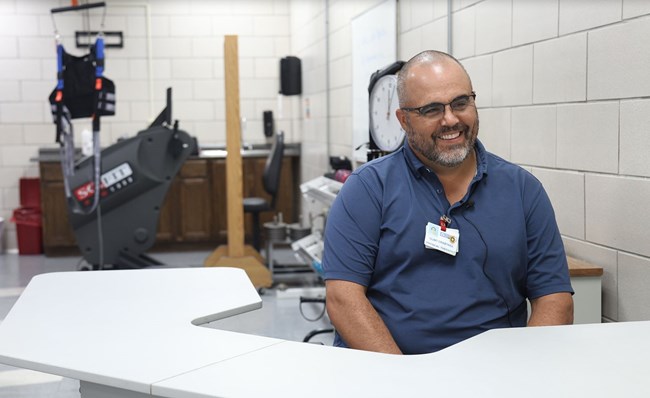
Clint Crabtree, director of rehabilitation services at the Levi, 2023. Hot Springs National Park Archives.
Today the hospital mainly offers mental health and physical therapy, and it still uses the park's thermal water. Clint Crabtree, its director of rehabilitation services, calls the century-long link a great partnership: the water is a tool that improves patients' mobility, and the hospital brings it to patients who cannot easily move. Records show the Levi uses more than two million gallons of thermal water a year for patients and the community.
The Levi and Hot Springs link Jewish American communities to the national parks in a relationship older than the National Park Service itself. The hospital stands for successful Jewish philanthropy and a vibrant Jewish history in Hot Springs: it used the park's water to treat Jewish visitors with disabilities, pushed back against antisemitism by caring for everyone who needed help, and remains a place of thermal-water care.
Sources
- National Park Service, Hot Springs National Park, "A Partnership Built on Faith and Water: The Levi Memorial Hospital and Hot Springs National Park," by Daniel Chmill, PhD. https://www.nps.gov/articles/000/levi-hospital.htm
- The original's endnotes cite, among others: Carolyn Gray LeMaster, A Corner of the Tapestry: A History of the Jewish Experience in Arkansas, 1820s–1990s (University of Arkansas Press, 1994); A. B. Rhine's articles of 1913, 1927 and 1939; William P. Parks, Report of the Superintendent of the Hot Springs Reservation (1915); and a 2023 interview with Clint Crabtree held in the park's archives.
- The original names the paper that described Golik's recovery as the "Jewish Morning Call in Patterson, New Jersey"; the city is Paterson, and its endnote gives the title as The Morning Call.
- Words on this page from people and organisations outside the federal government are paraphrased; rewritten in hubnx's own words.
In these publicationsHot Springs National Park
Licence: CC0 1.0 (public domain) · Adapted from www.nps.gov
1
0
0
0

Comments


