
Summary
- Mother-to-child transmission of HIV can be prevented with antiretroviral therapy (ART) during pregnancy and after birth — yet UNAIDS estimated 160,000 new HIV infections in children in 2018.
- In national surveys in eight sub-Saharan African countries, children of mothers with HIV were most likely to survive free of HIV when their mothers were on ART before pregnancy.
- Programs should put early diagnosis and starting treatment before pregnancy first, along with preventing HIV in women.
The surveys
The Population-based HIV Impact Assessment (PHIA) surveys ran in 2015–2017 in Eswatini, Lesotho, Malawi, Namibia, Tanzania, Uganda, Zambia and Zimbabwe. Women 15 and older answered questions about their most recent live birth in the previous 3 years (births in 2012–2017): antenatal care, when they were tested for HIV, their HIV status, and, if they had HIV, when they started ART. They reported whether the child was alive and its HIV status. Mothers and a random subsample of children were tested at home, with results and referral to treatment. Survival was estimated with Kaplan-Meier methods.
What was found
Survival to age 3, among 33,863 children:
| Mother's HIV status | Children | Survival |
|---|---|---|
| Without HIV | 30,703 | 97.6% |
| With HIV | 3,020 | 94.7% |
HIV-free survival — alive and without HIV — among 2,373 children of mothers with HIV who had complete data was 85.3% overall (127 had HIV and 108 had died), and depended strongly on the timing of the mother's treatment:
| Mother's ART | Share of children | HIV-free survival |
|---|---|---|
| Started before pregnancy | 52.8% | 93.0% |
| Started during pregnancy, labor or delivery | 35.5% | 87.8% |
| None during pregnancy | 11.6% | 53.4% |
Leaving out children still breastfeeding (who could yet be infected) didn't change the results.
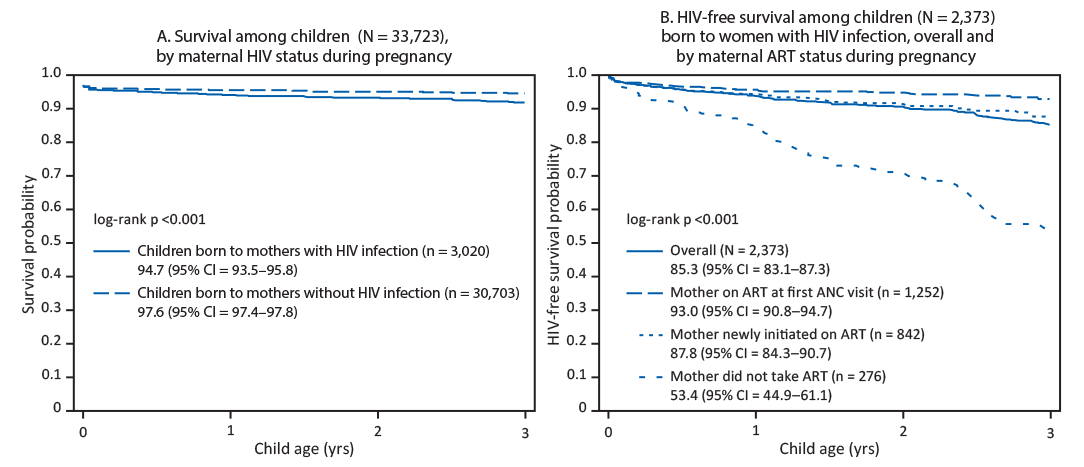
Survival and HIV-free survival among children aged 3 and under. Figure from the CDC report.
What it means
- Children of mothers with HIV still survive less often — as earlier studies found — but most children here were born before or early in the scale-up of Option B+ (lifelong ART for all pregnant and breastfeeding women with HIV, from 2011–2014) and "treat-all" (from 2016). The gap appears to be narrowing among the youngest children, perhaps an early sign that better treatment for adults benefits their children.
- An HIV-free survival of 85.3% shows big gaps remain. Starting ART before pregnancy prevents infection in the womb and helps mothers stay on treatment after birth, which also protects babies through breastfeeding. Yet only about half of mothers here were on ART before pregnancy.
- Ending mother-to-child transmission will need earlier diagnosis and treatment of women with HIV, preventing HIV in women, preventing unintended pregnancies, and safe conception planning, so mothers are on ART and virally suppressed before they conceive. The difference by treatment timing was smallest among children 1 or younger, who likely benefited most from Option B+ and treat-all.
Limits: care standards changed over 2012–2017; a snapshot survey can't credit results to specific programs; and counting only the most recent birth gives lower death estimates than surveys that count all births over 5 years.
Sources
Based on Sasi Jonnalagadda, Katharine Yuengling, Elaine Abrams and others, "Survival and HIV-Free Survival Among Children Aged ≤3 Years — Eight Sub-Saharan African Countries, 2015–2017," MMWR, Centers for Disease Control and Prevention; a work of the United States government in the public domain. The report says more than 90% of mothers with HIV received ART during pregnancy, while its own figures (52.8% before and 35.5% during) add up to less; this page leaves that figure out.
Licence: CC0 1.0 (public domain) · Adapted from www.cdc.gov
1
0
0
0

Comments


