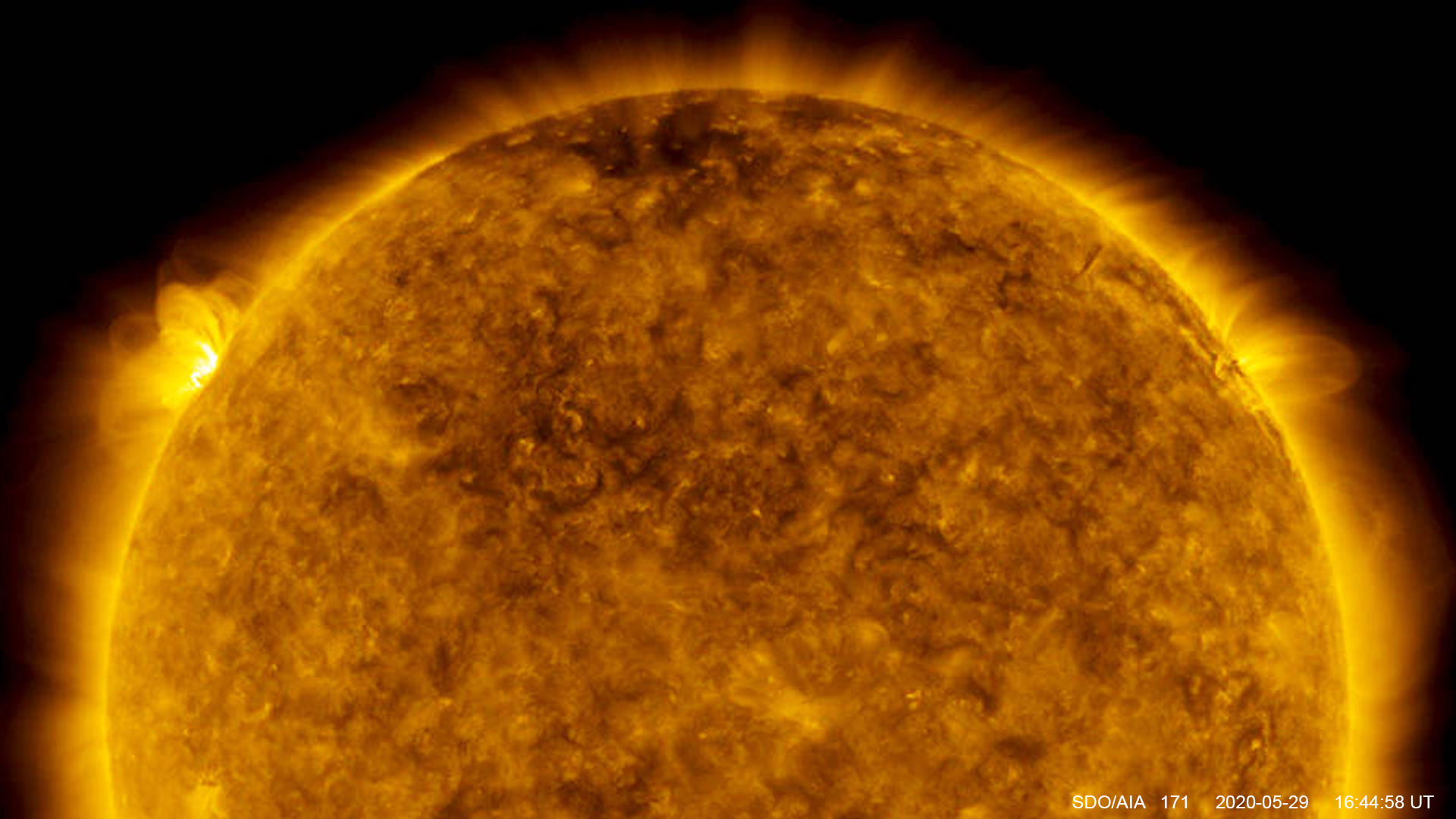
At 3:24 a.m. EST on May 29, 2020, the Solar Dynamics Observatory, operated by our partners at NASA, captured the largest solar flare, or eruption of radiation on the surface of the sun, since October 2017. The flare can be seen on the upper left side of the sun’s horizon.
The moment the flare occurred was also seen via the Solar Ultraviolet Imager (SUVI) instrument onboard NOAA’s GOES-East satellite.
The flare seen via the SUVI instrument onboard the GOES-East satellite.
The sun is a pretty turbulent place, and its massive, complex magnetic field causes giant solar eruptions such as solar flares and coronal mass ejections. This field is large enough to encapsulate space far past the edge of the planets and helps protect the planets within it from harmful cosmic particles, similar to how the Earth’s magnetic field protects it from much of the sun’s radiation. We can see manifestations of the magnetic field in the form of sunspots, which are cooler, dark areas on the sun’s surface which mark regions where magnetism is the strongest. Solar flares are most often associated with these regions.
Flares are classified according to their strength and range: B, C, M, and X are ordered from smallest to largest, with each letter representing a ten-fold increase in energy output. This particular flare was a relatively small M-class flare. Although X-class flares are the most dangerous, with the potential to damage satellites, communication systems, ground-based technologies, and power grids, M-class flares can cause brief radio blackouts at the poles and minor radiation storms that can potentially harm astronauts beyond the planet’s atmosphere. This is why it’s important for scientists to constantly monitor the sun’s activity for changes.
The sun’s solar cycle spans roughly 11 years, and when the sun reaches its maximum activity, these flares become larger and more frequent, which increases the chances that one may affect the Earth. Although it’s difficult at this point to say if the sun’s activity is beginning to ramp up, scientists will continue to watch the sun closely over the next several months to see what happens next.
NASA’s Solar Dynamics Observatory satellite studies the solar atmosphere so that we can better understand how the sun influences the Earth and near-Earth space.
The GOES-East geostationary satellite, also known as GOES-16, keeps watch over most of North America, including the continental United States and Mexico, as well as Central and South America, the Caribbean, and the Atlantic Ocean to the west coast of Africa. The satellite also contains the Solar Ultraviolet Imager (SUVI) telescope that monitors the sun in the extreme ultraviolet wavelength range.
Where this page came from
This page was imported from NOAA Satellites (NESDIS). Published by NOAA's National Environmental Satellite, Data, and Information Service and, as a work of the United States government, in the public domain; pictures credited elsewhere are left out.
Nobody has written it yet — it is the source material at a new address, which is why search engines are asked to skip it and why no one earns from it. It is up for grabs: take it on, and it is yours to rewrite and to earn from.
Licence: CC0 1.0 (public domain) · Adapted from www.nesdis.noaa.gov
1
0
0
0

Comments