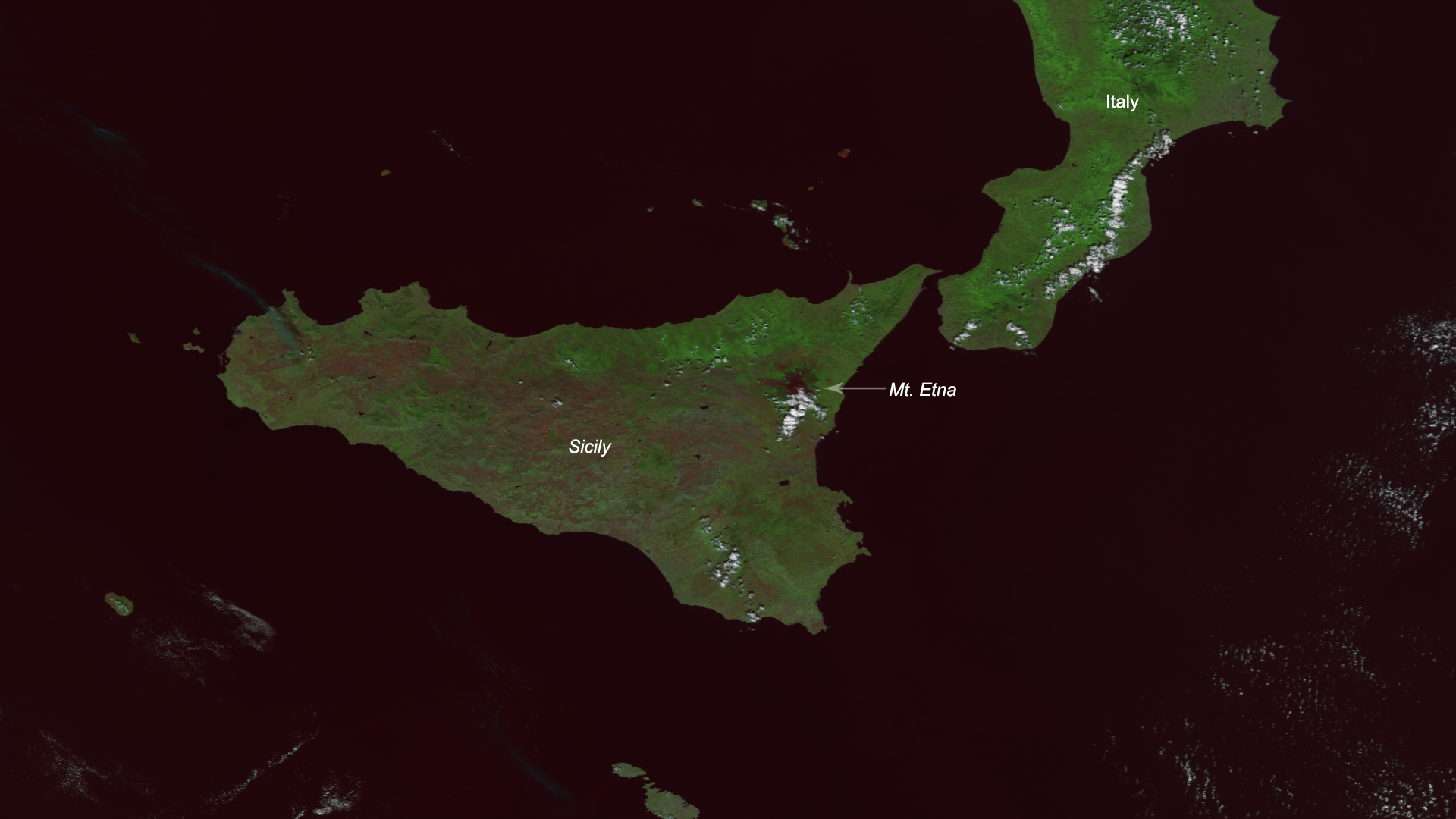
Download Image Download Image of the Volcanic Activity at Mount Etna
Mount Etna, the famous volcano on the Italian island of Sicily, has been spewing ash and red-hot chunks of lava known as “lava bombs” almost continuously since Sept. 9. The NOAA-20 satellite spied steam condensing from these intense explosions, known as “strombolian” eruptions, on Sept. 13, 2019, which could be felt more than 18 miles away.
Mount Etna is the most active volcano in Europe, and the second-most active volcano in the world, behind Kilauea in Hawaii. The National Institute of Geophysics and Volcanology-Etnean Observatory reported that these types of eruptions happen regularly, and that the intensity of the eruptions has been gradually rising since August. Before that, the volcano erupted in July, releasing huge plumes of ash 15,000 feet above sea level while another eruption of nearby Mount Stromboli, off the coast of Sicily, caused lava flows in the area.
This false-color RGB image via channels 4, 2, and 1 was captured by the VIIRS sensor onboard NOAA-20, which provides daily, high-resolution visible and infrared images of Earth's atmosphere from across the globe.
Where this page came from
This page was imported from NOAA Satellites (NESDIS). Published by NOAA's National Environmental Satellite, Data, and Information Service and, as a work of the United States government, in the public domain; pictures credited elsewhere are left out.
Nobody has written it yet — it is the source material at a new address, which is why search engines are asked to skip it and why no one earns from it. It is up for grabs: take it on, and it is yours to rewrite and to earn from.
Licence: CC0 1.0 (public domain) · Adapted from www.nesdis.noaa.gov
1
0
0
0

Comments