Please note: This report has been corrected.
Ian W. Pray, PhD1,2,3,; Laura Ford, PhD1,2,; Devlin Cole, MD3,4; Christine Lee, PhD1,5; John Paul Bigouette, PhD1,2; Glen R. Abedi, MPH1; Dena Bushman, MSN, MPH1,2; Miranda J. Delahoy, PhD1,2; Dustin Currie, PhD1,2; Blake Cherney, MS1; Marie Kirby, PhD1; Geroncio Fajardo, MD1; Motria Caudill, PhD1,6; Kimberly Langolf, MS7; Juliana Kahrs, MS7; Patrick Kelly, MD4,8; Collin Pitts, MD4,8; Ailam Lim, PhD9; Nicole Aulik, PhD9; Azaibi Tamin, PhD1; Jennifer L. Harcourt, PhD1; Krista Queen, PhD1; Jing Zhang, PhD1; Brett Whitaker, PhD1; Hannah Browne1; Magdalena Medrzycki, PhD1; Patricia Shewmaker, PhD1; Jennifer Folster, PhD1; Bettina Bankamp, PhD1; Michael D. Bowen, PhD1; Natalie J. Thornburg, PhD1; Kimberly Goffard, MBA10; Brandi Limbago, PhD1; Allen Bateman, PhD7,11; Jacqueline E. Tate, PhD1; Douglas Gieryn10; Hannah L. Kirking, MD1; Ryan Westergaard, MD, PhD3,4; Marie Killerby, VetMB1; CDC COVID-19 Surge Laboratory Group
Summary
What is already known about this topic?
Antigen tests for SARS-CoV-2 are inexpensive and can return results within 15 minutes, but test performance data in asymptomatic and symptomatic persons are limited.
What is added by this report?
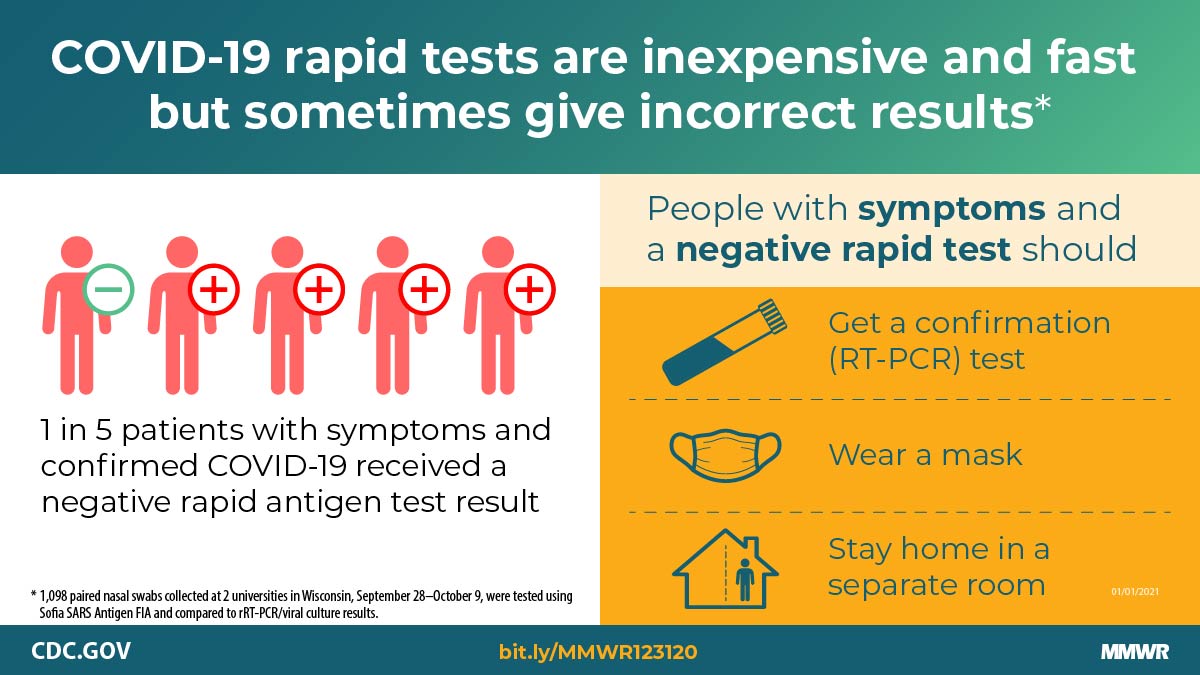
Compared with real-time reverse transcription–polymerase chain reaction (RT-PCR) testing, the Sofia antigen test had a sensitivity of 80.0% and specificity of 98.9% among symptomatic persons; accuracy was lower (sensitivity 41.2% and specificity 98.4%) when used for screening of asymptomatic persons.
What are the implications for public health practice?
To account for reduced antigen test accuracy, confirmatory testing with a nucleic acid amplification test (e.g., RT-PCR) should be considered after negative antigen test results in symptomatic persons and positive antigen test results in asymptomatic persons.
Tables
Related Materials

[JPG - 135 KB]](https://www.cdc.gov/mmwr/volumes/69/wr/social-media/mm695152a3_RapidAntigenTestResultsCOVID19_IMAGE_01Jan21_1200x675.jpg)
Discussion
The Sofia SARS Antigen FIA received FDA EUA on May 8, 2020, for use in symptomatic persons within 5 days of symptom onset (2). In this investigation, among persons reporting COVID-19–compatible symptoms at specimen collection, the test was less accurate (sensitivity = 80.0%; specificity = 98.9%) than reported in the FDA EUA (sensitivity = 96.7%; specificity = 100%) (2). Two of eight specimens from symptomatic persons that had false-negative antigen test results were positive by viral culture, indicating that potentially infectious persons might not be detected by antigen testing. To reduce the impact of false-negative antigen test results, confirmatory testing with an FDA-authorized NAAT, such as RT-PCR, should be considered following negative antigen test results in symptomatic persons (1).
Among asymptomatic participants, antigen test sensitivity was 41.2%, specificity was 98.4%, and PPV in this population was 33.3%. This low PPV was observed despite a relatively high prevalence of SARS-CoV-2 in this population (5.2% prevalence overall; 2.0% among asymptomatic persons), suggesting that PPV could be even lower when using this antigen test among populations with lower expected SARS-CoV-2 prevalence. To account for false-positive results when using antigen tests for asymptomatic screening, confirmatory NAAT testing should be considered following positive antigen test results in asymptomatic persons, particularly when pretest probability of SARS-CoV-2 infection is low (1). The NPV of antigen testing among asymptomatic participants was 98.8%, and virus was not cultured from asymptomatic participants with antigen-negative results, indicating that asymptomatic persons with negative antigen results are unlikely to be infected with SARS-CoV-2 and would not require confirmatory NAAT (1).
The findings in this report are subject to at least four limitations. First, participants were predominantly young adults in university settings where ongoing serial testing was being conducted. Antigen test performance might differ in other populations with different characteristics and testing schedules. Second, given the limitations of RT-PCR, some false-positive antigen test results might represent true infections not identified by RT-PCR. Third, the ability to recover infectious virus in culture is limited and decreases for specimens with higher Ct values (8); a lack of virus recovery by culture does not indicate that a person is not infectious. Finally, this investigation evaluated the Sofia SARS Antigen FIA, and cannot be generalized to other FDA-authorized SARS-CoV-2 antigen tests.
Serial testing of asymptomatic and symptomatic persons has been proposed for prevention and control of SARS-CoV-2 transmission (9,10) and is currently being implemented at U.S. colleges and universities and in other congregate settings (3–5). Despite reduced sensitivity compared with real-time RT-PCR, the use of antigen tests for serial testing in these settings, particularly when RT-PCR tests are not available or have a prolonged turnaround time, might still allow rapid identification of infectious persons and control of outbreaks (1). However, antigen-based testing strategies should account for the lower sensitivity and lower PPV when used for asymptomatic screening by considering confirmatory testing with an FDA-authorized NAAT, such as RT-PCR, after a positive antigen test result in an asymptomatic person. Confirmatory testing should also be considered following a negative antigen test result in a person experiencing COVID-19–compatible symptoms. All persons with negative antigen test results should continue to take measures to prevent SARS-CoV-2 transmission, including wearing a mask, reducing contact with nonhousehold members, and getting tested if they experience symptoms or have close contact with someone who has COVID-19.††† Symptomatic persons with negative antigen test results should continue to follow CDC guidance§§§ for persons who might have COVID-19, including staying home except to get medical care and protecting household members by staying in a separate room, wearing a mask indoors, washing hands often, and frequently disinfecting surfaces.
Acknowledgments
Edward Samuel Rivera, Daniel J. O’Donnell, University of Wisconsin-Oshkosh; Margaret Okomo-Adhiambo, Umesh Parashar, Paul Rota, Lauren Franco, Gerardo Garcia-Lerma, CDC; Neeti Dahal, Wisconsin Veterinary Diagnostic Laboratory-Wisconsin State Laboratory of Hygiene COVID Laboratory, University of Wisconsin-Madison.
CDC COVID-19 Surge Laboratory Group
Baoming Jiang, CDC; Jan Vinjé, CDC; Amy L. Hopkins, CDC; Eric Katz, CDC; Leslie Barclay, CDC; Mathew Esona, CDC; Rashi Gautam, CDC; Slavica Mijatovic-Rustempasic, CDC; Sung-Sil Moon, CDC; Theresa Bessey, CDC; Preeti Chhabra, CDC; Sarah L. Smart, CDC; Raydel Anderson, CDC; Kay W. Radford, CDC; Gimin Kim, CDC; Dexter Thompson, CDC; Congrong Miao, CDC; Min-hsin Chen, CDC; Lalitha Gade, CDC; Renee Galloway, CDC; Kashif Sahibzada, CDC; Nhien M. Tran, CDC; Srinivasan Velusamy, CDC; HaoQiang Zheng, CDC; Kenny Nguyen, Oak Ridge Institute for Science and Education, Oak Ridge, Tennessee; Claire Hartloge, Oak Ridge Institute for Science and Education, Oak Ridge, Tennessee; Brent Jenkins, Oak Ridge Institute for Science and Education, Oak Ridge, Tennessee; Phili Wong, Oak Ridge Institute for Science and Education, Oak Ridge, Tennessee
Corresponding author: Ian Pray, ian.pray@dhs.wisconsin.gov.
1CDC COVID-19 Response Team; 2Epidemic Intelligence Service, CDC; 3Wisconsin Department of Health Services; 4School of Medicine and Public Health, University of Wisconsin-Madison; 5Laboratory Leadership Service, CDC; 6Agency for Toxic Substances and Disease Registry, Atlanta, Georgia; 7University of Wisconsin-Oshkosh; 8University Health Services, University of Wisconsin-Madison; 9Wisconsin Veterinary Diagnostic Laboratory, University of Wisconsin-Madison; 10Winnebago County Health Department, Oshkosh, Wisconsin; 11Wisconsin State Laboratory of Hygiene.
All authors have completed and submitted the International Committee of Medical Journal Editors form for disclosure of potential conflicts of interest. No potential conflicts of interest were disclosed.
- These authors contributed equally to this report.
† Other affiliates were participants who did not mark “student” or “staff” on the questionnaire (they selected “other” or did not respond); the majority of these persons were family members of staff members.
§ Symptom list was based on the interim position statement for COVID-19 case definitions from the Council of State and Territorial Epidemiologists, updated August 7, 2020. Clinical criteria for COVID-19 included fever, cough, shortness of breath, fatigue, sore throat, headache, muscle aches, chills, nasal congestion, difficulty breathing, diarrhea, nausea, vomiting, abdominal pain, rigors, loss of taste, and loss of smell. https://cdn.ymaws.com/www.cste.org/resource/resmgr/ps/positionstatement2020/Interim-20-ID-02_COVID-19.pdf.
¶ Recent exposure was defined as being within 6 feet of a person with a COVID-19 diagnosis for ≥15 minutes in the past 14 days.
** https://www.fda.gov/media/137885/download.
†† Specimens were used to perform a limiting-dilution inoculation of Vero CCL-81 cells, and cultures showing evidence of cytopathic effect (CPE) were tested by real-time RT-PCR for the presence of SARS-CoV-2 RNA. Viral recovery was defined as any culture in which the first passage had an N1 Ct at least twofold lower than the corresponding clinical specimen.
§§ Ct values from real-time RT-PCR were only compared for specimens collected at university A that were analyzed with the CDC 2019-nCoV real-time RT-PCR diagnostic panel for detection of SARS-CoV-2.
¶¶ 45 C.F.R. part 46.102(l)(2), 21 C.F.R. part 56; 42 U.S.C. Sect. 241(d); 5 U.S.C. Sect. 552a; 44 U.S.C. Sect. 3501 et seq.
*** The participant with a false-negative result 2 days after symptom onset had a repeat specimen 2 days later; the results of testing were positive by antigen test and by real-time RT-PCR.
††† https://www.cdc.gov/coronavirus/2019-ncov/prevent-getting-sick/prevention.html.
§§§ https://www.cdc.gov/coronavirus/2019-ncov/if-you-are-sick/steps-when-sick.html.
References
- CDC. Coronavirus disease 2019 (COVID-19): interim guidance for antigen testing for SARS-CoV-2. Atlanta, GA: US Department of Health and Human Services, CDC; 2020. https://www.cdc.gov/coronavirus/2019-ncov/lab/resources/antigen-tests-guidelines.html
- Food and Drug Administration. In vitro diagnostics EUAs. Silver Spring, MD: US Department of Health and Human Services, Food and Drug Administration; 2020. https://www.fda.gov/medical-devices/coronavirus-disease-2019-covid-19-emergency-use-authorizations-medical-devices/vitro-diagnostics-euas
- CDC. Coronavirus disease 2019 (COVID-19): guidance for testing, screening, and outbreak response for institutions of higher education (IHEs). Atlanta, GA: US Department of Health and Human Services, CDC; 2020. https://www.cdc.gov/coronavirus/2019-ncov/community/colleges-universities/ihe-testing.html
- CDC. Coronavirus disease 2019 (COVID-19): testing guidelines for nursing homes. Atlanta, GA: US Department of Health and Human Services, CDC; 2020. https://www.cdc.gov/coronavirus/2019-ncov/hcp/nursing-homes-testing.html
- CDC. Coronavirus disease 2019 (COVID-19): interim considerations for SARS-CoV-2 testing in correctional and detention facilities. Atlanta, GA: US Department of Health and Human Services, CDC; 2020. https://www.cdc.gov/coronavirus/2019-ncov/community/correction-detention/testing.html
- Lu X, Wang L, Sakthivel SK, et al. US CDC real-time reverse transcription PCR panel for detection of severe acute respiratory syndrome coronavirus 2. Emerg Infect Dis 2020;26:1654–65. CrossRef PubMed
- Harcourt J, Tamin A, Lu X, et al. Severe acute respiratory syndrome coronavirus 2 from patient with coronavirus disease, United States. Emerg Infect Dis 2020;26:1266–73. CrossRef PubMed
- Gniazdowski V, Morris CP, Wohl S, et al. Repeat COVID-19 molecular testing: correlation of SARS-CoV-2 culture with molecular assays and cycle thresholds. Clin Infect Dis 2020;ciaa1616. CrossRef PubMed
- Walke HT, Honein MA, Redfield RR. Preventing and responding to COVID-19 on college campuses. JAMA 2020;324:1727–8. CrossRef PubMed
- Paltiel AD, Zheng A, Walensky RP. Assessment of SARS-CoV-2 screening strategies to permit the safe reopening of college campuses in the United States. JAMA Netw Open 2020;3:e2016818. CrossRef PubMed
| Characteristic | No (%) | ||||
|---|---|---|---|---|---|
| True positives (N = 39) | False negatives (N = 18) | False positives (N = 16) | True negatives (N = 1,025) | Total (N = 1,098) | |
| Testing site | |||||
| University A § | 37 (94.9) | 17 (94.4) | 15 (93.8) | 982 (95.8) | 1,051 (95.7) |
| University B ¶ | 2 (5.1) | 1 (5.6) | 1 (6.3) | 43 (4.2) | 47 (4.3) |
| Sex | |||||
| Male | 16 (41.0) | 9 (50.0) | 12 (75.0) | 416 (40.6) | 453 (41.3) |
| Female | 23 (59.0) | 9 (50.0) | 4 (25.0) | 609 (59.4) | 645 (58.7) |
| Age group (yrs) | |||||
| 15–24** | 35 (89.7) | 16 (88.9) | 11 (68.8) | 909 (88.7) | 971 (88.4) |
| ≥25 | 4 (10.3) | 2 (11.1) | 5 (31.3) | 116 (11.3) | 127 (11.6) |
| Race/Ethnicity †† | |||||
| White | 31 (79.5) | 17 (94.4) | 12 (75.0) | 857 (83.6) | 917 (83.5) |
| Hispanic/Latino | 6 (15.4) | 0 (0) | 1 (6.3) | 54 (5.3) | 61 (5.6) |
| Black/African-American | 0 (0) | 1 (5.6) | 2 (12.5) | 26 (2.5) | 29 (2.6) |
| Asian/Pacific Islander | 0 (0) | 0 (0) | 0 (0) | 49 (4.8) | 49 (4.5) |
| American Indian/Alaska Native | 0 (0) | 0 (0) | 0 (0) | 3 (0.3) | 3 (0.3) |
| Other/Unknown/Multiple races | 2 (5.1) | 0 (0) | 1 (6.3) | 36 (3.5) | 39 (3.6) |
| University status | |||||
| Student | 35 (89.7) | 17 (94.4) | 13 (81.3) | 929 (90.6) | 994 (90.5) |
| Faculty or staff member | 4 (10.3) | 1 (5.6) | 3 (18.8) | 74 (7.2) | 82 (7.5) |
| Other affiliate or unknown §§ | 0 (0) | 0 (0) | 0 (0) | 22 (2.2) | 22 (2.0) |
| Exposure ¶¶ to a COVID-19 case | |||||
| Been in close contact in the past 14 days | 13 (33.3) | 9 (50.0) | 4 (25.0) | 128 (12.5) | 154 (14.0) |
| Quarantine status | |||||
| Quarantined at time of specimen collection | 17 (43.6) | 6 (33.3) | 3 (18.8) | 109 (10.6) | 135 (12.3) |
| Time between quarantine initiation to specimen collection, median days (range) | 1 (0–8) | 3.5 (0–6) | 1 (0–4) | 4 (0–28) | 4 (0–28) |
| Reported symptoms | |||||
| No current symptoms | 7 (17.9) | 10 (55.6) | 14 (87.5) | 840 (82.0) | 871 (79.3) |
| One or more symptoms in the past 14 days | 2 (28.6) | 1 (10.0) | 0 (0) | 50 (6.0) | 53 (6.1) |
| No symptoms in the past 14 days | 5 (71.4) | 9 (90.0) | 14 (100.0) | 790 (94.0) | 818 (93.9) |
| One or more current symptoms | 32 (82.1) | 8 (44.4) | 2 (12.5) | 185 (18.0) | 227 (20.7) |
| Nasal congestion | 24 (75.0) | 2 (25.0) | 1 (50.0) | 87 (47.0) | 114 (50.2) |
| Sore throat | 12 (37.5) | 5 (62.5) | 1 (50.0) | 79 (42.7) | 97 (42.7) |
| Headache | 17 (53.1) | 3 (37.5) | 1 (50.0) | 66 (35.7) | 87 (38.3) |
| Cough | 18 (56.3) | 6 (75.0) | 1 (50.0) | 45 (24.3) | 70 (30.8) |
| Fatigue | 14 (43.8) | 3 (37.5) | 1 (50.0) | 42 (22.7) | 60 (26.4) |
| Muscle aches | 11 (34.4) | 2 (25.0) | 0 (0) | 30 (16.2) | 43 (18.9) |
| Shortness of breath | 7 (21.9) | 1 (12.5) | 0 (0) | 16 (8.6) | 24 (10.6) |
| Chills | 4 (12.5) | 0 (0) | 0 (0) | 14 (7.6) | 18 (7.9) |
| Diarrhea | 3 (9.4) | 0 (0) | 0 (0) | 15 (8.1) | 18 (7.9) |
| Nausea or vomiting | 3 (9.4) | 0 (0) | 0 (0) | 14 (7.6) | 17 (7.5) |
| Loss of taste | 8 (25.0) | 2 (25.0) | 1 (50.0) | 3 (1.6) | 14 (6.2) |
| Loss of smell | 8 (25.0) | 2 (25.0) | 1 (50.0) | 2 (1.1) | 13 (5.7) |
| Fever | 6 (18.8) | 0 (0) | 0 (0) | 5 (2.7) | 11 (4.8) |
| Difficulty breathing | 3 (9.4) | 0 (0) | 0 (0) | 8 (4.3) | 11 (4.8) |
| Abdominal pain | 1 (3.1) | 0 (0) | 0 (0) | 6 (3.2) | 7 (3.1) |
| Rigors | 0 (0) | 0 (0) | 0 (0) | 0 (0) | 0 (0.0) |
| Other reported symptoms*** | 1 (3.1) | 0 (0) | 0 (0) | 4 (2.2) | 5 (2.2) |
| Symptom onset date reported | 31 (96.9) | 8 (100.0) | 2 (100.0) | 169 (91.4) | 210 (92.5) |
| ≤5 days between reported symptom onset and specimen collection | 23 (74.2) | 8 (100.0) | 1 (50.0) | 120 (71.0) | 152 (72.4) |
† True positive = antigen-positive and real-time RT-PCR–positive; false negative = antigen-negative and real-time RT-PCR–positive; false positive = antigen-positive and real-time RT-PCR–negative; true negative = antigen-negative and real-time RT-PCR–negative; these definitions do not reflect results from viral culture.
§ At university A, real-time RT-PCR was performed using the CDC 2019-nCoV real-time RT-PCR diagnostic panel for detection of SARS-CoV-2.
¶ At university B, real-time RT-PCR was performed using Thermo Fisher Scientific’s TaqPath COVID-19 Combo Kit for detection of SARS-CoV-2.
** One university staff member’s child aged 15 years. All other participants were aged ≥17 years.
†† Non-Hispanic ethnicity represented for all White, Black/African-American, Asian/Pacific Islander, American Indian/Alaska Native, Other/Unknown/Multiple races.
§§ Other affiliates were participants who did not mark “student” or “staff” on the questionnaire (they selected “other” or did not respond); the majority of these persons were family members of staff members.
¶¶ Ever in close contact was defined as within 6 feet for ≥15 minutes of a person with a diagnosis of COVID-19.
*** Other reported symptoms included allergies, cough that is not dry, and difficulty breathing from anxiety.
| Antigen test result | Real-time RT-PCR result, no. | |||||
|---|---|---|---|---|---|---|
| Asymptomatic (N = 871) | Symptomatic* (N = 227) | |||||
| Positive | Negative | Total | Positive | Negative | Total | |
| Positive | 7 | 14 | 21 | 32 | 2 | 34 |
| Negative | 10 | 840 | 850 | 8 | 185 | 193 |
| Total | 17 | 854 | 871 | 40 | 187 | 227 |
| Test evaluation, % (95% CI) | ||||||
| Sensitivity | 41.2 (18.4–67.1) | 80.0 (64.4–90.9) | ||||
| Specificity | 98.4 (97.3–99.1) | 98.9 (96.2–99.9) | ||||
| Positive predictive value | 33.3 (14.6–57.0) | 94.1 (80.3–99.3) | ||||
| Negative predictive value | 98.8 (97.8–99.4) | 95.9 (92.0–98.2) |
- One or more symptoms reported.
FIGURE. Viral culture results among participants with positive Sofia SARS Antigen Fluorescent Immunoassay or positive SARS-CoV-2 real-time reverse transcription–polymerase chain reaction (RT-PCR) results (n = 69), by cycle threshold (Ct) value† and the interval between specimen collection and reported symptom onset or asymptomatic status — university A, Wisconsin, September–October 2020*

- n = 30 antigen- and culture-positive; n = 22 antigen-positive and culture-negative; n = 15 antigen- and culture-negative; n = two antigen- negative and culture-positive.
† Ct values represent cycle thresholds for the N1 target probe during SARS-CoV-2 real-time RT-PCR; Ct values are represented on the y-axis in descending order to indicate that lower Ct values represent higher levels of RNA in the specimen.
Where this page came from
This page was imported from Centers for Disease Control and Prevention. Material produced by the Centers for Disease Control and Prevention is a work of the United States government and is in the public domain.
Nobody has written it yet — it is the source material at a new address, which is why search engines are asked to skip it and why no one earns from it. It is up for grabs: take it on, and it is yours to rewrite and to earn from.
Licence: CC0 1.0 (public domain) · Adapted from www.cdc.gov
1
0
0
0

Comments