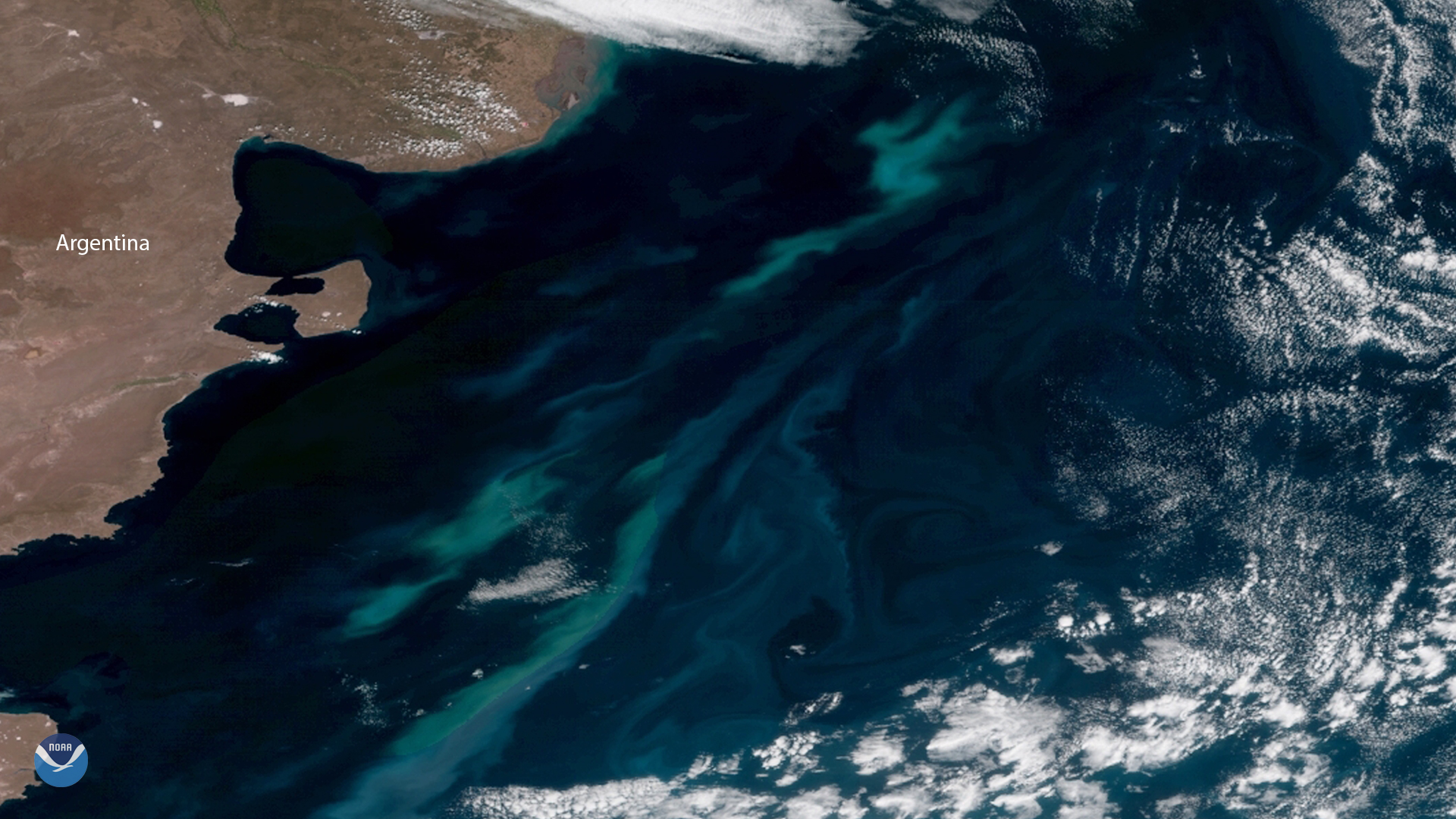
Download Image Download GOES East imagery of phytoplankton bloom
December is the beginning of summer in Earth's Southern Hemisphere. The long days and abundant sunlight help millions of tiny plant-like organisms, called phytoplankton, grow in nutrient-rich coastal waters.
On Dec. 17, 2018, the GOES East satellite spotted a large phytoplankton bloom stretching hundreds of miles off the coast of Argentina. Seen from space, these microscopic plant-like organisms – also called microalgae – brighten the dark blue ocean into brilliant shades of blue, green and turquoise. The swirling patterns reveal not just the presence of phytoplankton, but also show how ocean currents are moving them around.
Like land plants, phytoplankton contain chlorophyll and require sunlight to live and grow. Large blooms are most common in the South Atlantic during late spring and summer. In December 2017, satellites saw an impressive bloom near the Falkland Islands, about 300 miles off the coast of southern Argentina.
This geocolor-enhanced imagery was created by NOAA's partners at the Cooperative Institute for Research in the Atmosphere. The GOES East geostationary satellite, also known as GOES-16, provides high-resolution atmospheric imagery of Earth's Western Hemisphere, including North and South America, from 22,000 miles in space.
Where this page came from
This page was imported from NOAA Satellites (NESDIS). Published by NOAA's National Environmental Satellite, Data, and Information Service and, as a work of the United States government, in the public domain; pictures credited elsewhere are left out.
Nobody has written it yet — it is the source material at a new address, which is why search engines are asked to skip it and why no one earns from it. It is up for grabs: take it on, and it is yours to rewrite and to earn from.
Licence: CC0 1.0 (public domain) · Adapted from www.nesdis.noaa.gov
1
0
0
0

Comments