
Potentially harmful to humans and other animals, the red-rimmed melania snail (Melanoides tuberculatus; family Thiaridae) was discovered in Biscayne National Park, Florida, in 2003 by U.S. Geological Survey (USGS) researchers (figs. 1, 2; box on p. 2). The discovery raised concerns for park managers because this aquatic non-native snail is present in significant numbers in areas frequently used by park visitors and poses a risk of exposure. Researchers are addressing questions such as: Is this species a danger to human health? How widespread is it within the park? What factors control the distribution of the species? Is its presence a threat to native animals?

Figure 1. Juvenile and adult Melanoides tuberculatus. This non-native species shows many variations and can be easily confused with native snails. mm, millimeter.

Figure 2. Known U.S. distribution of Melanoides tuberculatus as of April 2006; the non-native snail may have expanded its range from the areas shown. Map courtesy of A.J. Benson, USGS; adapted from http://nas.er.usgs.gov/queries/ SpeciesList.asp?Group=Mollusks.
What We Know about Melanoides tuberculatus
How did Melanoides tuberculatus get here?
Melanoides tuberculatus is native to tropical and subtropical regions of Africa and Asia (Clench, 1969). Specifics of how and when M. tuberculatus got to the United States are not known, but Murray (1971) and Roessler and others (1977) believed it was through the aquarium trade. The species was first reported in Arizona in the 1950s (Murray, 1971; Dundee, 1974) and in south Florida in 1971 (Russo, 1973). By 1977, it had reached areas adjacent to Biscayne Bay (Roessler and others, 1977). The known distribution of the species in the United States is shown in figure 2.

Figure 3. Generalized life cycle of trematodes that infect Melanoides tuberculatus and other aquatic snails. Hosts differ at each stage, depending on the species of trematode. Trematodes are parasitic worms (also called “flukes”) that can cause illness in humans and other animals. Proper food preparation can prevent humans from being infected.
Why should you be concerned?
First, human health issues. Nobody wants to be home to liver or lung flukes. In Asia, where Melanoides tuberculatus is native, the snails are part of the complex life cycle of several species of parasitic trematode worms, including liver flukes—Clonorchis sinensis, Opisthorchis spp., and Haplorchis spp.—and a lung fluke—Paragonimus westermani. The life cycle of these trematode parasites (fig. 3) involves both vertebrate and invertebrate hosts; for example, humans, fish, snails, and crustaceans (such as crabs, crayfish, and shrimp). The cycle continues when a person (or alternate host such as a bird or raccoon) eats raw or undercooked fish or crab that has been infected.


In the 1970s, some researchers (Murray, 1971; Roessler and others, 1977) thought the risk to human health from these parasites was minimal in the United States because sewage treatment and food preparation methods would prevent the spread of infection. The advent of more ethnic and diversified methods of food preparation in recent decades (Simonne and others, 2004), however, in creases the chances of live parasite ingestion. Infection by the lung fluke (Paragonimus) has been documented in people in the United States (Stoll, 1947; Mariano and others, 1986; DeFrain and Hooker, 2002). Parasite infections can last for years (Stauffer and others, 2004), increasing the chances of the host passing infectious materials on and starting the life cycle again.
Second, animal health issues. Trematode flukes affect waterfowl, fish, and other animals (including humans). Melanoides tuberculatus is a known host for several of these parasites and a potential host for others. Centrocestus formosanus is a trematode parasite that burrows into the gills of fish and then enters mammals or birds that consume the fish. Centrocestus causes losses of over $3 million annually to ornamental fish producers and has been found on fish in the wild in Texas, Florida, and Utah (Mitchell, 2005). Haplorchis spp., another parasite present in M. tuberculatus, infects the muscle tissue of fish.


Other parasites are not yet known to include Melanoides tuberculatus in their life cycles but are cause for concern. The trematode parasite Philophthalmus megalurus affects the eyes of birds, including waterfowl, exposed to M. tuberculatus while feeding in the shallow waters of Biscayne Bay. These parasites can potentially adapt to new animal hosts. Penner and Fried (1963) found a marine species of Philophthalmus along the Gulf Coast of Florida to Key West that utilizes another snail—Batillaria minima (West Indian false cerith)—as its host. Because B. minima and M. tuberculatus co-exist in Biscayne Bay, there is a potential for the parasite to expand from one host species to an alternate, previously unaffected, host population.
Third, potential displacement of native species. A new, prolific species that can out-compete native species for food sources could cause serious ecological damage (Murray, 1971; Roessler and others, 1977; Mitchell, 2005). Melanoides tuberculatus has been found in Florida in densities of 10,000 per square meter at St. Johns River (Thompson, 2004) and 23,000 per square meter near Coral Gables (Roessler and others, 1977). M. tuberculatus (and other members of the family Thiaridae) can reproduce asexually; thus, a single snail is all it takes to populate a new area, and the reproductive rates are extremely high. In addition, M. tuberculatus snails do not lay eggs, but brood their young internally; this reproductive strategy may also give them an advantage over native species.

Figure 4. Satellite image showing location of sites in and near Biscayne National Park, Florida, where Melanoides tuberculatus snails (live and debris) were found during field surveys conducted by the USGS between October 2004 and July 2007. Inset at upper left shows part of transect at Black Point. Inset maps at right show location of larger view. Base image is a mosaic of Landsat orthorectified data obtained from the USGS EROS Data Center. Photograph of Black Point by James B. Murray, USGS.
How do conditions in south Florida increase the potential for Melanoides tuberculatus to affect human and animal health?
The potential danger to human health and animal health is increased by the presence of Melanoides tuberculatus in south Florida because conditions here favor the parasitic life cycle shown in figure 3. First, the potential snail, fish, and crustacean hosts are present in large numbers. Second, many activities bring people and animals into contact with the hosts. Fish and shellfish are popular food sources in the region and are sometimes eaten raw or undercooked. From 1990 to 2000, Florida had the highest incidence in the Nation of illness outbreaks caused by ethnic food (Simonne and others, 2004). Water birds (photos at right) and small mammals, such as raccoons, frequent the shoreline to feed on crabs, fish, and invertebrates. Fishing, swimming, and other water sports bring people into contact with the water. Third, exposure to potentially infected, untreated human waste is a concern because Miami-Dade County is underlain by porous limestone, and about 27 percent of households used septic tanks in 2000 (data from http://www.doh.state.fl.us/Environment/ostds/statistics/ostdsstatistics.htm and http://www.miamidade.gov/planzone/Library/Census/MiamiDadeCountyFacts-2005.pdf).
In addition to having all the components of the trematode life cycle in place, south Florida has a climate similar to that of southeast Asia, where M. tuberculatus is native. These factors increase the likelihood of the spread of M. tuberculatus and the displacement of native south Florida species.
What We’ve Learned in This Study
What is the distribution of Melanoides tuberculatus within Biscayne National Park?
Both living Melanoides tuberculatus snails and shell debris have been found near canal mouths and in the nearshore areas in Biscayne National Park (figs. 4, 5). The highest concentrations of live and dead shells were near Black Point. Field surveys in 2004 and 2006 showed that M. tuberculatus is becoming increasingly abundant at Black Point (fig. 5). The estimated number of M. tuberculatus snails per square meter approaches 60,000 on the Black Point transect at site TR4, which is about 500 meters offshore.
In order to determine how many introductions of Melanoides tuberculatus have taken place in Biscayne Bay, we are analyzing mitochondrial DNA from selected locations. Analysis of samples from Black Creek Canal and site TR2 on the Black Point transect show that the two populations are indistinguishable. This finding suggests that the population at Black Point is the result of a single introduction of one clonal type of M. tuberculatus. The numbers shown in figure 5 illustrate how rapidly this species is spreading from a single introduction and indicate the level of care
in south Florida, it is adapting to estuarine salinity conditions (Russo, 1973; Roessler and others, 1977). In Biscayne Bay, we have collected live M. tuberculatus snails at just under normal marine salinity (up to 33 parts per thousand (ppt) of dissolved salts). Experiments to determine what environmental conditions might deter the spread of M. tuberculatus are being conducted. One experiment on necessary to prevent the release of non-native species.

Figure 5. Raw count of Melanoides tuberculatus, live and dead, collected in 2004 and 2006 along a transect from Black Point (fig. 4). Black numbers are actual counts from three bottom grab samples collected (by using a petite ponar device) at each site. Red numbers are estimates of the numbers of individuals per square meter (m) based on the raw count.
What factors control the distribution of Melanoides tuberculatus?
habitat, Melanoides In its native

Great blue heron salinity tolerance illustrates the hardi-
tuberculatus is considered primarily a freshwater species; however, salinity tolerance illustrates the hardiness of the species (fig. 6). None of the original adult specimens died as salinity was gradually increased during the 6-week-long experiment, and juveniles appeared during the second week and survived, even though one tank reached extreme conditions (45 ppt). Although experimental results such as these may not translate directly to the natural environment, they indicate that the population of M. tuberculatus in Biscayne Bay is no longer restricted to freshwater.
Other environmental factors such as temperature, oxygen levels, and substrate need further investigation. In Biscayne Bay, temperature is not likely to be a limiting factor because water temperatures are similar to those in the snail’s native habitat. Mitchell (2005) reported that M. tuberculatus is resistant to desiccation, and Neck (1985) found that the species is resistant to low oxygen levels.
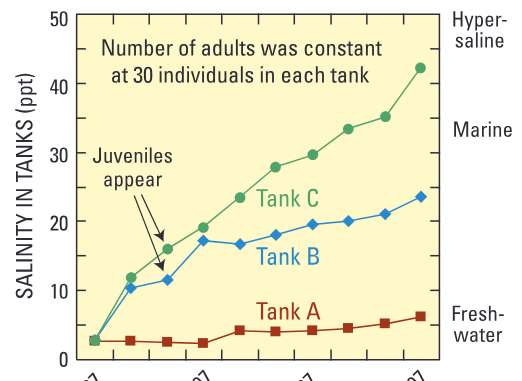
Figure 6. Salinity during a 6-week experiment to test the tolerance of Melanoides tuberculatus for increasing salinity. Starting salinity in all three tanks was less than 5 parts per thousand (ppt) dissolved salts. Salinities in tanks B and C were gradually increased while tank A was maintained at approximately 5 ppt as a control. All 30 adults placed in each tank survived, and juveniles appeared in tanks B and C, confirming that the freshwater snail M. tuberculatus is adapting to estuarine salinities.
How does Melanoides tuberculatus affect native animal populations?
The numbers of Melanoides tuberculatus snails found at some of the sites around Black Point (fig. 5) are far in excess of the numbers of any of the native mollusk species present. Although we have not directly tested the effect on the native mollusks and other invertebrates in Biscayne National Park, we assume that there is competition for food (the microalgae on which M. tuberculatus and other invertebrate organisms feed). Additional experiments and fieldwork are needed to determine the precise effects on the native invertebrates within Biscayne Bay and on the fish, birds, and mammals that feed upon these organisms.
What are the risks from Melanoides tuberculatus in Biscayne National Park?
There is good news and bad news. The good news is that, to date, the Melanoides tuberculatus population in Biscayne National Park has not revealed evidence of harmful parasites. The bad news is that if parasites appear in a small portion of the population, both parasites and host snails could spread rapidly. As mentioned above, all components of the trematode life cycle are in place in the park, and other snails known to carry parasites co-occur with M. tuberculatus populations. Continued monitoring of the snail population in the park should be done to detect any parasites that appear.
More good news is that all Melanoides tuberculatus snails found within Biscayne National Park to date are concen trated near canal mouths and in the near shore areas between canals. The more open regions of Biscayne Bay appear to be free of this non-native snail. The area around Black Point has an especially high concentration, yet this population appears to have begun from a single introduction. If it is possible to get rid of M. tuberculatus at Black Point, there is less likelihood of it being reintroduced than if it had entered the environment repeatedly. Additional genetic testing should be done on other populations to determine how many introductions have occurred. M. tuberculatus is variable and hard to distinguish from some native snails; careful notes and measurements (figs. 7, 8) are needed and so are studies to examine the diversity of the populations within Biscayne National Park.

Figure 7. An example of the type of notes and sketches made by scientists when studying and measuring distinguishing characteristics of snails. Melanoides tuberculatus is variable and difficult to distinguish from some native species.
The expansion of M. tuberculatus from freshwater into the brackish estuaries of south Florida increases the potential number of species that can be involved in the transmission of any parasites that may exist to include other snails, blue crabs, spiny lobsters, shrimp, stone crabs, and other saltwater crustaceans and fish. It also indicates the species’ ability to adapt and survive and implies that the distribution of M. tuberculatus will likely expand in the future unless actions are taken to control the further spread of the species.
Is Melanoides tuberculatus an invasive species?
According to Federal law (Executive Order 13112 of Feb. 3, 1999), an alien species is any species capable of propagating in a particular ecosystem that is not native to that ecosystem. An invasive species is an alien species “whose introduction does or is likely to cause economic or environmental harm or harm to human health” (http://www.invasivespeciesinfo.gov/laws/execorder.shtml#sec1). Melanoides tuberculatus is officially listed as an alien species or non-native species by most sources, not as an invasive species. What do you think?
What should be done?
Regardless of its official status as an alien or invasive species, Melanoides tuberculatus is a species of concern for Biscayne National Park and elsewhere. Researchers should monitor its distribu-

Figure 8. Adult specimens of Melanoides tuberculatus that have been sorted from a sample (see box on p. 2) and prepared for counting. Comparing all of the shells from each sample allows us to see the variation within a population. cm, centimeter.
References Cited
tion, frequently check for the presence of parasites, and measure the effects on the native animals of the park. If parasites become a problem, future restrictions may need to be placed on fishing and consumption of species from the park and on recreational use of the nearshore waters. If flushing of freshwater through canal systems increases (a possible consequence of south Florida restoration) and if the global climate warms in this century as predicted by the Intergovernmental Panel on Climate Change (IPCC, 2007), then M. tuberculatus will be likely to spread within Biscayne National Park and beyond.
Murray, H.D., 1971, The introduction and spread of thiarids in the United States: The Biologist, v. 53, no. 3, p. 133–135.
Acknowledgments
This project was funded by the U.S. Geological Survey Geology Venture Capital Fund for 2007. The work was done in cooperation with Biscayne National Park. We thank Dr. Fred Thompson, Florida Museum of Natural History, for verifying our initial identification of Melanoides tuberculatus. Ruth Ortiz and Carlos Budet, USGS, prepared samples for analysis; high school volunteers Christopher Wingard and Tara Colley assisted with this project.
By G. Lynn Wingard, James B. Murray, W. Bane Schill, and Emily C. Phillips
For further information, please contact:
926A National Center Reston, VA 20192 Telephone: 703–648–5352 E-mail: lwingard@usgs.gov Web sites: http://sofia.usgs.gov http://sofia.usgs.gov/exchange/flaecohist/(data for this project)
Where this page came from
This page was imported from U.S. Geological Survey. Published by the U.S. Geological Survey and, as a work of the United States government, in the public domain.
Nobody has written it yet — it is the source material at a new address, which is why search engines are asked to skip it and why no one earns from it. It is up for grabs: take it on, and it is yours to rewrite and to earn from.
Licence: CC0 1.0 (public domain) · Adapted from pubs.usgs.gov
1
0
0
0

Comments


