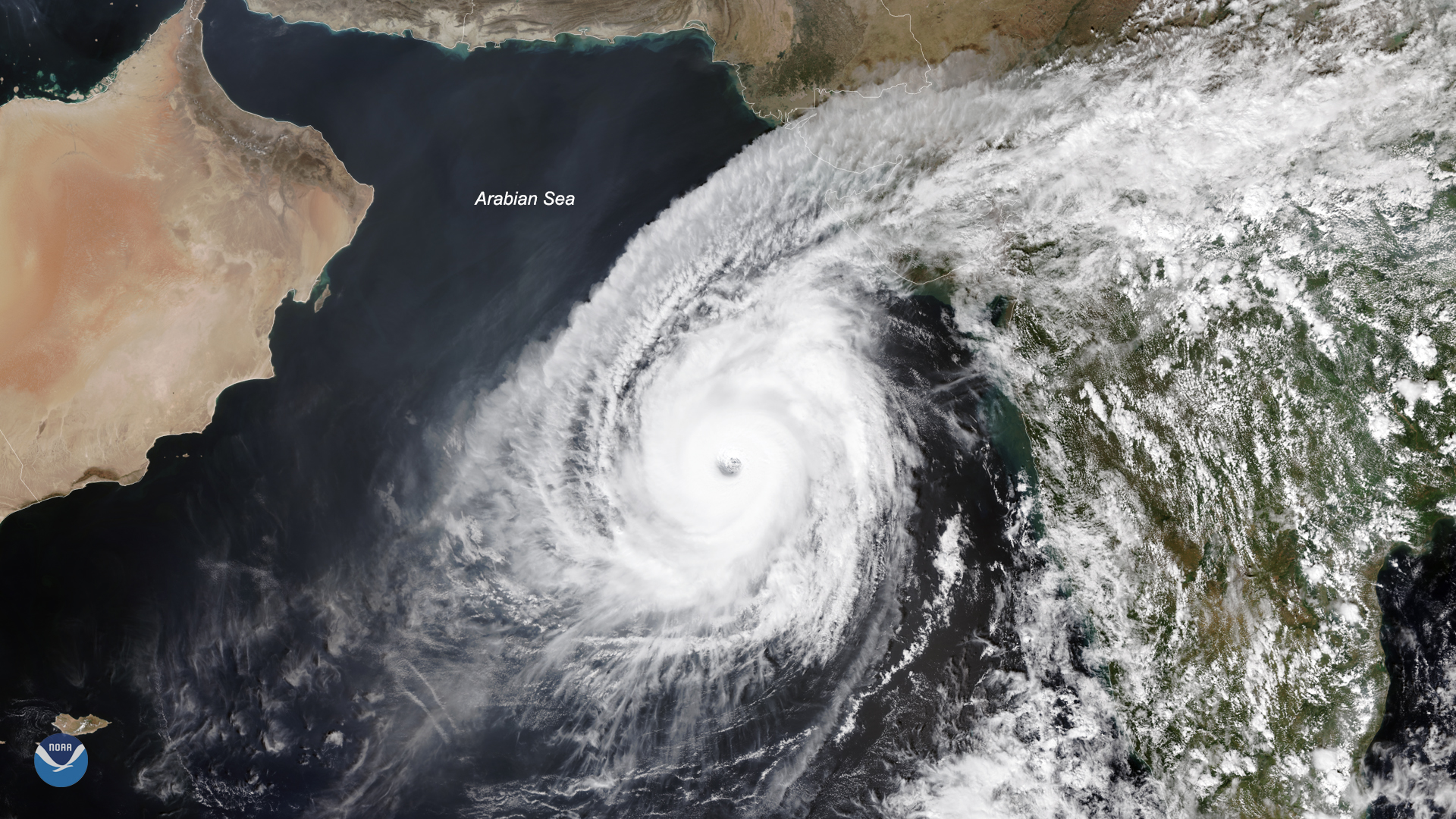
Download Image Download Image of the Super Cyclonic Storm Kyarr
A tropical cyclone that formed in the Arabian Sea near the coast of western India on Friday intensified into a super cyclonic storm on Sunday morning, according to the India Meteorological Department (IMD). This is the highest classification for storms of this kind used in the north Indian Ocean, which possess hurricane-force winds above 138 mph.
Kyarr is the first super cyclone that has formed over the Arabian Sea since Super Cyclonic Storm Gonu in 2007. It also has the lowest pressure since Super Cyclonic Storm Odisha in 1999, according to lead international forecaster at AccuWeather, Jason Nicholls. Gonu, the strongest tropical cyclone on record over the Arabian Sea to date, had 3-minute maximum sustained wind speeds of 146 mph and killed more than 70 people.
With maximum sustained wind speeds of 143 – 149 mph and gusts up to 184 mph, Kyarr may likely surpass Gonu and become the strongest on record for the area. The storm is continuing to strengthen as it moves west-northwestward over the water at a speed of roughly 7 mph, but is expected to weaken somewhat by the time it approaches eastern Oman by the middle of the week. Additionally, parts of India along the western coast may still experience some heavy rain, thunderstorms, and rough surf into Tuesday.
Philip Klotzbach, a meteorologist from Colorado State University, said the 2019 North Indian Ocean cyclone season has now generated more accumulated cyclone energy than any other north Indian Ocean cyclone season since records began in 1972.
This true-color image was captured by the VIIRS sensor on board the NOAA-20 satellite, which provides daily, high-resolution visible and infrared images of Earth's atmosphere from across the globe.
Where this page came from
This page was imported from NOAA Satellites (NESDIS). Published by NOAA's National Environmental Satellite, Data, and Information Service and, as a work of the United States government, in the public domain; pictures credited elsewhere are left out.
Nobody has written it yet — it is the source material at a new address, which is why search engines are asked to skip it and why no one earns from it. It is up for grabs: take it on, and it is yours to rewrite and to earn from.
Licence: CC0 1.0 (public domain) · Adapted from www.nesdis.noaa.gov
1
0
0
0

Comments