This page is public.
In The Devonshire Manuscript · page 111 of 215
| 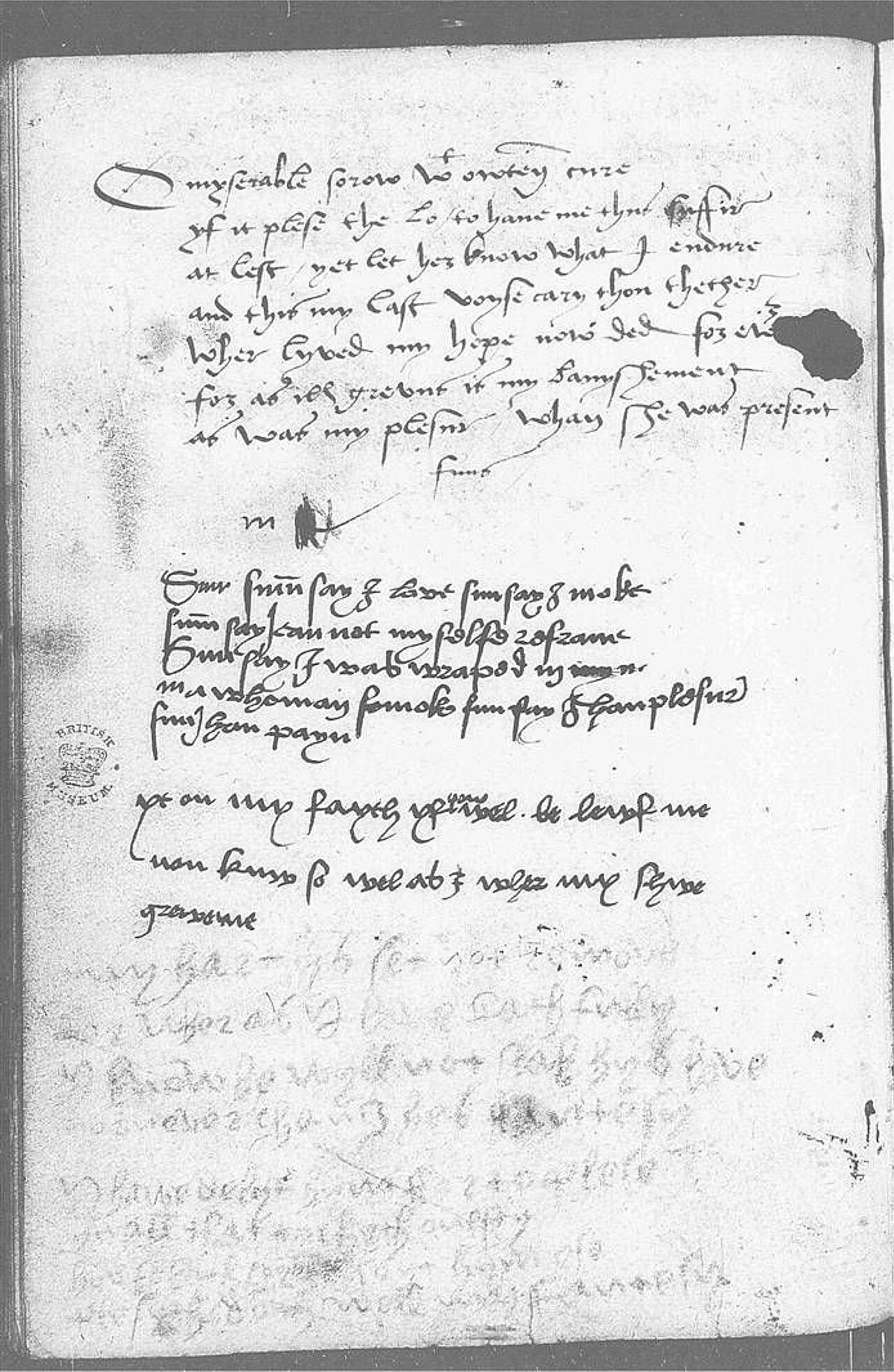
The Devonshire Manuscript facsimile 58v (Image: DMSEG, CC BY-SA 3.0) |
| --- |
|---|
f. [58v]
1 O myserable sorow with{w+t+}owten cure
2 yf it plese the lo / to haue me thus suffir
3 at lest / yet let her know what I endure
4 and this my last voyse cary thou thether
5 wher lyved my hope now ded foreer{w+r+}1, 2
6 for as ill grevus is my banyshement
7 as was my plesur whan she was present
finis
mh3, 4
Notes & Glosses
- A large inkblot follows the line, obscuring what may have been the written-out "er" of "forewer," which the scribe may have appended with the supralinear.
- The abbreviation is unique within the manuscript.
- The initials "MH" may refer to Lady Mary Howard. If so, her unmarried name is being used, offering a possible clue towards a time frame or an indication of her feelings.
- Consider the names of the two women as in "Madame margeret" (68r).
Commentary
Attributed to Sir Thomas Wyatt,1] this poem was entered by [H7. In the poem, the speaker laments his banishment from his beloved.
A light annotation appears in the left margin, “m h,” possibly entered by Margaret Douglas. An unknown hand also enters the same initials beneath the poem, but these could be linked to the following poem (or to neither). The initials might refer to Margaret Douglas's betrothed name “Howard” as a bold assertion of her solidarity with Thomas Howard, who was imprisoned because of their relationship. Alternatively, the initials might refer to Mary Howard's support of the beleaguered couple. By using her maiden name to associate herself to her brother Thomas Howard, Mary distances herself from her husband Henry Fitzroy (an illegitimate son of Henry VIII). The initials “mar h” also appear at the end of "Wyth sorowful syghes and wondes smart" (26v).
Works Cited
Where this page came from
This page was imported from Wikibooks. From “The Devonshire Manuscript” on Wikibooks, by its contributors, under CC BY-SA 4.0. Changed here: set as a page; navigation and edit links left out; each image under its own licence, credited in its caption.
Nobody has written it yet — it is the source material at a new address, which is why search engines are asked to skip it and why no one earns from it. It is up for grabs: take it on, and it is yours to rewrite and to earn from.
In these publicationsThe Devonshire Manuscript
Licence: CC BY-SA 4.0 · Adapted from en.wikibooks.org
Comments