
This page is public.
In Chemistry (OpenStax) · page 86 of 114
Learning Objectives
By the end of this section, you will be able to:
- Relate cell potentials to free energy changes
- Use the Nernst equation to determine cell potentials at nonstandard conditions
- Perform calculations that involve converting between cell potentials, free energy changes, and equilibrium constants
We will now extend electrochemistry by determining the relationship between {E}_{\text{cell}}^{°} and the thermodynamics quantities such as ΔG° (Gibbs free energy) and K (the equilibrium constant). In galvanic cells, chemical energy is converted into electrical energy, which can do work. The electrical work is the product of the charge transferred multiplied by the potential difference (voltage):
\text{electrical work} = \text{volts} \ × \ ( \text{charge in coulombs} ) = \text{J}17.76
The charge on 1 mole of electrons is given by Faraday’s constant (F)
F = \ \frac{6.022 \ × \ {10}^{23} {\text{e}}^{\text{−}}}{\text{mol}} \ × \ \frac{1.602 \ × \ {10}^{− 19} \ \text{C}}{{\text{e}}^{\text{−}}} \ = 9.648 \ × \ {10}^{4} \frac{\text{C}}{\text{mol}} \ = 9.648 \ × \ {10}^{4} \frac{\text{J}}{\text{V·mol}}17.77
\text{total charge} = {( \text{number of moles of e}}^{\text{−}} ) \ × \ F = n F17.78
In this equation, n is the number of moles of electrons for the balanced oxidation-reduction reaction. The measured cell potential is the maximum potential the cell can produce and is related to the electrical work (wele) by
{E}_{\text{cell}} = \ \frac{− {w}_{\text{ele}}}{n F} \ \text{or} \ {w}_{\text{ele}} = \text{−} n F {E}_{\text{cell}}17.79
The negative sign for the work indicates that the electrical work is done by the system (the galvanic cell) on the surroundings. In an earlier chapter, the free energy was defined as the energy that was available to do work. In particular, the change in free energy was defined in terms of the maximum work (wmax), which, for electrochemical systems, is wele.
\text{Δ} G = {w}_{\text{max}} = {w}_{\text{ele}}17.80
\text{Δ} G = \text{−} n F {E}_{\text{cell}}17.81
We can verify the signs are correct when we realize that n and F are positive constants and that galvanic cells, which have positive cell potentials, involve spontaneous reactions. Thus, spontaneous reactions, which have ΔG < 0, must have Ecell > 0. If all the reactants and products are in their standard states, this becomes
\text{Δ} G \text{°} = \text{−} n F {E}_{\text{cell}}^{°}17.82
This provides a way to relate standard cell potentials to equilibrium constants, since
\text{Δ} G \text{°} = \text{−} R T \ \text{ln} \ K17.83
\text{−} n F {E}_{\text{cell}}^{°} = \text{−} R T \ \text{ln} \ K \ \text{or} \ {E}_{\text{cell}}^{°} = \ \frac{R T}{n F} \ \text{ln} \ K17.84
Most of the time, the electrochemical reactions are run at standard temperature (298.15 K). Collecting terms at this temperature yields
{E}_{\text{cell}}^{°} = \ \frac{R T}{n F} \ \text{ln} \ K = \ \frac{( 8.314 \frac{\text{J}}{\text{K·mol}} ) ( 298.15 K )}{n \ × \ \text{96,485 C/V·mol}} \ \text{ln} \ K = \ \frac{\text{0.0257 V}}{n} \ \text{ln} \ K17.85
where n is the number of moles of electrons. For historical reasons, the logarithm in equations involving cell potentials is often expressed using base 10 logarithms (log), which changes the constant by a factor of 2.303:
{E}_{\text{cell}}^{°} = \ \frac{0.0 \text{592 V}}{n} \ \text{log} \ K17.86
Thus, if ΔG°, K, or {E}_{\text{cell}}^{°} is known or can be calculated, the other two quantities can be readily determined. The relationships are shown graphically in Figure 17.9.
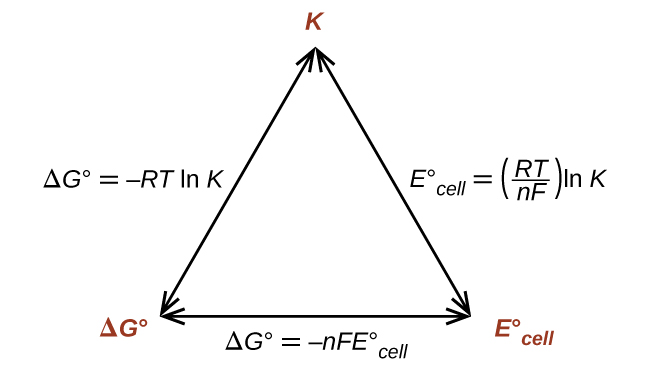
Figure 17.9. The relationships between Δ G °, K , and {E}_{\text{cell}}^{°} . Given any one of the three quantities, the other two can be calculated, so any of the quantities could be used to determine whether a process was spontaneous.
Given any one of the quantities, the other two can be calculated.
Example
17.5
Equilibrium Constants, Standard Cell Potentials, and Standard Free Energy Changes
What is the standard free energy change and equilibrium constant for the following reaction at 25 °C?
2 {\text{Ag}}^{\text{+}} ( a q ) + \text{Fe} ( s ) ⇌ \text{2Ag} ( s ) + {\text{Fe}}^{2+} ( a q )17.87
Solution
The reaction involves an oxidation-reduction reaction, so the standard cell potential can be calculated using the data in Appendix L.
\begin{matrix} \\ \text{anode (oxidation):} \ \text{Fe} ( s ) \ ⟶ \ {\text{Fe}}^{2+} ( a q ) + {\text{2e}}^{\text{−}} \ {E}_{{\text{Fe}}^{2+} \text{/Fe}}^{°} = \text{−0.447 V} \\ \text{cathode (reduction):} \ 2 \ × \ ( {\text{Ag}}^{\text{+}} ( a q ) + {\text{e}}^{\text{−}} \ ⟶ \ \text{Ag} ( s ) ) \ {E}_{{\text{Ag}}^{\text{+}} \text{/Ag}}^{°} = \text{0.7996 V} \\ {E}_{\text{cell}}^{°} = {E}_{\text{cathode}}^{°} − {E}_{\text{anode}}^{°} = {E}_{{\text{Ag}}^{\text{+}} \text{/Ag}}^{°} − {E}_{{\text{Fe}}^{2+} \text{/Fe}}^{°} = \text{+1.247 V}\end{matrix}17.88
Remember that the cell potential for the cathode is not multiplied by two when determining the standard cell potential. With n = 2, the equilibrium constant is then
{E}_{\text{cell}}^{°} = \ \frac{\text{0.0592 V}}{n} \ \text{log} \ K17.89
K = {10}^{n \ × \ {E}_{\text{cell}}^{°} \text{/} \text{0.0592 V}}17.90
K = {10}^{2 \ × \ \text{1.247 V/0.0592 V}}17.91
K = {10}^{42.128}17.92
K = 1.3 \ × \ {10}^{42}17.93
The standard free energy is then
\text{Δ} {G}^{°} = \text{−} n F {E}_{\text{cell}}^{°}17.94
\text{Δ} G \text{°} = −2 \ × \ 96,485 \ \frac{\text{J}}{\text{V·mol}} \ × \ \text{1.247 V} = −240.6 \ \frac{\text{kJ}}{\text{mol}}17.95
Check your answer: A positive standard cell potential means a spontaneous reaction, so the standard free energy change should be negative, and an equilibrium constant should be >1.
Check Your Learning
What is the standard free energy change and the equilibrium constant for the following reaction at room temperature? Is the reaction spontaneous?
\text{Sn} ( s ) + 2 {\text{Cu}}^{2+} ( a q ) ⇌ {\text{Sn}}^{2+} ( a q ) + 2 {\text{Cu}}^{\text{+}} ( a q )17.96
Answer:
Spontaneous; n = 2; {E}_{\text{cell}}^{°} = \text{+0.291 V} ; \text{Δ} G \text{°} = −56.2 \ \frac{\text{kJ}}{\text{mol}} ; K = 6.8 × 10⁹.
Now that the connection has been made between the free energy and cell potentials, nonstandard concentrations follow. Recall that
\text{Δ} G = \text{Δ} G \text{°} + R T \ \text{ln} \ Q17.97
where Q is the reaction quotient (see the chapter on equilibrium fundamentals). Converting to cell potentials:
\text{−} n F {E}_{\text{cell}} = \text{−} n F {E}_{\text{cell}}^{°} + R T \ \text{ln} \ Q \ \text{or} \ {E}_{\text{cell}} = {E}_{\text{cell}}^{°} − \ \frac{R T}{n F} \ \text{ln} \ Q17.98
This is the Nernst equation. At standard temperature (298.15 K), it is possible to write the above equations as
{E}_{\text{cell}} = {E}_{\text{cell}}^{°} − \ \frac{0.0 \text{257 V}}{n} \ \text{ln} \ Q \ \text{or} \ {E}_{\text{cell}} = {E}_{\text{cell}}^{°} − \ \frac{\text{0.0592 V}}{n} \ \text{log} \ Q17.99
If the temperature is not 298.15 K, it is necessary to recalculate the value of the constant. With the Nernst equation, it is possible to calculate the cell potential at nonstandard conditions. This adjustment is necessary because potentials determined under different conditions will have different values.
Example
17.6
Cell Potentials at Nonstandard Conditions
Consider the following reaction at room temperature:
\text{Co} ( s ) + {\text{Fe}}^{2+} ( a q , \ 1.94 \ M ) \ ⟶ \ {\text{Co}}^{2+} ( a q \text{, 0.15} \ M ) + \text{Fe} ( s )17.100
Is the process spontaneous?
Solution
There are two ways to solve the problem. If the thermodynamic information in Appendix G were available, you could calculate the free energy change. If the free energy change is negative, the process is spontaneous. The other approach, which we will use, requires information like that given in Appendix L. Using those data, the cell potential can be determined. If the cell potential is positive, the process is spontaneous. Collecting information from Appendix L and the problem,
\begin{matrix} \\ \text{Anode (oxidation):} \ \text{Co} ( s ) \ ⟶ \ {\text{Co}}^{2+} ( a q ) + {\text{2e}}^{\text{−}} \ {E}_{{\text{Co}}^{2+} \text{/Co}}^{°} = \text{−0.28 V} \\ \text{Cathode (reduction):} \ {\text{Fe}}^{2+} ( a q ) + {\text{2e}}^{\text{−}} \ ⟶ \ \text{Fe} ( s ) \ {E}_{{\text{Fe}}^{2+} \text{/Fe}}^{°} = \text{−0.447 V} \\ {E}_{\text{cell}}^{°} = {E}_{\text{cathode}}^{°} − {E}_{\text{anode}}^{°} = \text{−0.447 V} − ( \text{−0.28 V} ) = \text{−0.17 V}\end{matrix}17.101
The process is not spontaneous under standard conditions. Using the Nernst equation and the concentrations stated in the problem and n = 2,
Q = \ \frac{{[ \text{Co}}^{2+} ]}{{[ \text{Fe}}^{2+} ]} \ = \ \frac{0.15 \ M}{1.94 \ M} \ = 0.07717.102
{E}_{\text{cell}} = {E}_{\text{cell}}^{°} − \ \frac{0.0592 V}{n} \ \text{log} \ Q17.103
{E}_{\text{cell}} = −0.1 \text{7 V} − \ \frac{0.0592 V}{2} \ \text{log} \ 0.07717.104
{E}_{\text{cell}} = \text{−0.17 V} + 0.033 V = −0.014 V17.105
The process is (still) nonspontaneous.
Check Your Learning
What is the cell potential for the following reaction at room temperature?
\text{Al} ( s ) │ {\text{Al}}^{3+} ( a q , \ 0.15 \ M ) ║ {\text{Cu}}^{2+} ( a q , \ 0.025 \ M ) │ \text{Cu} ( s )17.106
What are the values of n and Q for the overall reaction? Is the reaction spontaneous under these conditions?
Answer:
n = 6; Q = 1440; Ecell = +1.97 V, spontaneous.
Finally, we will take a brief look at a special type of cell called a concentration cell. In a concentration cell, the electrodes are the same material and the half-cells differ only in concentration. Since one or both compartments is not standard, the cell potentials will be unequal; therefore, there will be a potential difference, which can be determined with the aid of the Nernst equation.
Example
17.7
Concentration Cells
What is the cell potential of the concentration cell described by
\text{Zn} ( s ) │ {\text{Zn}}^{2+} ( a q \text{, 0.10} \ M ) ║ {\text{Zn}}^{2+} ( a q \text{, 0.50} \ M ) │ \text{Zn} ( s )17.107
Solution
From the information given:
\begin{matrix} \\ {\begin{matrix}\text{Anode:} \ \text{Zn} ( s ) \ ⟶ \ {\text{Zn}}^{2+} ( a q \text{, 0.10} \ M ) + {\text{2e}}^{\text{−}} \ {E}_{\text{anode}}^{°} = \text{−0.7618 V} \\ \text{Cathode:} \ {\text{Zn}}^{2+} ( a q \text{, 0.50} \ M ) + {\text{2e}}^{\text{−}} \ ⟶ \ \text{Zn} ( s ) \ {E}_{\text{cathode}}^{°} = \text{−0.7618 V}\end{matrix}}_{¯} \\ \text{Overall:} \ {\text{Zn}}^{2+} ( a q \text{, 0.50} \ M ) \ ⟶ \ {\text{Zn}}^{2+} ( a q \text{, 0.10} \ M ) \ {E}_{\text{cell}}^{°} = \text{0.000 V}\end{matrix}17.108
The standard cell potential is zero because the anode and cathode involve the same reaction; only the concentration of Zn2+ changes. Substituting into the Nernst equation,
{E}_{\text{cell}} = \text{0.000 V} − \ \frac{\text{0.0592 V}}{2} \ \text{log} \ \frac{0.10}{0.50} \ = +0.021 V17.109
and the process is spontaneous at these conditions.
Check your answer: In a concentration cell, the standard cell potential will always be zero. To get a positive cell potential (spontaneous process) the reaction quotient Q must be <1. Q < 1 in this case, so the process is spontaneous.
Check Your Learning
What value of Q for the previous concentration cell would result in a voltage of 0.10 V? If the concentration of zinc ion at the cathode was 0.50 M, what was the concentration at the anode?
Answer:
Q = 0.00042; [Zn2+]cat = 2.1 × 10⁻⁴ M.
Where this page came from
This page was imported from OpenStax, Chemistry. Section 17.4 of Chemistry by Paul Flowers, William R. Robinson, PhD, Richard Langley, Klaus Theopold, published by OpenStax (Rice University) under CC BY 4.0; the book is free at openstax.org. Changed here: set as a page on its own.
Nobody has written it yet — it is the source material at a new address, which is why search engines are asked to skip it and why no one earns from it. It is up for grabs: take it on, and it is yours to rewrite and to earn from.
In these publicationsChemistry (OpenStax)
Licence: CC BY 4.0 · Adapted from openstax.org
Comments