Download Image Download Image of the earth
The 2018 summer solstice occurred at 6:07 a.m. Eastern Time on June 21, marking the longest day of the year and the first day of astronomical summer in Earth's northern hemisphere. The June solstice is the exact moment each year when the Northern Hemisphere reaches its greatest possible tilt toward the sun. The sun's direct rays reach their northernmost position with respect to Earth's equator, along the Tropic of Cancer, at 23.5°N latitude.
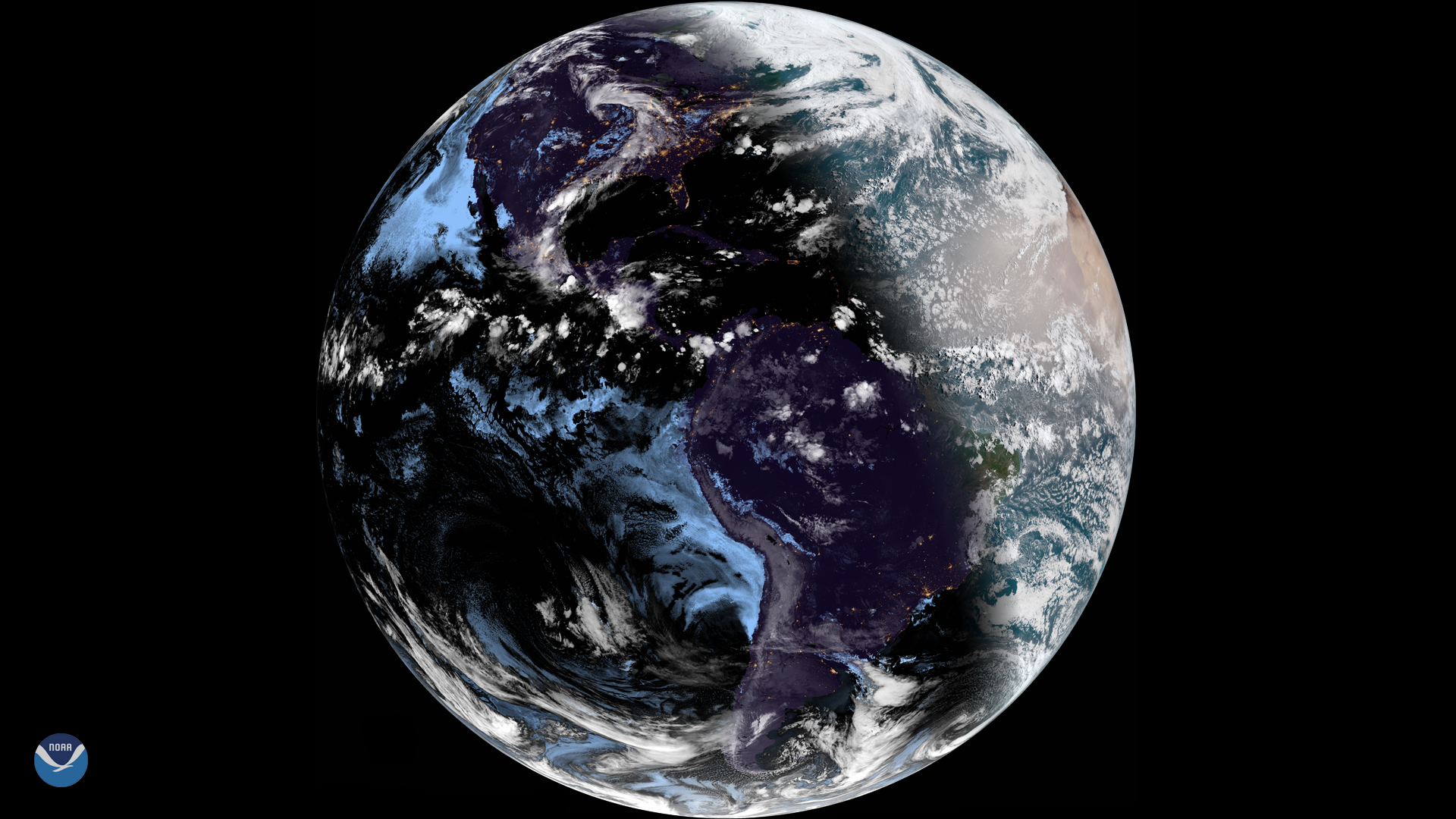
This visible imagery, captured by the GOES East (GOES-16) satellite on June 21, 2018, shows the pattern of Earth's illumination by the sun just before the solstice. Notice how the daylight terminator, the shadow that separates day and night across Earth, appears highly slanted. As the Earth rotates on its axis, the North Pole basks in 24-hour daylight, while the South Pole is obscured in darkness. The opposite occurs at each pole in December, when the Northern Hemisphere sees its shortest day and longest night of the year.
Although the amount of solar radiation reaching Earth peaks at the summer solstice on June 21 in the Northern Hemisphere, temperatures for most of the United States (and other countries north of the equator) tend to keep increasing into July. The temperature increase occurs because the rate of heat input from the sun during the day continues to be greater than the cooling at night for several weeks. Not until late July and early August do temperatures slowly start to descend.
A map from NOAA's National Centers for Environmental Information shows how the date of the hottest day of the year across the U.S. varies by geographic region. On average, the East Coast is warmest in mid-July, while temperatures don't peak until late August or even September along parts of the West Coast.
Where this page came from
This page was imported from NOAA Satellites (NESDIS). Published by NOAA's National Environmental Satellite, Data, and Information Service and, as a work of the United States government, in the public domain; pictures credited elsewhere are left out.
Nobody has written it yet — it is the source material at a new address, which is why search engines are asked to skip it and why no one earns from it. It is up for grabs: take it on, and it is yours to rewrite and to earn from.
Licence: CC0 1.0 (public domain) · Adapted from www.nesdis.noaa.gov
1
0
0
0

Comments