
A COORDINATED EFFORT
Coordination among agencies and organizations is an integral part of the NAWQA Program. We want to acknowledge the significant contribution by members of these organizations through their regular participation in the study liaison committee:
Federal and Interstate Organizations U.S. Fish and Wildlife Service U.S. Environmental Protection Agency New England Interstate Water Pollution Control Commission Connecticut River Joint River Commission (New Hampshire, Vermont)
State Agencies Connecticut Department of Environmental Protection Massachusetts Department of Environmental Protection New Hampshire Department of Environmental Services Vermont Department of Environmental Conservation
Much appreciation is extended to several U.S. Geological Survey employees for their significant contributions to this report: Robert F. Breault, Jonathan Morrison, John R. Mullaney, Peter A. Steeves, and Britt O. Stock. Special appreciation is extended to volunteer Peter Mitchell for his help and support.
Illustrations by Luis E. Menoyo; Rerendered by Mark V. Bonito Edited by Linda S. Rogers Hardcopy manuscript prepared by Luis E. Menoyo; PDF version prepared by Mark V. Bonito
Front cover: The Connecticut River near Sunderland, Massachusetts; photograph by Peter A. Steeves Back cover: (left) White River near West Hartford, Vermont; photograph by Britt O. Stock;
MA-RI District Office 10 Bearfoot Road, Suite 6 Northborough, MA 01532
connect to the NAWQA Home Page using the Universal Resources Locator (URL): http://wwwrvares.er.usgs.gov/nawqa/nawqa_home.html
The Connecticut, Housatonic, and Thames River Basins Study Unit’s Home Page can be accessed at URL: http://mass1.er.usgs.gov or http://ma.water.usgs.gov
Private Organizations Pioneer Valley Planning Commission Middlesex County Soil and Water Conservation District
University of Massachusetts University of Connecticut
Connecticut River Watershed Council Housatonic River Valley Association Nature Conservancy River Watch Network
CONTENTS
National Water-Quality Assessment Program.................................................... 1
Summary of major issues and findings........ 2
Environmental setting and hydrologic conditions ................................................. 4
Major issues and findings:
Contaminants in streambed sediments and fish tissue ............................................. 6 Nutrients in surface water......................... 8 Pesticides in surface water ....................... 10 Pesticides in ground water ....................... 12 Volatile organic compounds in ground water ........................................ 14 Nitrate in ground water ............................. 16 Radon in ground water ............................. 17
Study design and data collection................. 22
Summary of compound detections and concentrations .......................................... 24
Box 25286 Denver, CO 80225–0286 NATIONAL WATER-QUALITY ASSESSMENT PROGRAM
of the implications to human and aquatic health and because of the significant costs associated with decisions involving land and water management, conservation, and regulation. In 1991, the U.S. Congress appropriated funds for the U.S. Geological Survey (USGS) to begin the National Water-Quality Assessment (NAWQA) Program to help meet the continuing need for sound, scientific information on the areal extent of the water-quality problems, how these problems are changing with time, and an understanding of the effects of human actions and natural factors on water-quality conditions.
The NAWQA Program is assessing the water-quality conditions of more than 50 of the Nation's largest river basins and aquifers, known as Study Units. Collectively, these Study Units cover about one-half of the United States and include sources of drinking water used by about 70 percent of the U.S. population. Comprehensive assessments of about one-third of the Study Units are ongoing at a given time. Each Study Unit is scheduled to be revisited every decade to evaluate changes in water-quality conditions. NAWQA assessments rely heavily on existing information collected by the USGS and many other agencies as well as the use of nationally consistent study designs and methods of sampling and analysis. Such consistency simultaneously provides information about the status and trends in water-quality conditions in a particular stream or aquifer and, more importantly, provides the basis to make comparisons among watersheds and improve our understanding of the factors that affect water-quality conditions regionally and nationally.
This report is intended to summarize major findings that emerged between 1992 and 1995 from the water-quality assessment of the Connecticut, Housatonic, and Thames River Basins Study Unit and to relate these findings to water-quality issues of regional and national concern. The information is primarily intended for those who are involved in water-resource management. Indeed, this report addresses many of the concerns raised by regulators, water-utility managers, industry representatives, and other scientists, engineers, public officials, and members of stakeholder groups who provided advice and input to the USGS during this NAWQA Study-Unit investigation. Yet, the information contained here may also interest those who simply wish to know more about the quality of water in the rivers and aquifers in the area where they live.
Robert M. Hirsch, Chief Hydrologist
U.S. Geological Survey Circular 1155
SUMMARY OF MAJOR ISSUES AND FINDINGS
Toxic contaminants have accumulated in some Study Unit streambed sediments and fish.
Concentrations of polychlorinated biphenyls (PCBs) in streambed sediments and fish in the Housatonic River were among some of the highest detected in NAWQA Study Units across the Nation. Concentrations of trace elements and organic contaminants in streambed sediment and fish generally were highest in the southern part of the Study Unit (Massachusetts and Connecticut). Because of the presence of these contaminants, fish consumption advisories have been issued for a number of rivers and lakes throughout the Study Unit. These advisories recommend limiting the number of fish of certain species that should be consumed by people, particularly by children and pregnant women.
Nutrient (nitrogen and phosphorus) concentrations are a concern for surface-water quality.
The large amount of nitrogen entering Long Island Sound from streams, precipitation, and coastal communities has stimulated algal blooms. Decay of the algae then produces low dissolved-oxygen conditions in the Sound, creating poor habitat for fish and other marine animals. Nitrogen and phosphorus concentrations are highest in urban streams, primarily because of wastewater discharges from sewage-treatment facilities.
Pesticides were frequently detected in Study Unit streams.
The herbicides atrazine, metolachlor, prometon, and simazine, and the insecticides diazinon and carbaryl were the most frequently detected compounds. Concentrations of atrazine, metolachlor, and simazine were highest in surface water draining from agricultural areas. Concentrations of prometon, diazinon, and carbaryl were highest in surface water draining from urban areas. However, current drinking-water standards were not exceeded. None of the pesticides were detected at concentrations greater than the U.S. Environmental Protection Agency’s maximum contaminant level (MCL) or the health advisory limit (HAL), and few pesticide concentrations exceeded 1 microgram per liter (1 μg/L). Current drinking-water standards, however, do not include some detected pesticides (or breakdown products), and do not include consideration of more than one pesticide in the water. Thus, the actual health concern posed by these results is somewhat uncertain.
Several classes of contaminants were detected in ground water.
These contaminants included pesticides, volatile organic compounds (VOCs), and nitrate. Twenty-four different pesticides (or their breakdown products) were detected in shallow ground water beneath the Study Unit. Atrazine, prometon, and simazine were the most commonly detected pesticides in ground water. VOCs were detected in 70 percent of the shallow ground-water samples collected in urban areas. Methyl tertbutyl ether (MTBE), a gasoline additive, was the most frequently detected VOC, and chloroform, a byproduct of water disinfection, was the second most frequently detected. Median nitrate concentrations in shallow ground water beneath agricultural fields (3.8 mg/L) were nearly 30 times higher than background concentrations (0.14 mg/L).
Water Quality in the Connecticut, Housatonic, and Thames River Basins, 1992-95
SUMMARY OF MAJOR ISSUES AND FINDINGS
Some contaminant MCLs were exeeded in ground water.
The pesticides atrazine and ethylene dibromide were detected at concentrations greater than their MCLs in a few samples collected from agricultural areas. The VOCs—tetrachloroethene, trichloroethene, benzene, and naphthalene—exceeded their MCLs in some samples collected from urban areas. Nitrate concentrations exceeded the MCL in 15 percent of the samples of shallow ground water collected in agricultural areas.
Radon is present in ground water across the Study Unit.
Radon is a naturally occurring, colorless, odorless radioactive gas derived from uranium. Exposure to radon has been recognized as a health risk, primarily as a cause of lung cancer. Radon concentrations exceeded the previously proposed limit of 300 picocuries per liter in 97 percent of water samples collected from bedrock supply wells, and in 88 percent of water samples collected from the shallow monitoring wells in the Study Unit.
U.S. Geological Survey Circular 1155
ENVIRONMENTAL SETTING AND HYDROLOGIC CONDITIONS

All streams in the Study Unit flow to Long Island Sound, with a combined drainage area of nearly 16,000 square miles.
The Connecticut, Housatonic, and Thames River Basins Study Unit, 15,760 square miles in extent, includes eastern Vermont, western New Hampshire, west-central Massachusetts, nearly all of Connecticut, and small parts of New York, Rhode Island, and the Province of Quebec, Canada. Altitudes in the Study Unit range from sea level in coastal Connecticut to 6,288 feet at the peak of Mount Washington in the White Mountains of New Hampshire. The population in the Study Unit is about 4.5 million people, about 2 percent of the Nation’s population. Population density varies from the sparsely populated, rural agrarian and wilderness areas of northern Vermont and New Hampshire to the densely populated urban areas of southwestern Connecticut and the southcentral part of the Connecticut River Valley. Most of the area is forested undeveloped land, agriculture covers about 12 percent of the total area of the Study Unit, and urban areas cover about 8 percent of the Study Unit. All major cities, including Hartford, Springfield, Bridgeport, and New Haven, are in the southern part of the area. Total freshwater use in the Study Unit during 1990 was estimated to be about 2,300 Mgal/d (million gallons per day). The dominant surface-water use is for thermoelectric power generation, and the next largest use is for public supply. Ground water supplied about 12 percent (270 Mgal/d) of the freshwater used in the Study Unit. Ground water is used primarily for public supply and self-supplied domestic use. Discharges of treated sewage, amounting to about 520 Mgal/d, are released from 145 wastewater-treatment facilities, most of which are in the densely populated southern part of the area. The climate in the Connecticut, Housatonic, and Thames River Basins generally is temperate and humid. Mean annual precipitation averages about 43 inches over the entire Study Unit but ranges from about 34 inches at places in the northern end of the Connecticut River Valley to more than 65 inches in adjacent mountainous regions. In general, average precipitation is evenly distributed throughout the year. Precipitation generally was close to average during 1992-95, with a slightly dry condition from March through June 1995.

All streams in the Study Unit flow to Long Island Sound, with a combined drainage area of nearly 16,000 square miles.
Water Quality in the Connecticut, Housatonic, and Thames River Basins, 1992-95.
ENVIRONMENTAL SETTING AND HYDROLOGIC CONDITIONS
The Connecticut River is the principal river in the Study Unit, extending about 400 miles from its source in northern New Hampshire to the mouth at Old Saybrook, Connecticut, on Long Island Sound. The drainage area of the Connecticut River is 11,260 square miles, or about 72 percent of the Study Unit; average discharge at the mouth of the river is estimated to be 19,200 cubic feet per second. The Connecticut River is heavily regulated, with at least 125 reservoirs within the basin used for power generation and 16 flood-control reservoirs. Other major streams include the Housatonic and Thames Rivers, which together drain 3,420 square miles, or about 20 percent of the Study Unit. Average monthly discharge for an unregulated stream (that is, not dammed) show that peak streamflow generally is in late winter and early spring, but discharges in mid-1995 were uniformly lower than average because of below-average precipitation. The average annual discharge for the Connecticut River in 1995 was the sixth lowest discharge for 1930-95 owing to the dry conditions that year. The aquifers that yield the most water in the Study Unit are sand and gravel deposits within the glacial stratified drift that fills many of the valleys in the region. Water levels in wells are typically at their highest elevations in early spring and lowest elevations in late summer. Ground-water levels generally were close to average during 1992-95 but were slightly lower during mid-1995 as a result of the dry conditions that year.

Discharge in Study Unit streams without dams is highest in the spring and lowest in late summer. Note the effect of decreased precipitation on discharge in 1995.

About 80 percent of all freshwater used in the Study Unit is from surface sources. Most of this water is used for cooling in thermoelectric power generation and for public supply.


Precipitation was close to average during 1992-95, except for slightly dry conditions in spring 1995.
U.S. Geological Survey Circular 1155
Toxic contaminants have accumulated in some Study Unit streambed sediments and fish
Samples collected at selected sites show that toxic contaminants have accumulated in streambed sediment and fish in many parts of the Study Unit (Coles, 1996; Breault and Harris, 1997). These are contaminants that do not easily dissolve in water but instead tend to accumulate in streambed sediments and aquatic animals. The most common contaminants detected in bed sediment were the trace elements chromium, copper, lead, mercury, nickel, and zinc, and the organic compounds chlordane, dichlorodiphenyltrichloroethane (DDT), polychlorinated biphenyls (PCBs), and polycyclic aromatic hydrocarbons (PAHs). The most commonly detected organic compounds detected in whole fish samples included chlordane, DDT (and its breakdown product DDE), and PCBs. These trace elements and organic compounds are on the U.S. Environmental Protection Agency’s Priority Pollutant List and have been given high priority in water-quality monitoring and pollution abatement programs. Trace elements and organic compounds in streambed sediments and fish generally were detected at lowest concentrations in the northern forested drainage basins and at highest concentrations in the southern urban drainage basins because of an increased number of sources in the southern basins. In addition, streams that drain large basins typically had more frequent detections of toxic contaminants because these streams generally drain large urban areas, providing more potential contaminant sources. The highest percentages of trace-element concentrations exceeding naturally occurring concentrations were in samples collected from streambed sediments in the Thames River Basin. The highest percentages of organic-compound detections were in streambed
Water Quality in the Connecticut, Housatonic, and Thames River Basins, 1992-95
sediments from smaller streams that drain to Long Island Sound. Concentrations of PCBs in streambed sediments and fish in the Housatonic River are some of the highest for NAWQA Study Units in the Nation; several of these concentrations exceeded 10,000 parts per billion. Aquatic organisms can concentrate contaminants, and adverse effects on bottom-dwelling organisms (for example, aquatic insects, clams, crayfish) can be related to elevated trace-element and organic-compound concentrations in streambed sediments (Breault and Harris, 1997). Adverse effects can include decreased numbers of species and death of contaminant-sensitive species (Ecosystem Conservation Directorate, 1995). Trace elements represent the most geographically widespread concern to aquatic organisms, exceeding sedimentquality guidelines over a wider geographical area than the organic compounds. However, some organic compounds (chlordane and PCBs) pose the greatest biological concern in terms of exceeding sedimentquality aquatic life guidelines; they are present at sufficiently high concentrations to cause severe effects at several locations in the Study Unit (see map at right). Once bottom-dwelling organisms have become contaminated, they become a source of contaminants to fish. Many of the contaminants are readily stored in the fatty tissue of fish where they tend to accumulate. Fish-eating mammals and birds can then consume the contaminated fish, and so pass contaminants up the food chain. National Academy of Science and National Academy of Engineering guidelines (1973) for fish tissue, issued for the protection of fish-eating wildlife, were exceeded at many sampling sites because of high concentrations of PCBs, total chlordane, and dieldrin (see map at right). Contaminants in fish tissue are a concern not only because of hazards to wildlife but also because of human health concerns. U.S. Environmental Protection Agency guidelines and U.S. Food and Drug Administration standards have been established for contaminant concentrations in fish tissue for human consumption. The possible risks to human health through the consumption of contaminated fish have resulted in advisories to restrict the consumption of some species of fish in the Study Unit. These advisories recommend limiting the number of fish of certain species that are consumed by people, particularly by children and pregnant women. Fish consumption advisories now in effect include those issued for mercury contamination in Connecticut (Department of Environmental Protection, 1994, 1996), Massachusetts (Department
CONTAMINANTS IN STREAMBED SEDIMENTS AND FISH TISSUE
of Environmental Protection, 1995), New Hampshire (Department of Environmental Services, 1996) and Vermont (Department of Environmental Conservation, 1996). Other consumption advisories include those issued for selected fish species from specific stream reaches because of contamination by PCB. These stream reaches include lengths along the Connecticut, Housatonic, Millers, and Otter Rivers in Massachusetts, (Department of Environmental Protection, 1995); and the Connecticut and Housatonic
U.S. Geological Survey Circular 1155
MAJOR ISSUES AND FINDINGS
Rivers in Connecticut (Connecticut Department of Environmental Protection, 1994). Information on fish consumption advisories is available in pamphlets distributed with fishing licenses and on signs posted along affected stream reaches.
Nutrient (nitrogen and phosphorus) concentrations are a concern for surface-water quality
Streams, lakes, and estuaries in the Study Unit have been adversely affected by eutrophication caused by above-background nutrient concentrations, primarily downstream from major urban wastewater-treatment facilities. Nutrients are compounds containing nitrogen and phosphorus. Nutrients in streams are derived from natural sources and human activities, including decaying plants, animal wastes, fertilizers, municipal and industrial wastewater, and atmospheric deposition. Many of these nutrient sources are quite large; for example, about 58 million pounds of nitrogen and 11 million pounds of phosphorus are applied each year as chemical fertilizer and manure in the Study Unit . Although nitrogen and phosphorus are essential for plant growth, high concentrations of these nutrients can cause eutrophication, a condition in which aquatic plant and algal growth is excessive. Decomposition of the plants and algae reduces dissolved-oxygen concentrations in the water, creating poor habitat for fish and other aquatic animals. In addition, nitrogen in the form of ammonia can be toxic to aquatic life, the toxicity level depending on the temperature and pH of the water. Nitrogen and phosphorus compounds have different effects in freshwater and saltwater bodies. Nitrogen concentrations are rarely low enough to limit aquatic plant growth in fresh-water, whereas phosphorus concentrations generally are low enough to limit plant growth. Hence, excessive aquatic plant growth and eutrophication in freshwater generally result from high phosphorus concentrations (typically greater than 0.1 mg/L). In
Water Quality in the Connecticut, Housatonic, and Thames River Basins, 1992-95
contrast, nitrogen is typically the limiting nutrient for aquatic plant growth in saltwater, and excess nitrogen can lead to algal blooms and low concentrations of dissolved oxygen in coastal waters. For example, Long Island Sound ultimately receives all the water (and wastewater) from streams in the Study Unit, and algal blooms created by excess nutrients have caused low concentrations of dissolved oxygen and poor habitat for fish and other marine animals in the sound (U.S. Environmental Protection Agency, 1997).
Land use and nutrient concentrations in streams are related
Nutrient concentrations are substantially higher in streams draining urban areas than in streams draining either agricultural or forested areas in the Study Unit (Zimmerman and others, 1996). The median concentration of nitrate in water samples from urban streams was more than twice that of streams in agricultural areas and more than 10 times that in streams draining forested areas. Ammonia and phosphorus concentrations are much higher in urban water-quality samples than in samples from either agricultural or forested areas. The median phosphorus concentration for urban streams was three times that of streams in agricultural areas and nine times the median for streams in forested areas (see graph at right). Wastewater-treatment facilities are major sources of nutrients in surface water in urban areas. Nutrient concentrations at four urban-area streams sampled as part of the NAWQA program were examined to determine the effect of wastewater in these streams. Median concentrations of ammonia, nitrate, and total phosphorus for two streams with wastewater effluent greater than 10 percent of the flow at the sampling site were from 2 to more than 10 times the median concentrations for two urban streams without large upstream wastewater discharges. The median nutrient concentrations at the urban streams without large upstream wastewater discharges were comparable to stream concentrations in agricultural areas. The highest nitrate concentration (10 mg/L) measured in surface water during this study was collected from a station downstream from a wastewater-treatment facility. In contrast, the highest concentration of nitrate detected in an agricultural-area stream was one-half the highest concentration detected in an urban-area stream.

Concentrations of nitrogen and phosphorus are substantially higher in streams draining urban areas than in streams draining either agricultural or forested areas.
Nutrient concentrations are changing with time
Nitrate concentrations in streams commonly increased during 1980- 92, whereas ammonia and total phosphorus concentrations commonly decreased (Zimmerman, 1997). Decreases in ammonia concentrations were generally associated with increases in nitrate


Concentrations of nutrients in Connecticut from 1980 to 1992 were generally unchanged for total nitrogen, increased for nitrate, and decreased for ammonia and phosphorus. These changes were primarily the result of more effective wastewater treatment, which has significantly improved the water quality in streams over this period (Zimmerman, 1997).

Concentrations of nutrients in Connecticut from 1980 to 1992 were generally unchanged for total nitrogen, increased for nitrate, and decreased for ammonia and phosphorus. These changes were primarily the result of more effective wastewater treatment, which has significantly improved the water quality in streams over this period (Zimmerman, 1997).
NUTRIENTS IN SURFACE WATER
concentrations, resulting primarily from improved wastewater-treatment processes, which convert ammonia to nitrate (Trench, 1996). Decreases in total phosphorus concentrations also are likely due to improvements in wastewater treatment and to the elimination or reduction of phosphate in detergents. Although more effective wastewater treatment has improved surface-water-quality conditions in many parts of the Study Unit, the
U.S. Geological Survey Circular 1155
MAJOR ISSUES AND FINDINGS
total amount of nutrients (particularly nitrogen) discharged to Long Island Sound is still considered an environmental concern (U.S. Environmental Protection Agency, 1997). The MCL for nitrate (10 mg/L as N) was rarely exceeded in the Study Unit, indicating that nutrient concentrations generally are not a concern for surface-water supplies used for drinking water.
Pesticides were frequently detected in Study Unit streams
Nationally, more than 1.1 billion pounds of pesticides are applied each year to control rodents, insects and grubs, weeds, fungi, and other pests in urban centers, suburbs, rural communities, and farms. The occurrence and distribution of pesticides in water draining from various land-use types were investigated as part of the NAWQA program by collecting and analyzing samples from 56 stream sites across the Study Unit. Streams were sampled after spring applications of pesticides and during low-flow conditions (late summer). The pesticides most frequently detected in streams in the Study Unit include the herbicides atrazine, metolachlor, simazine, and prometon. Atrazine and metolachlor are used for selective weed control, typically in the cultivation of feed corn, which is grown in New England primarily

Water Quality in the Connecticut, Housatonic, and Thames River Basins, 1992-95

The concentrations of most common herbicides were highest in streams draining agricultural areas in the Study Unit, whereas concentrations of most common insecticides were highest in urban-area streams.
prometon is a broad-band (nonselective) weed control commonly used along highways and railroads. Other commonly detected pesticides included the insecticides diazinon (for crops and home applications) and carbaryl (for crops and other plants). Each of these pesticides was detected at 20 percent or more of the stream sites.
Land use and pesticide concentrations in streams are related
Different numbers and types of pesticides were detected in samples collected from streams draining urban, agricultural, and forested areas, and streams draining large basin areas. Twenty-seven pesticides or breakdown products were detected in samples collected in urban areas. Diazinon was the most commonly detected pesticide in urban stream sites; it was detected in one or more samples at 92 percent of these sites. Other commonly detected pesticides at urban streams were atrazine and prometon. The maximum concentrations of carbaryl, diazinon, and prometon were detected at urban streams, but these concentrations did not exceed their HALs. However, carbaryl and diazinon concentrations did exceed the aquatic-life criteria in samples collected from a stream draining an urban area. A study was conducted at a site on the Norwalk River (Winnipauk, Connecticut) to investigate pesticide concentrations in a stream draining an urban/suburban setting. Samples were collected weekly from March through October and monthly from November through February during 1993 and 1994, for a total of 59 pesticide samples in this period. Twenty-two pesticides or breakdown products were detected at the Norwalk River site; however, only prometon and atrazine were detected in more than 50 percent of the samples. Prometon was detected in more than 90 percent of the Norwalk River samples. The highest prometon concentration was 0.14 μg/L, about 1,000 times lower than the MCL for this compound. Other commonly detected pesticides included simazine, carbaryl, metolachlor, and DCPA (another herbicide); these pesticides were detected in more than 20 percent of the samples collected at this site. Fourteen pesticides or breakdown products were detected in streams draining agricultural basins in the Study Unit. Three herbicides—atrazine, metolachlor, and simazine—were the most frequently detected pesticides at agricultural stream sites; the maximum concentrations for these compounds were in samples collected at agricultural sites. Atrazine was detected at 88 percent of the agricultural sites, and was the most commonly detected pesticide for the study overall. Although none of the atrazine
MAJOR ISSUES AND FINDINGS PESTICIDES IN SURFACE WATER
concentrations exceeded the MCL, atrazine was frequently detected in combination with other pesticides and with desethylatrazine, a breakdown product of atrazine. Pesticide detections generally were fewer in streams draining forested basins than in streams draining urban and agricultural areas, and pesticide concentrations also were low in streams in forested basins. The greatest variety of pesticides generally was detected in samples collected from large rivers (see map at right). The most commonly detected pesticides in samples collected from large rivers were atrazine and metolachlor, with mixtures of several pesticides common. Although many pesticides were detected in samples collected from large rivers, the concentrations were low, and none of the concentrations were maximums for these compounds for this study. These results reflect the mixed nature of the upstream land use in larger basins and the dilution of pesticide concentrations in these rivers by large flows. Rivers with the highest percentage of pesticide detections generally were in the southern part of the Study Unit, where population density is greatest and agricultural activity generally is most intensive. Current drinking-water standards were not exceeded. None of the pesticides were detected at concentrations greater than the U.S. Environmental Protection Agency’s MCL or HAL for the compound, and few pesticide concentrations exceeded 1 μg/L. Current drinking-water standards, however, do not include some of the detected pesticides (or breakdown products) and do not include consideration of more than one pesticide in the water. Thus, there is some uncertainty in the actual health concern posed by these results.
U.S. Geological Survey Circular 1155
Pesticides were frequently detected in ground water
Twenty-four pesticide compounds or breakdown products were detected in shallow monitoring wells across the Study Unit (Grady and Mullaney, 1998). Although pesticides were frequently detected, the concentrations generally were low, and more than 75 percent of all pesticide detections reported in this study were at trace-level concentrations of less than 0.1 μg/L.
The pesticides (or breakdown products) were detected in water samples collected from 103 monitoring wells in the Study Unit. The depths of these monitoring wells ranged from 7 to 54 ft below land surface and generally were screened in the upper 10 ft of the aquifer. Herbicides comprised 90 percent of the pesticide detections in these wells. Atrazine,

Water Quality in the Connecticut, Housatonic, and Thames River Basins, 1992-95 desethylatrazine, prometon, and simazine alone accounted for 72 percent of all pesticide detections. Metolachlor also was frequently detected, comprising 9 percent of the total. Carbaryl was the most frequently detected insecticide. The only other insecticide detected in more than two wells was DDE, a breakdown product of DDT.
A few of the most heavily applied pesticides in the Study Unit were not detected in shallow ground-water samples, for example, alachlor and chlorpyrifos. Important factors in the mobility and detection of a pesticide include solubility (the compound’s ability to dissolve in water), persistence (how slowly it breaks down), and the soil characteristics in the area where it is applied. Low solubility pesticides tend to stay adsorbed to the soil and thus do not leach into ground water. Pesticides that degrade quickly also are less likely to be detected in ground water. Pesticides applied in areas of finegrained soils will move slowly through these materials and make it less likely that the pesticide will be detected in ground water. Thus, the probability that a pesticide will be detected in shallow ground water is highest for pesticides that are highly soluble in water, relatively stable, and applied in large amounts to highly permeable soils. An additional factor is the sensitivity of the chemical analysis for the pesticide; this varies depending on the actual concentration of the pesticide (low concentrations generally are less likely to be detected), and the characteristics inherent to the analytical method used for each pesticide.
Land use and pesticide concentrations in ground water are related
A comparison of pesticide detection frequencies by land-use category indicates that the proportions of wells with pesticide detections differed among the three major land-use categories. Water samples from 80 percent of agricultural wells contained at least one pesticide as compared to 60 percent of the water samples from
PESTICIDES IN GROUND WATER
wells in urban areas and 48 percent of water samples from wells in forested areas. Of the 24 compounds detected in samples from all well types, 19 were detected in samples from agricultural wells, including 12 compounds that were detected exclusively in these wells. Atrazine, desethylatrazine, and metolachlor were detected in water samples from agricultural wells more often than in samples from wells in forested or urban areas. More than 70 percent of the agricultural wells contained either atrazine and or desethylatrazine, and metolachlor was detected in 28 percent of these wells. More than 50 percent of the water samples from agricultural wells contained two or more pesticides.
In contrast to other herbicides, prometon was detected primarily in water samples from wells in urban areas, with about 33 percent of these samples containing this compound. Similarly, simazine was most frequently detected in water samples from wells in urban areas.
U.S. Geological Survey Circular 1155
MAJOR ISSUES AND FINDINGS
Pesticide concentrations generally were highest in water samples from wells in agricultural areas; more than 33 percent of the concentrations were greater than or equal to 0.1 μg/L. In contrast, most of the pesticide detections in ground water beneath urban and forested areas were at concentrations less than 0.1 μg/L. Only two pesticides, atrazine and ethylene dibromide (EDB), were detected at concentrations that exceeded their MCLs (although several detected pesticides do not have MCLs). An atrazine concentration of 3.6 μg/L in a sample from a cornfield well was slightly greater than the MCL of 3.0 μg/L. An EDB concentration of 1.4 μg/L in a sample from an area of ornamental plant cultivation was substantially greater than the MCL of 0.05 μg/L. The area of ornamental plant cultivation had recently been in tobacco production. Although banned for use now, EDB was used as a pesticide in the cultivation of tobacco in the Study Unit.
MAJOR ISSUES AND FINDINGS VOLATILE ORGANIC COMPOUNDS IN GROUND WATER

Volatile organic compounds were detected in ground water most frequently in the urban areas of the southern part of the Study Unit.
VOCs were also frequently
detected in ground water
Volatile organic compounds are frequently detected in shallow ground water beneath urban areas in the Study Unit. These compounds are used in paints, adhesives, petroleum products (fuels), pharmaceuticals, refrigerants, solvents, hydraulic fluids, dry cleaning agents, and some pesticides, and they can contaminate ground water by way of industrial use and release, leaking underground fuel tanks and pipelines, accidental surface spills and leaks, and infiltration of runoff from paved urban areas.
Twenty-five different VOCs were detected in water from wells sampled in the Study Unit (Grady, 1997). The gasoline additive MTBE was detected in about 25 percent of all wells and was the most commonly detected compound. Chloroform (a trihalomethane) can form during disinfection of drinking-water supplies and was the second most frequently detected compound. Chloroform was present in a little less than 25 percent of all wells. Tetrachloroethene and trichloroethene, solvents commonly used in industrial and commercial activities (for example as degreasers), also were commonly detected in wells in the Study Unit.

Methyl tert-butyl ether and chloroform were the most frequently detected volatile organic compounds.
Land use and VOC concentrations in ground water are related
Of the 133 wells sampled for VOCs, most of the 61 wells with VOC detections were in the southern part of the Study Unit (Grady, 1997). VOCs were most commonly detected in samples from wells in urban areas, with 70 percent of monitoring wells in urban areas containing one or more compounds. Twenty-three of the 25 VOCs present in ground-water samples were detected at least once in monitoring wells in urban areas, and 19 of the 23 compounds were detected exclusively or most frequently in
Water Quality in the Connecticut, Housatonic, and Thames River Basins, 1992-95 wells in urban areas. VOCs were detected in 37 percent of the samples collected from monitoring wells in agricultural areas; nine compounds were detected, due in part to the use of some VOCs (EDB and naphthalene) as pesticides. The fewest number of VOC detections (9 percent) were in samples from monitoring wells in forested areas, and only three compounds were detected. VOCs also were detected in domestic water-supply wells drilled into bedrock; most in wells within a 0.25 mile distance of an urban land-use area.
Although most VOC concentrations measured in ground-water samples were low, concentrations were as high as 300 μg/L. High concentrations of tetrachlorethane (250 μg/L), trichloroethene (63 μg/L), benzene (73 μg/L), and total xylenes (300 μg/L) were detected in samples from three monitoring wells in an urban area; these VOC concentrations are indicative of nearby point sources. Most of the VOC detections (64 percent), however, were at concentrations less than 1.0 μg/L; these concentrations are more indicative of nonpoint sources.
Volatile organic compound contamination of drinking-water supplies is a health concern because many of these compounds are toxic and are known or suspected human carcinogens. Concentrations of benzene, EDB, naphthalene, tetrachloroethene, and trichloroethene exceeded their MCLs or HALs in samples from five monitoring wells; all but one of which were in urban areas. Public-supply wells are completed in several of the same aquifers that were sampled in this study. Therefore, these study results indicate that high VOC concentrations are of potential health concern with regard to drinking-water supplies, particularly for ground water in urban areas, where10 percent of the monitoring wells exceeded a VOC MCL.
VOLATILE ORGANIC COMPOUNDS IN GROUND WATER
MTBE and its effect on ground-water quality
The Clean Air Act Amendments of 1990 mandated use of oxygenated or reformulated gasoline in specific parts of the United States where carbon monoxide and ozone concentrations do not meet air-quality standards. As a result, MTBE is added to gasoline as an oxygenate across the Northeastern United States, including most of New England, to help meet these standards. As a consequence of its extensive use and persistence, MTBE was the most commonly detected VOC in ground water in the Study Unit. MTBE was detected in water samples in 33 of the 133 wells sampled, at concentrations ranging from 0.2 to 5.8 μg/L. Most of the detectable MTBE concentrations were in water samples from wells in Connecticut and Massachusetts, where use of oxygenated or reformulated gasoline is required.
The presence of MTBE in ground water appears to be related to urban land use, as it was detected in nearly 50 percent of the wells sampled in
U.S. Geological Survey Circular 1155
MAJOR ISSUES AND FINDINGS
urban areas but was undetected or rarely detected in ground water beneath forested and agricultural areas. Most MTBE detections (69 percent) have been in shallow monitoring wells that are within 0.25 mile of gasoline stations. All MTBE concentrations were less than the current U.S. Environmental Protection Agency drinking-water health advisory (U.S. Environmental Protection Agency, 1996) for this compound (20 to 40 μg/L).
Nitrate concentrations can be a ground-water quality concern
The widespread application of chemical fertilizers, manure, and sewage sludge to some agricultural fields has caused high nitrate concentrations in shallow ground water in the Study Unit (Grady and Mullaney, 1998).
Reported total applications of nitrogen in chemical fertilizer and manure are estimated to be about 58 million pounds in the Study Unit. Much of the nitrogen is applied to agricultural fields, but fertilizers also are commonly used on lawns and turf in urban and suburban areas. Other sources of nitrogen in urban areas are from septic system and sanitary-sewer effluents, domestic animal wastes, and infiltration of runoff from urban streets and parking lots. Significant amounts of nitrogen also are deposited by precipitation in the Study Unit, with 2,200 to 2,400 kilograms per year per square mile estimated for most of the area. Although nitrogen is deposited and applied in various forms, the most common form of nitrogen in ground water is nitrate.
Concentrations of nitrate were measured in samples from 120 monitoring wells across the Study Unit. Results from this investigation showed nitrogen concentrations in samples from wells in agricultural areas were significantly higher than in samples collected from wells in either urban or forested areas. The median nitrate concentration in samples from agricultural wells is 3.8 mg/L, which is nearly 30 times the median concentration for wells in forested areas (0.14 mg/L) and more than 3 times the median concentration in urban areas (1.1 mg/L).
Nitrate concentrations in ground water in urban areas generally are low because average nitrogen fertilizer application rates are less than the fertilizer and manure applications in agricultural areas. The highest nitrate concentration for urban ground water is 9.7 mg/L,
Water Quality in the Connecticut, Housatonic, and Thames River Basins, 1992-95 significantly lower than the maximum concentration in ground water beneath agricultural areas (22 mg/L). Nitrate concentrations in ground-water samples from urban areas are substantially higher than those in samples from forested areas, but less than those in agricultural areas. The median concentration of nitrate in ground-water samples from forested areas is only 0.14 mg/L; this represents the expected natural background concentration of nitrate in ground water. Only two samples from wells in forested areas contained more than 1.0 mg/L of nitrate, and these samples were from sites where transport of nitrogen from nearby agricultural fields was possible.

Nitrate concentrations were highest in shallow ground water beneath agricultural areas.
Drinking water that contains nitrate concentrations that exceed the MCL (10 mg/L) is a health concern, particularly for infants. In this study, 15 percent of the water collected from wells in agricultural areas yielded water with nitrate concentrations that exceeded the MCL. Although the wells sampled as part of this study are not used for drinking water, many of the aquifers that were sampled are used for drinking-water supplies. These results indicate a potential health concern, particularly for shallow wells used for rural domestic supply in agricultural areas.
Radon is present in ground water across the Study Unit
Almost all monitoring and supply wells sampled as part of this study exceeded the previously proposed limit for radon.
Radon is a naturally occurring, colorless, odorless radioactive gas, which can be a health risk for lung cancer when people are exposed to high concentrations over an extended period of time. Exposures to radon gas occur primarily through the movement of soil gas into a home, but radon also can enter homes from ground water pumped from private wells. Radon concentrations are reported as a measure of its radioactivity, an “activity” in picocuries per liter. The previously proposed limit on the activity of radon gas was 300 picocuries per liter of water (pCi/L) (U.S. Environmental Protection Agency, 1996).
All rocks in the Study Unit contain some uranium, the first element in the radioactive decay series that leads to the formation of radon gas, but the distribution is not even. Some types of igneous and metamorphic rocks (granites, for example) have high uranium content and are frequently associated with high radon activities. After radon gas is produced in the rock, some of it can become dissolved in the water passing through the rock, and the water (with the radon in it) may be pumped from a well and used in a home. Use of the water for washing, cooking, or drinking exposes people to the radon gas, creating a health risk.
Analyses of ground-water samples collected in the Study Unit indicate that almost all water samples (94 percent of samples from 47 wells) exceeded the previously proposed limit. Two types of wells were sampled for radon as part of this study—bedrock supply wells and shallow monitoring wells in stratified-drift aquifers. Median radon
U.S. Geological Survey Circular 1155
MAJOR ISSUES AND FINDINGS RADON IN GROUND WATER
activity was high in the water samples from the bedrock-supply wells (2,150 pCi/L); 97 percent of these samples exceeded the previously proposed limit. Median radon activity was low for water samples from shallow monitoring wells in stratified-drift aquifers (520 pCi/L), but 88 percent of samples from these wells still exceeded the previously proposed limit. Water from a few shallow monitoring wells exceeded 1,000 pCi/L, but radon activities of most samples (88 percent) from crystalline bedrock wells were greater than 1,000 pCi/L and samples from two bedrock wells exceeded 10,000 pCi/L. Although these radon levels in bedrock wells are high in comparison to levels in other NAWQA Study Units (see Water-Quality Conditions in a National Context), they are similar to ranges of radon levels reported for ground water from bedrock in other areas of the United States (Brill, 1994).
WATER-QUALITY CONDITIONS IN A NATIONAL CONTEXT
Comparison of Stream Quality in the Connecticut, Housatonic, and Thames River Basins with Nationwide NAWQA Findings


Water Quality in the Connecticut, Housatonic, and Thames River Basins, 1992-95 Concentrations of PCBs and organochlorine compounds were among some of the highest of the NAWQA Study Units. Organochlorine compound and PCB concentrations exceeded aquatic life criteria at several sites. Although most of these compounds are presently banned, they still persist. Water-quality characteristics were evaluated for stream sites in each NAWQA Study Unit. Summary scores for each characteristic were computed for all sites that had adequate data. Scores for each site in the Connecticut, Housatonic, and Thames River Basins were compared with scores for all sites sampled in the 20 NAWQA Study Units during 1992–95. Results are summarized by percentiles; higher percentile values generally indicate poorer quality compared with other NAWQA sites. Water-quality conditions at each site also are compared to established criteria for protection of aquatic life. Applicable criteria are limited to nutrients and pesticides in water, and semivolatile organic compounds, organochlorine pesticides and PCBs in sediment. (Methods used to compute rankings and evaluate aquatic-life criteria are described by Gilliom and others, in press.) Several sites sampled for SVOCs were ranked among some of the highest of the NAWQA Study Units. These compounds are commonly associated with the byproducts of fuel combustion. Several sites exceeded the aquatic life criteria for SVOCs. Trace elements in sediment were high compared to other NAWQA Study Units. Many sites contained at least one trace element that exceeded aquatic life criteria. Though some trace elements occur naturally in soils, sites shaded darkest show the effects of point and nonpoint waste-discharge sources of these elements.


WATER-QUALITY CONDITIONS IN A NATIONAL CONTEXT

Nutrient levels downstream from urban and agricultural areas were among some of the highest of the NAWQA Study Units. Nutrient concentrations in some streams were high enough to contribute to eutrophication and low dissolved-oxygen conditions, particularly in lakes and estuaries downstream from major urban areas.
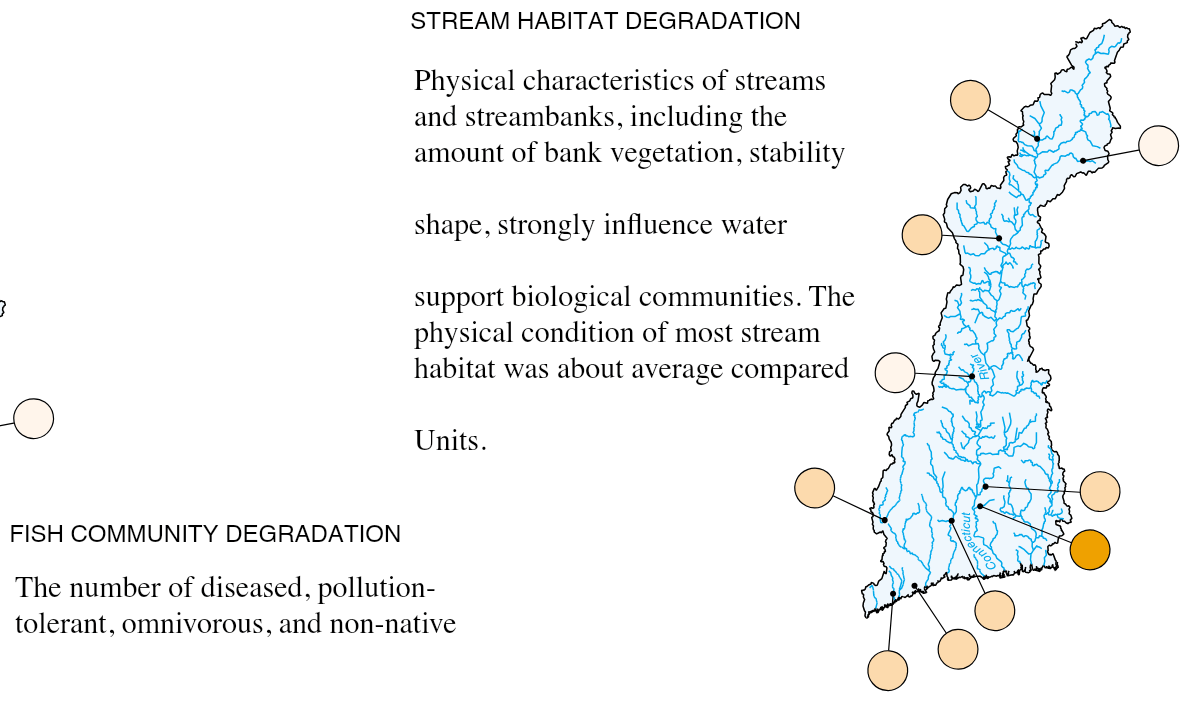
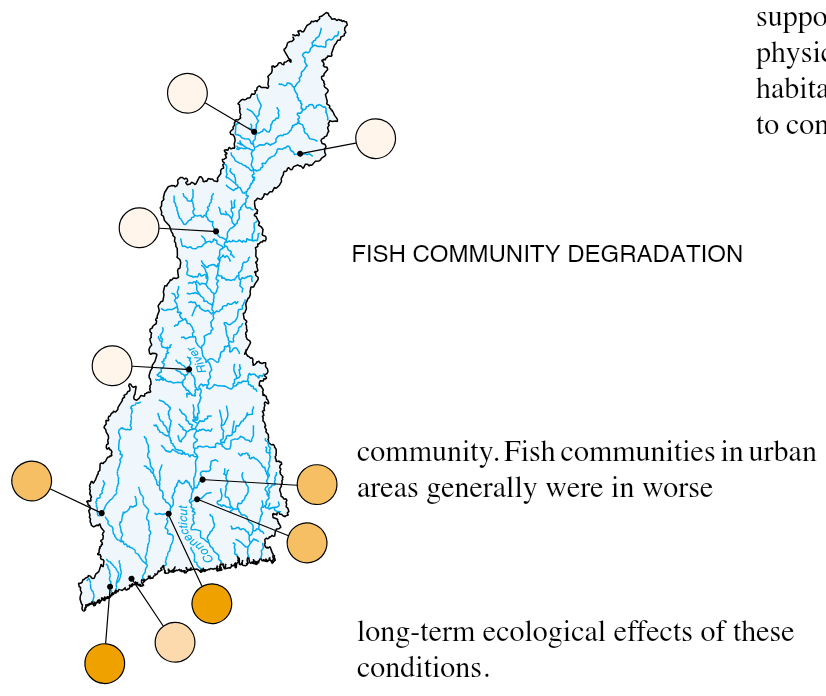
The number of diseased, pollutiontolerant, omnivorous, and non-native fish at several sites is higher than what would be expected in a healthy fish community. Fish communities in urban areas generally were in worse condition than those found in other NAWQA Study Units. There are no standards with which to evaluate the long-term ecological effects of these conditions. Physical characteristics of streams and streambanks, including the amount of bank vegetation, stability of bank soils, and stream depth and shape, strongly influence water quality and the ability of streams to support biological communities. The physical condition of most stream habitat was about average compared to conditions at other NAWQA Study Units.
CONCLUSIONS
In the Connecticut, Housatonic, and Thames River Basins, compared to other NAWQA Study Units:
- High concentrations of nutrients, primarily
from wastewater-treatment facilities in urban areas, are causing eutrophication in some lakes, streams, and ponds.
- Pesticide concentrations in water are
relatively low. Guidelines for the protection of aquatic life are exceeded by pesticide concentrations only infrequently.
- Concentrations of PCBs and
organochlorine pesticides in bed sediment and fish are among the highest for NAWQA Study Units, and concentrations exceeded guidelines for the protection of wildlife in several places.
- Degradation of stream habitat and fish
communities, as indicated at the limited number of NAWQA stream sites, is moderate in the Study Unit.
U.S. Geological Survey Circular 1155
WATER-QUALITY CONDITIONS IN A NATIONAL CONTEXT
Comparison of Ground-Water Quality in the Connecticut, Housatonic, and Thames River Basins with Nationwide NAWQA Findings


Water Quality in the Connecticut, Housatonic, and Thames River Basins, 1992-95 Water-quality characteristics were evaluated for ground-water studies in each NAWQA Study Unit. Ground-water resources were divided into two categories: (1) drinking-water aquifers, and (2) shallow ground water underlying agricultural or urban areas. Summary scores were computed for each characteristic for all aquifers and shallow ground-water areas that had adequate data. Scores for each aquifer and shallow ground-water area in the Connecticut, Housatonic, and Thames River Basins were compared with scores for all aquifers and shallow ground-water areas sampled in the 20 NAWQA Study Units during 1992–95. Results are summarized by percentiles; higher percentile values generally indicate poorer quality compared with other NAWQA ground-water studies. Water-quality conditions for each drinking-water aquifer also are compared to established drinking-water standards and criteria for protection of human health. (Methods used to compute rankings and evaluate standards and criteria are described by Gilliom and others, in press.)

Ranking of ground-water quality relative to all NAWQA ground-water studies — Darker colored circles generally indicate poorer quality. Bold outline of circle indicates one or more standards or criteria were exceeded.
Pesticide detection was common from wells in agricultural areas, with detection in more than 80 percent of wells sampled. Concentrations were generally low, with only two samples exceeding the drinking water standards. Pesticides were also commonly detected in urban wells, but were detected much less frequently in forested areas and drinking-water (bedrock) wells.
Nitrate concentrations in shallow ground water under agricultural areas generally were greater than the national median concentration, and 15 percent of these wells exceeded the drinking-water standard for nitrate. In contrast, nitrate concentrations in other shallow ground water and bedrock wells generally were less than the national median for NAWQA sites. Volatile organic compounds were frequently detected in study area wells, with more than 70 percent of urban wells sampled containing VOCs, placing them among the top 25 percent of all NAWQA ground-water samples. VOCs also were frequently detected in bedrock wells used for drinking water; however, VOCs were not frequently detected in wells in agricultural areas.

WATER-QUALITY CONDITIONS IN A NATIONAL CONTEXT
Radon, a decay product of uranium, occurs naturally in soils. Radon levels in the drinking-water wells completed in bedrock were among the highest observed nationally. Almost all of these wells (97 percent) exceeded the previously proposed limit for radon.
CONCLUSIONS
In the Connecticut, Housatonic, and Thames River Basins, compared to other NAWQA Study Units:
- Pesticide detections were common, but
concentrations generally were low. Samples from only 2 percent of the monitoring wells exceeded a pesticide MCL, and only in agricultural areas.
- VOCs were commonly detected in urban
wells; samples from 10 percent of the wells in urban areas exceeded a VOC MCL.
- Nitrate concentrations in ground water
under agricultural areas are 30 times higher than background concentrations; samples from 15 percent of these wells exceeded the nitrate MCL.
- Radon activities are high; activities in
ground water from almost all bedrock wells exceeded the previously proposed limit.

the drinking-water wells completed in bedrock were among the highest wells (97 percent) exceeded the previously proposed limit for radon.
U.S. Geological Survey Circular 1155
STUDY DESIGN AND DATA COLLECTION

Water Quality in the Connecticut, Housatonic, and Thames River Basins, 1992-95 EXPLANATION
Sampling sites were selected to assess the occurrence and distribution of dissolved constituents in streamwater. Data from basic fixed sites were used to evaluate the effect of upstream land use on stream chemistry. Data from the intensive fixed site, which was sampled more frequently, was used to evaluate the seasonal variation of stream chemistry at an urban site. Synoptic surveys were conducted during two summers to evaluate the distribution of pesticides throughout the Study Unit. Samples were collected to assess the distribution of trace elements and organic compounds in bed sediments across the Study Unit.
Intensive ecological assessments were conducted at basic fixed sites across the Study Unit for use in measuring the impact water quality has had on aquatic communities. These assessments included the collection of fish, macroinvertebrate, and algae samples for indentification, along with habitat characterization at each site. Fish tissue samples were collected at selected sites across the Study Unit for trace element and organic compound analysis. Ground-water samples were collected at two types of sites across the Study Unit, shallow wells in glacial stratified drift, and deeper wells in crystalline bedrock. Samples from shallow wells in stratified drift were collected to characterize the effects of land use on ground-water quality, whereas samples from the deeper bedrock wells were collected to characterize water-quality from water-supply wells in this Study Unit survey. Data collection efforts were designed to assess the quality of both surface and ground waters across the Study Unit for both regional and national needs (Gilliom and others, 1995). This design included three components, stream chemistry, stream ecology, and ground-water chemistry.
Summary of Data Collection in the Connecticut, Housatonic, and Thames River Basins, 1992-95

STUDY DESIGN AND DATA COLLECTION
Brief description and Number water-quality measures of sites
U.S. Geological Survey Circular 1155 Frequency during 1992-95
SUMMARY OF COMPOUND DETECTIONS AND CONCENTRATIONS
The following tables summarize data collected for NAWQA studies from 1992–1995 by showing results for the Connecticut, Housatonic, and Thames River Basins Study Unit compared to the NAWQA national range for each compound detected. The data were collected at a variety of places and times. In order to represent the wide concentration ranges observed among Study Units, logarithmic scales are used to emphasize the general magnitude of the concentrations (such as 10, 100, or 1000), rather than the precise number. The complete dataset used to construct these tables is available upon request.

Water-Quality in the Connecticut, Housatonic, and Thames River Basins, 1992-95
SUMMARY OF COMPOUND DETECTIONS AND CONCENTRATIONS

U.S. Geological Survey Circular 1155
SUMMARY OF COMPOUND DETECTIONS AND CONCENTRATIONS
Volatile organic Nutrients Herbicides compounds
Insecticides
Water-Quality in the Connecticut, Housatonic, and Thames River Basins, 1992-95
SUMMARY OF COMPOUND DETECTIONS AND CONCENTRATIONS


Concentration, in μg/kg Rate of Semivolatile organic compound detec- 10,000 100,000 1,000 100 10 1 0.1 tion b
U.S. Geological Survey Circular 1155
SUMMARY OF COMPOUND DETECTIONS AND CONCENTRATIONS

Water-Quality in the Connecticut, Housatonic, and Thames River Basins, 1992-95
SUMMARY OF COMPOUND DETECTIONS AND CONCENTRATIONS
Semivolatile Organochlorine Trace elements organic compounds compounds
U.S. Geological Survey Circular 1155
THIS REPORT WAS BASED ON THE FOLLOWING PUBLICATIONS
Breault, R.F., and Harris, S.L., 1997, Geographical distribution and potential for adverse biological effects of selected trace elements and organic compounds in streambed sediment in the Connecticut, Housatonic, and Thames River Basins, 1992-94: U.S. Geological Survey Water-Resources Investigations Report 97-4169, 24 p. Brill, A.B., 1994, Facts concerning environmental radon, Journal of Nuclear Medicine, v. 35, no. 2. Coles, J.F., 1996, Organochlorine compounds and trace elements in fish tissue and ancillary data for the Connecticut, Housatonic, and Thames River Basins, 1992-94: U.S. Geological Survey Open-File Report 96-358, 26 p. Connecticut Department of Environmental Protection, 1994, Water quality report: Hartford, Conn., 97 p. _____1996, Connecticut waterbodies not meeting water-quality standards in 1996: Hartford, Conn., 24 p. Ecosystem Conservation Directorate—Evaluation and Interpretation Branch, 1995, Interim sediment quality guidelines: Ottawa, Ontario, Soil and sediment quality section, Guidelines Division, 12 p. Gilliom, R.J., Alley, W.M., and Gurtz, M.E., 1995, Design of the National Water-Quality Assessment Program— Occurrence and distribution of water-quality conditions: U.S. Geological Survey Circular 1112, 33 p. Gilliom, R.J., Muller, D.K., and Nowell, L.H., in press, Methods for comparing water-quality conditions among National Water-Quality Assessment Study Units, 1992-1995: U.S. Geological Survey Open-File Report 97-589.
Water Quality in the Connecticut, Housatonic, and Thames River Basins, 1992-95 Grady, S.J., 1997, Occurrence of volatile organic compounds in ground water in the Connecticut, Housatonic, and Thames River Basins: U.S. Geological Survey Fact Sheet FS-029-97, 6 p. Grady, S.J., and Mullaney, J.R., 1998, Natural and human factors affecting shallow water quality in surficial aquifers in the Connecticut, Housatonic, and Thames River Basins: U.S. Geological Survey Water-Resources Investigations Report 98-4042, 81 p. Massachusetts Department of Environmental Protection, 1995, Summary of water quality: Boston, Mass., 97 p. Mitchell, W.B., Guptill, S.C., Anderson, K.E., Fegas, R.G., and Hallam, C.A., 1977, GIRAS—A geographic information and analysis system for handling land use and land cover data: U.S. Geological Survey Professional Paper 1059, 16 p. National Academy of Sciences and National Academy of Engineering, 1973 [1974], Water-quality criteria, 1972: U.S. Environmental Protection Agency, EPA R3-73-033, 594 p. New Hampshire Department of Environmental Services, 1996, Water quality report: Concord, N.H. Trench, E.C.T., 1996, Trends in surface-water quality in Connecticut, 1969-88: U.S. Geological Survey Water-Resources Investigations Report 96-4161, 176 p. U.S. Environmental Protection Agency, 1994,Water quality standards handbook (2nd ed.): U.S. Environmental Protection Agency: EPA-823-B-94-005b, Appendix P, 3 p. U.S. Environmental Protection Agency, 1996, Drinking water regulations and health advisories: Office of Water, EPA 822-R-96- 001, 16 p. _____1997, The Long Island Sound Study-Proposal for phase III actions for hypoxia management: EPA 840-R-97-001, 25 p. Vermont Department of Environmental Conservation, 1996, Water quality assessment: Waterbury, Vt. Zimmerman, M.J., Grady, S.J., Trench, E.C.T., Flanagan, S.M., and Nielsen, M.G., 1996, Water-quality assessment of the Connecticut, Housatonic, and Thames River Basins study unit: Analysis of available information on nutrients, suspended sediments, and pesticides, 1972- 92: U.S. Geological Survey Water-Resources Investigations Report 95-4203, 162 p. Zaugg, S.D., Sandstorm, M.W., Smith, S.G., and Fehlberg, K.M., 1995, Methods of analysis by the U.S. Geological Survey National Water Quality Laboratory— Determination of pesticides in water by C-18 solid-phase extraction and capillary-column gas chromatography/mass spectrometry with selected-ion monitoring: U.S. Geological Survey Open-File Report 95-181, 49 p. Zimmerman, M.J., 1997, Trends in nitrogen and phosphorus concentrations in southern New England streams, 1974-92: U.S. Geological Survey Fact Sheet FS-001-97, 4 p. The terms in this glossary were compiled from numerous sources. Some definitions have been modified and may not be the only valid ones for these terms.
Ammonia - A compound of nitrogen and hydrogen (NH3) that is a common by-product of animal waste. Ammonia readily converts to nitrate in soils and streams. Aquatic-life criteria - Water-quality guidelines for protection of aquatic life. Often refers to U.S. Environmental Protection Agency water-quality criteria for protection of aquatic organisms. See also Water-quality guidelines, Water-quality criteria, and Freshwater chronic criteria. Aquifer - A water-bearing layer of soil, sand, gravel, or rock that will yield usable quantities of water to a well. Atmospheric deposition - The transfer of substances from the air to the surface of the Earth, either in wet form (rain, fog, snow, dew, frost, hail) or in dry form (gases, aerosols, particles). Basic Fixed Sites - Sites on streams at which streamflow is measured and samples are collected for measurement of analysis of temperature, salinity, suspended sediment, major ions and metals, nutrients, and organic carbon to assess the broad-scale spatial and temporal character and transport of inorganic constituents of streamwater in relation to hydrologic conditions and environmental settings. Bed sediment - The material that temporarily is stationary in the bottom of a stream or other watercourse. Benthic - Refers to plants or animals that live on the bottom of lakes, streams, or oceans. Breakdown product - A compound derived by chemical, biological, or physical action upon a pesticide. The breakdown is a natural process which may result in either a more toxic or a less toxic compound and either a more persistent or less persistent compound. Chlordane - Octachloro-4,7- methanotetrahydroindane. An organochlorine insecticide no longer registered for use in the U.S. Technical chlordane is a mixture in which the primary components are cis- and transchlordane, cis- and transnonachlor, and heptachlor. Concentration - The amount or mass of a substance present in a given volume or mass of sample. Usually expressed in micrograms per liter (water sample) or micrograms per kilogram (sediment or tissue sample). Detection limit - The concentration below which a particular analytical method cannot determine, with a high degree of certainty, a concentration. DDT - Dichloro-diphenyltrichloroethane. An organochlorine insecticide no longer registered for use in the United States. Dieldrin - An organochlorine insecticide no longer registered for use in the United States. Also a degradation product of the insecticide aldrin. Drainage basin - The portion of the surface of the Earth that contributes water to a stream through overland run-off, including tributaries and impoundments. Effluent - Outflow from a particular source, such as a stream that flows from a lake or liquid waste that flows from a factory or sewage-treatment plant. Eutrophication - The process by which water becomes enriched with plant nutrients, most commonly phosphorus and nitrogen. Fecal bacteria - Microscopic singlecelled organisms (primarily fecal coliforms and fecal streptococci) found in the wastes of warm-blooded animals. Their presence in water is used to assess the
U.S. Geological Survey Circular 1155
GLOSSARY
sanitary quality of water for bodycontact recreation or for consumption. Their presence indicates contamination by the wastes of warm-blooded animals and the possible presence of pathogenic (disease producing) organisms. Health advisory - Nonregulatory levels of contaminants in drinking water that may be used as guidance in the absence of regulatory limits. Advisories consist of estimates of concentrations that would result in no known or anticipated health effects (for carcinogens, a specified cancer risk) determined for a child or for an adult for various exposure periods. Herbicide - A chemical or other agent applied for the purpose of killing undesirable plants. See also Pesticide. Indicator sites - Stream sampling sites located at outlets of drainage basins with relatively homogeneous land use and physiographic conditions; most indicator-site basins have drainage areas ranging from 20 to 200 square miles. Insecticide - A substance or mixture of substances intended to destroy or repel insects. Integrator or Mixed-use site - Stream sampling site located at an outlet of a drainage basin that contains multiple environmental settings. Most integrator sites are on major streams with relatively large drainage areas. Intensive Fixed Sites - Basic Fixed Sites with increased sampling frequency during selected seasonal periods and analysis of dissolved pesticides for 1 year. Most NAWQA Study Units have one to two integrator Intensive Fixed Sites and one to four indicator Intensive Fixed Sites. Maximum contaminant level (MCL) - Maximum permissible level of a contaminant in water
GLOSSARY
that is delivered to any user of a public water system. MCLs are enforceable standards established by the U.S. Environmental Protection Agency. Mean - The arithmetic average of a set of observations, unless otherwise specified. Median - The middle or central value in a distribution of data ranked in order of magnitude. The median is also known as the 50th percentile. Micrograms per liter (μg/L) - A unit expressing the concentration of constituents in solution as weight (micrograms) of solute per unit volume (liter) of water; equivalent to one part per billion in most stream water and ground water. One thousand micrograms per liter equals 1 mg/L. Milligrams per liter (mg/L) - A unit expressing the concentration of chemical constituents in solution as weight (milligrams) of solute per unit volume (liter) of water; equivalent to one part per million in most stream water and ground water. One thousand micrograms per liter equals 1 mg/L. National Academy of Sciences/National Academy of Engineering (NAS/NAE) recommended maximum concentration in water - Numerical guidelines recommended by two joint NAS/NAE committees for the protection of freshwater and marine aquatic life, respectively. These guidelines were based on available aquatic toxicity studies, and were considered preliminary even at the time (1972). The guidelines used in the NAWQA summary reports are for freshwater. Nitrate - An ion consisting of nitrogen and oxygen (NO3-). Nitrate is a plant nutrient and is very mobile in soils. Nutrient - An element or compound essential for animal and plant growth. Common nutrients in fertilizer include nitrogen, phosphorus, and potassium.
Water Quality in the Connecticut, Housatonic, and Thames River Basins, 1992-95 Organochlorine compound - A synthetic organic compound containing chlorine. As generally used, the term refers to compounds containing mostly or exclusively carbon, hydrogen, and chlorine. Examples include organochlorine insecticides, polychlorinated biphenyls, and some solvents containing chlorine. Picocurie (pCi) - One trillionth (10-12)
of the amount of radioactivity represented by a curie (Ci). A curie is the amount of radioactivity that yields 3.7 x 10 radioactive disintegrations per second. Polychlorinated biphenyls (PCBs) - A mixture of chlorinated derivatives of biphenyl, marketed under the trade name Aroclor with a number designating the chlorine content (such as Aroclor 1260). PCBs were used in transformers and capacitors for insulating purposes and in gas pipeline systems as a lubricant. Further sale for new use was banned by law in 1979. Polycyclic aromatic hydrocarbon (PAH) - A class of organic compounds with a fused-ring aromatic structure. PAHs result from incomplete combustion of organic carbon (including wood), municipal solid waste, and fossil fuels, as well as from natural or anthropogenic introduction of uncombusted coal and oil. PAHs include benzo(a)pyrene, fluoranthene, and pyrene. Semivolatile organic compound (SVOC) - Operationally defined as a group of synthetic organic compounds that are solventextractable and can be determined by gas chromatography/mass spectrometry. SVOCs include phenols, phthalates, and Polycyclic aromatic hydrocarbons (PAHs). Study Unit - A major hydrologic system of the United States in which NAWQA studies are focused. Study Units are geographically defined by a combination of ground- and surface-water features and generally encompass more than 4,000 square miles of land area. Synoptic sites - Sites sampled during a short-term investigation of specific water-quality conditions during selected seasonal or hydrologic conditions to provide improved spatial resolution for critical water-quality conditions. Volatile organic compounds (VOCs) - Organic chemicals that have a high vapor pressure relative to their water solubility. VOCs include components of gasoline, fuel oils, and lubricants, as well as organic solvents, fumigants, some inert ingredients in pesticides, and some byproducts of chlorine disinfection. Water-quality criteria - Specific levels or concentrations of chemical constituents of organic compounds in water, which, if exceeded, are considered to render a body of water unsuitable for its designated use. Commonly refers to water-quality criteria established by the U.S. Environmental Protection Agency. Water-quality criteria are based on specific levels of pollutants that would make the water harmful if used for drinking, swimming, farming, fish production, or industrial processes. Water year - The continuous 12- month period, October 1 through September 30, in U.S. Geological Survey reports dealing with the surface-water supply. The water year is designated by the calendar year in which it ends and which includes 9 of the 12 months. Thus, the year ending September 30, 1980, is referred to as the "1980" water year.
Where this page came from
This page was imported from U.S. Geological Survey. Published by the U.S. Geological Survey and, as a work of the United States government, in the public domain.
Nobody has written it yet — it is the source material at a new address, which is why search engines are asked to skip it and why no one earns from it. It is up for grabs: take it on, and it is yours to rewrite and to earn from.
Licence: CC0 1.0 (public domain) · Adapted from pubs.usgs.gov
1
0
0
0

Comments


