
In the United States, arboviruses (arthropodborne viruses) reach people mainly through bites from infected mosquitoes or ticks; rarely, through a blood transfusion or organ transplant. Most infections cause no symptoms; illness ranges from a mild fever to severe neuroinvasive disease. There is no vaccine or specific treatment for any of the domestic ones, so prevention is what counts.

Image from the Centers for Disease Control and Prevention
2023 at a glance
States report six nationally notifiable arboviral diseases to CDC through ArboNET. For illness that began in 2023:
- 2,770 cases — 812 confirmed and 1,958 probable — from 48 states and DC and 772 of 3,143 counties.
- 2,022 (73%) hospitalized; 208 (8%) died.
- 57% of patients were aged 60 or older; 63% were male.
- That was more than double 2022's 1,247 cases, though below 3,035 in 2021, when a large West Nile outbreak in Maricopa County, Arizona made up about half of the total.
| Virus | Cases | Neuroinvasive | Hospitalized | Died | Median age |
|---|---|---|---|---|---|
| West Nile | 2,628 | 1,789 (68%) | 1,891 (72%) | 194 (7%) | 63 |
| Powassan | 49 | 47 (96%) | 44 (90%) | 8 (16%) | 68 |
| La Crosse | 35 | 34 (97%) | 35 (100%) | 0 | 7 |
| Jamestown Canyon | 27 | 20 (74%) | 25 (93%) | 3 (11%) | 60 |
| St. Louis encephalitis | 21 | 14 (67%) | 17 (81%) | 2 (10%) | 62 |
| Eastern equine encephalitis | 7 | 7 (100%) | 7 (100%) | 1 (14%) | 64 |
Three more cases were from unspecified California serogroup viruses. Neuroinvasive means meningitis, encephalitis, acute flaccid paralysis or another neurologic illness; incidence below counts only these cases, because they are diagnosed and reported more consistently.
West Nile virus
- Reported from 692 counties in 46 states and DC; 91% of illnesses began in July–September.
- 1,665 of the hospitalized patients had neuroinvasive disease. Those who died had a median age of 73, and 190 (98%) had neuroinvasive disease.
- National neuroinvasive incidence: 0.53 per 100,000 — rising with age from 0.02 under 10 to 1.56 at 70 and older, and higher in males (0.68) than females (0.38).
| Highest incidence (per 100,000) | Most cases |
|---|---|
| Colorado 5.38 | California 334 |
| South Dakota 5.00 | Colorado 316 |
| Nebraska 4.60 | Texas 122 |
The three states with the most cases held 43% of all neuroinvasive cases.
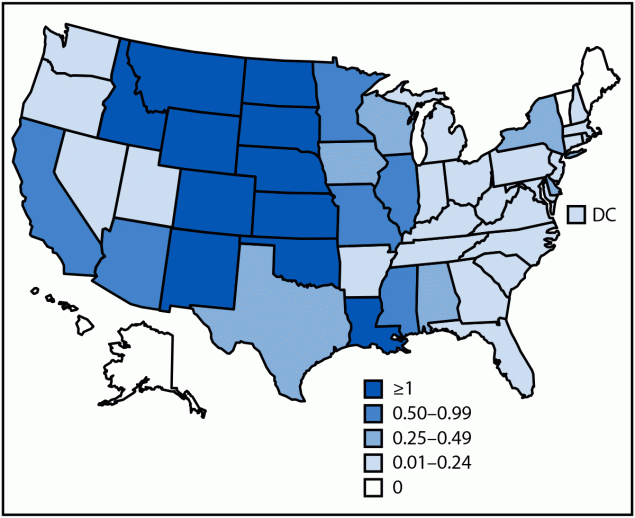
Incidence of neuroinvasive West Nile virus disease by state, 2023. Image from the Centers for Disease Control and Prevention
Transplants. Three patients were infected through organs from two donors who had no symptoms; one died. Since the last transplant cluster in 2018, four more were found in 2021, 2022 and 2023, with eight infected recipients, all with encephalitis, and three deaths — a case for possibly screening organ donors for viral RNA when West Nile risk is high.
A new lineage. Human West Nile disease had been linked only to lineage 1 and 2 strains. In 2023 a U.S. patient was coinfected with lineage 1b — the common U.S. strain — and lineage 3, known before only from mosquitoes in central Europe. How widespread it is here, and what it means for disease, is unknown.
Undercounting. Earlier studies put 30–70 nonneuroinvasive cases behind every reported neuroinvasive one. With 1,789 neuroinvasive cases, that suggests 53,670–125,230 nonneuroinvasive cases — but only 839 (0.7%–1.6%) were reported.
The other five
- Powassan — 49 cases in 11 states, the most since it became separately reportable in 2004, up from the previous record in 2022. Illness began across April–December (96%), evenly spread; two New England patients fell ill in December — the ticks that carry it are more active in cooler temperatures than mosquitoes are. Maryland reported its first case, in a resident infected in Canada. Highest incidence: Maine 0.50, New Hampshire 0.29, Vermont 0.15.
- La Crosse — 35 cases in 10 states; 91% of patients were under 18, making it the leading cause of neuroinvasive arboviral disease in children. All were hospitalized; none died. Ohio had the most neuroinvasive cases (12); highest incidence was in West Virginia (0.28), Ohio (0.10) and Tennessee (0.07).
- Jamestown Canyon — 27 cases in 7 states; 85% began in April–September, earlier in spring than other mosquitoborne disease; a wide variety of mosquitoes carry it. Highest incidence: Wisconsin 0.19, Michigan 0.05, Minnesota 0.03.
- St. Louis encephalitis — 21 cases in 3 states, the third-highest count in two decades, including South Carolina's first human case. Highest incidence: California, 0.03.
- Eastern equine encephalitis — 7 cases in 4 states, equal to the median for 2003–2022; six of the seven patients were male.
What this means for practice
- Test patients with acute febrile or neurologic illness — including transplant and transfusion recipients — when ticks and mosquitoes are active, choosing tests by when illness began and where the patient was exposed, and report positives to the health department.
- Order West Nile and Powassan tests by name: commercial arboviral panels usually leave them out. Rarer viruses and confirmatory tests usually go through public health laboratories.
- Powassan risk runs from spring to late fall in the Northeast and upper Midwest — worth telling patients and providers about.
- With care only supportive, prevention rests on insect repellent registered by the Environmental Protection Agency, protective clothing, household and community vector control, and screening blood and organ donors for West Nile.
Limitations
ArboNET does not require symptoms or lab results in reports, so cases may be misclassified; and as a passive system relying on people seeking care, being tested and being reported, it underestimates how common these diseases are.
Sources
Based on "West Nile Virus and Other Nationally Notifiable Arboviral Diseases — United States, 2023," by Hannah Padda, Daniel Jacobs, Carolyn V. Gould, Rebekah Sutter, Jennifer Lehman, J. Erin Staples and Shelby Lyons, Morbidity and Mortality Weekly Report 74(21), Centers for Disease Control and Prevention; a work of the United States government in the public domain.
Licence: CC0 1.0 (public domain) · Adapted from www.cdc.gov
1
0
0
0

Comments


