Go to any agency that is focused on weather or climate forecasting and you’ll hear scientists buzzing to one another about “ENSO” (pronounced “en-so”). After glancing at the stereotypical scientist, you might immediately assume “En-so” is a Star Wars character, but you would be mistaken. ENSO is one of the most important climate phenomena on Earth due to its ability to change the global atmospheric circulation, which in turn, influences temperature and precipitation across the globe. We also focus on ENSO because we can often predict its arrival many seasons in advance of its strongest impacts on weather and climate.
Though ENSO is a single climate phenomenon, it has three states, or phases, it can be in. The two opposite phases, “El Niño” and “La Niña,” require certain changes in both the ocean and the atmosphere because ENSO is a coupled climate phenomenon. “Neutral” is in the middle of the continuum.
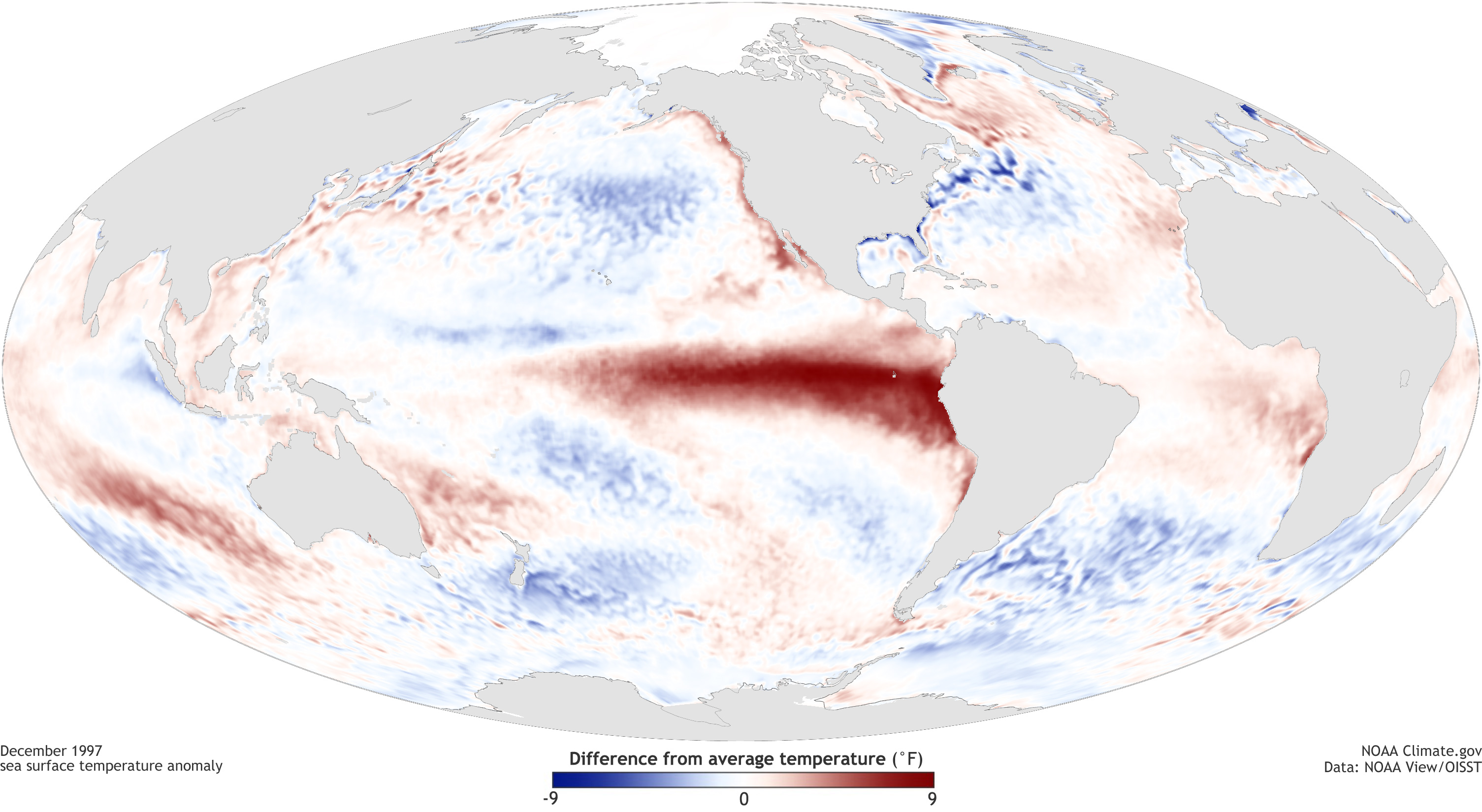
- El Niño: A warming of the ocean surface, or above-average sea surface temperatures (SST), in the central and eastern tropical Pacific Ocean. Over Indonesia, rainfall tends to become reduced while rainfall increases over the tropical Pacific Ocean. The low-level surface winds, which normally blow from east to west along the equator (“easterly winds”), instead weaken or, in some cases, start blowing the other direction (from west to east or “westerly winds”).
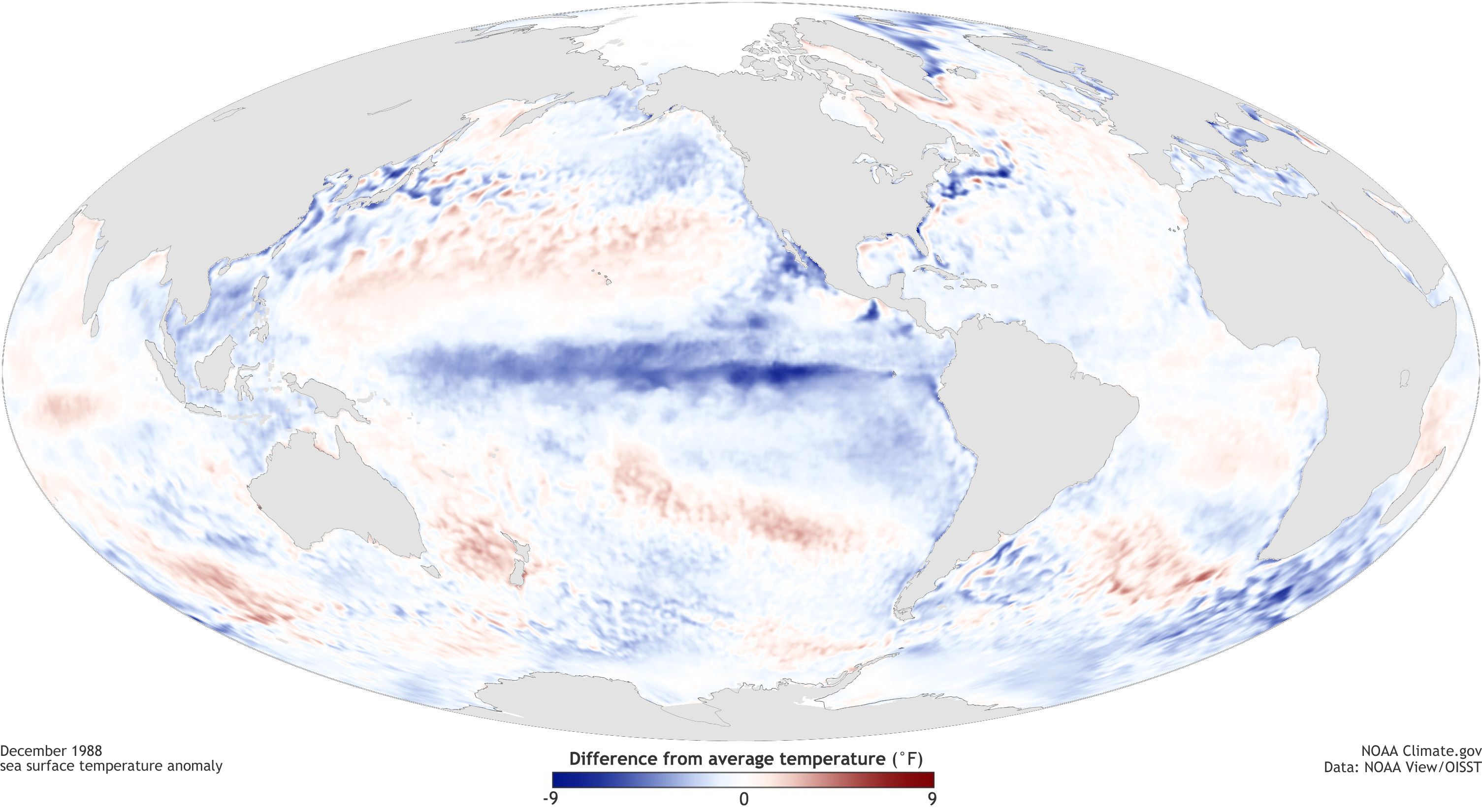
- La Niña: A cooling of the ocean surface, or below-average sea surface temperatures (SST), in the central and eastern tropical Pacific Ocean. Over Indonesia, rainfall tends to increase while rainfall decreases over the central tropical Pacific Ocean. The normal easterly winds along the equator become even stronger.
- Neutral: Neither El Niño or La Niña. Often tropical Pacific SSTs are generally close to average. However, there are some instances when the ocean can look like it is in an El Niño or La Niña state, but the atmosphere is not playing along (or vice versa).
Maps of sea surface temperature anomaly in the Pacific Ocean during a strong La Niña (top, December 1988) and El Niño (bottom, December 1997). Maps by NOAA Climate.gov, based on data provided by NOAA View. large versions La Niña | El Niño
So, by now, you might have noticed that while “ENSO” is a nice catchall acronym for all three states, that acronym doesn’t actually have the word La Niña in it. Why is that? Well, that is a fluke of history. Before La Niña was even recognized, South American fisherman noticed the warm up of coastal waters occurred every so often around Christmas. They referred to the warming as “El Niño,” (niño being Spanish for a boy child) in connection with the religious holiday.
Sir Gilbert Walker discovered the “Southern Oscillation,” or large-scale changes in sea level pressure across Indonesia and the tropical Pacific. However, he did not recognize that it was linked to changes in the Pacific Ocean or El Niño. It wasn’t until the late 1960s that Jacob Bjerknes and others realized that the changes in the ocean and the atmosphere were connected and the hybrid term “ENSO” was born. It wasn’t until the 1980s or later that the terms La Niña and Neutral gained prominence.
In future updates, we will spend more time describing ENSO and how it is defined and tracked, but if you can’t wait, you can read more here now.
But, if you just want to keep things simple, then watch Chris Farley play El Niño on Saturday Night Live.
Where this page came from
This page was imported from NOAA Climate.gov. Published by NOAA Climate.gov, which lets anything credited to it be re-used with attribution; material credited to others is left out.
Nobody has written it yet — it is the source material at a new address, which is why search engines are asked to skip it and why no one earns from it. It is up for grabs: take it on, and it is yours to rewrite and to earn from.
Licence: CC0 1.0 (public domain) · Adapted from www.climate.gov
1
0
0
0

Comments