
Quer melhorar o conteúdo da página? Proponha uma alteração.
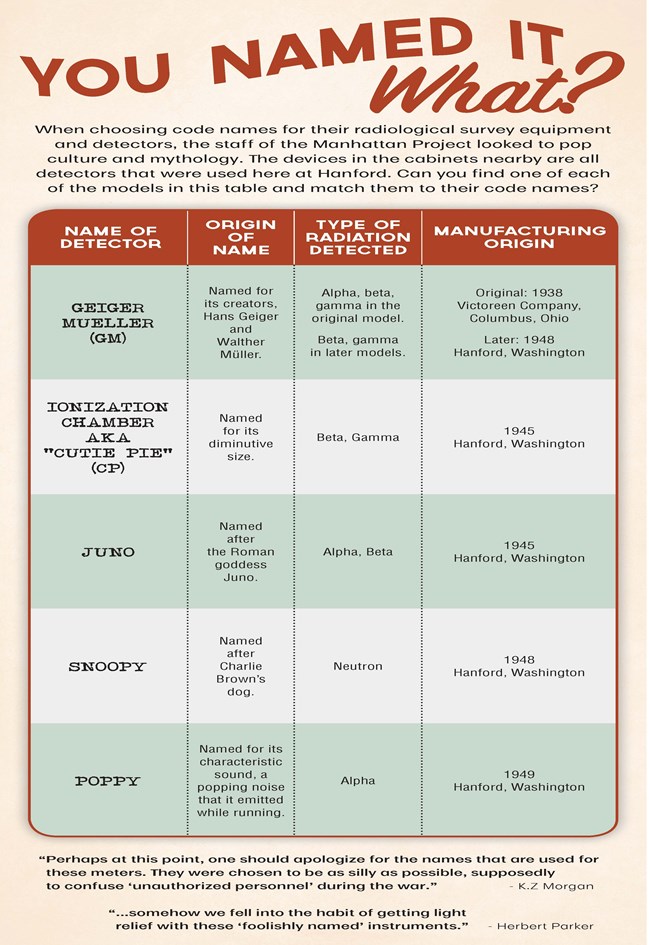
The You Named It What? panel in the Health Physics Exhibit. See exhibit panel for specific image credits.
**Main Text **
Text at the top reads: “When choosing code names for their radiological survey equipment and detectors, the staff of the Manhattan Project looked to pop culture and mythology. The devices in the cabinets nearby are all detectors that were used here at Hanford. Can you find one of each of the models in this table and match them to their code names?”
A quote by K. Z. Morgan at the bottom reads: “Perhaps at this point, one should apologize for the names that are used for these meters. They were chosen to be as silly as possible, supposedly to confuse ‘unauthorized personnel’ during the war.”
A quote from Herbert Parker reads: “…somehow we fell into the habit of getting light relief with these ‘foolishly named’ instruments.”
**Exhibit Panel Description **
A table in the center of this poster lists the name of the detector, the origin of the name, the type of radiation detected, and the manufacturing origin. Top to bottom, they are: “Geiger Mueller (GM). Named for its creators, Hans Geiger and Walter Müller. It detects alpha, beta, gamma in the original model. Beta, gamma in later models. Original: 1938 Victoreen Company, Columbus, Ohio. Later: 1948 Hanford, Washington.
“Ionization Chamber, a k a Cutie Pie (CP). Named for its diminutive size. Beta,
Gamma. 1945 Hanford, Washington.
“Juno. Named after the Roman goddess Juno. Alpha, Beta. 1945 Hanford,
Washington.
“Snoopy. Named after Charlie Brown’s dog. Neutron. 1948 Hanford, Washington.
“Poppy. Named for its characteristic sound, a popping noise that it emitted while running. Alpha. 1949 Hanford, Washington.”
**Visit This Exhibit Panel **
In-person visitation of the B Reactor is only authorized on guided tours offered by the Department of Energy.
Where this belongs
- Manhattan Project National Historical Park
Where this page came from
This page was imported from National Park Service. Produced by the U.S. National Park Service and, as a work of the United States government, in the public domain.
Nobody has written it yet — it is the source material at a new address, which is why search engines are asked to skip it and why no one earns from it. It is up for grabs: take it on, and it is yours to rewrite and to earn from.
Nestas coleçõesManhattan Project National Historical Park
Licença: CC0 1.0 (domínio público) · Adaptado de www.nps.gov
1
0
0
0

Comentários
Leia em seguida


