
Quer melhorar o conteúdo da página? Proponha uma alteração.
Laws in the 1970s encouraged the federal government to hire people with disabilities. But for women with disabilities who wanted to work for the National Park Service, the biggest obstacle was often other people’s misconceptions and discomfort. Those hired in the 1970s and early 1980s brought new skills and perspectives — and, like the first women rangers of the 1910s and 1920s, often held only short-term jobs. All of them challenged ideas of what a park ranger has to be.
A legal framework
Some veterans with disabilities — likely all men — probably worked for the Park Service after the world wars, but their stories are hard to trace. Neither the 1961 executive order launching affirmative action nor the Civil Rights Act of 1964 addressed disability discrimination. The Architectural Barriers Act of 1968, requiring federally funded or leased buildings to be accessible, first turned the Park Service toward accessibility. The Rehabilitation Act of 1973 defined exclusion of people with disabilities as discrimination and banned it in federal employment, programs and activities, and the Civil Service Reform Act of 1978 added hiring preference for disabled veterans and paid for interpreters and readers for deaf and blind employees.
“The filing cabinets are too high”
At first the Park Service concentrated on making facilities and programs accessible to visitors. In 1977 Director William Whalen formed an affirmative action task force of 12 employees, one of whom, Esther O. Hays, had a disability. It found “a reluctance on the part of many employees to hire or work with handicapped persons,” so that the Service was “missing out on an opportunity to provide meaningful employment to some very skilled persons.” As late as October 1979, the Western Region reported that supervisors wrongly assumed a disabled person could not do a job because “the filing cabinets are too high” or “the telephone can’t be answered by a deaf person” — adding that such jobs could easily be modified.
Another obstacle was a perhaps unconscious image of the ranger as an able-bodied outdoors person. Even the uniform could present hidden barriers.
The first hires
- Marilyn Strack, born with a limb difference on her left arm and holding a psychology degree from the University of California, Berkeley, struggled through months of fruitless job hunting before starting at Muir Woods National Monument in October 1973, working in the entrance station and information office.
- Esther O. Hays was working at George Washington Memorial Parkway by 1977.
- Darlene Les’Pere and Sheree Moses joined the Mid-Atlantic Region as clerk-typists in 1978 through a new program placing people with physical disabilities in federal agencies.
- Joanne Hodges, who used a wheelchair, staffed the information desk at Chickamauga & Chattanooga National Military Park and attended the first Park Service Women’s Conference in 1979. It was her first job, she said, and it was not as easy for people with disabilities.
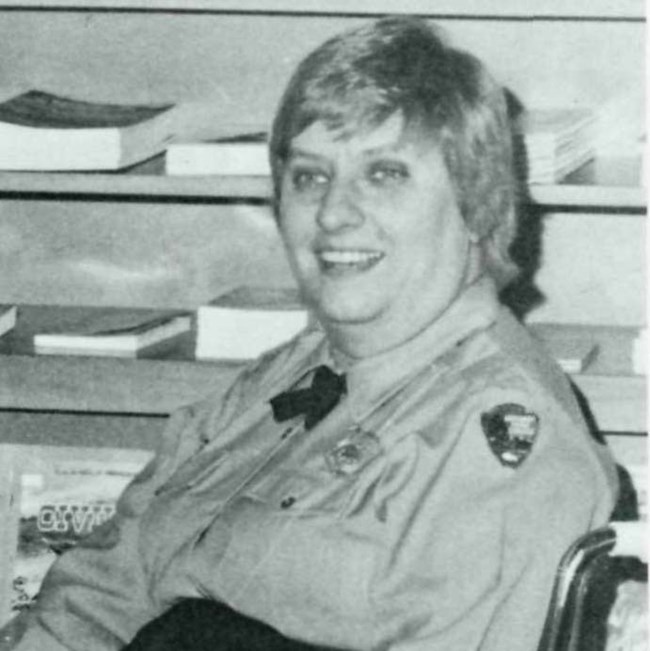
Park aide Joanne Hodges, about 1979. NPS History Collection.
By the end of 1979 the Park Service counted 760 employees with disabilities, 139 of them with “targeted” disabilities such as deafness, blindness or paralysis.
A champion ranger: Sydney Jacobs
Sydney Jacobs grew up camping in national parks and always wanted to be a ranger — a hope that seemed to end when a 1974 mountaineering accident in the North Cascades left her paralyzed from the waist down. She earned a journalism degree and swam internationally, winning medals at the 1980 Paralympics. A vocational rehabilitation counselor got her an interview at a shared Park Service–Forest Service office in the Pacific Northwest; she joined the Forest Service in 1978 and moved to the Park Service the next year.
In 1980 her supervisor arranged for her to work as a naturalist on Hurricane Ridge at Olympic National Park, leading meadow walks and talks each day and muscling her wheelchair along trails not built for it — despite a superintendent who was unhappy to have her. Hired as a park technician in 1981, she ran the Port Angeles visitor center, managed the museum collection, wrote the nomination to list the park as a World Heritage Site, and in 1982 was named one of ten Interior Department “Handicapped Employees of the Year.” An avid kayaker, she completed a 200-mile sea-kayak trip around Prince William Sound in 1984 with two men with disabilities. She left in 1985 for graduate school in museum education, and went on to teach about nature elsewhere, including at a county park in Maryland.
An international spotlight
The United Nations declared 1981 the International Year of the Handicapped, and more women with disabilities appear in the record from then:
- Vicki White, a full-time park technician at Golden Gate National Recreation Area in 1980 who used crutches and a wheelchair, helped the park modify walkways, restrooms and entrances for visitors with disabilities.
- Patricia “Patsy” Otero, who was deaf or hard of hearing, worked at the entrance station and on programs at White Sands from 1980.
- Maril Hanby Elliot, severely hard of hearing, joined Santa Monica Mountains National Recreation Area in 1980 after a campfire program she could not follow convinced her things had to change. She lip-read and signed with visitors, created programs including overnight trips for students from schools for the deaf, reached nearly 8,000 visitors with disabilities in a year, and got telephones for hearing-impaired callers installed at headquarters.
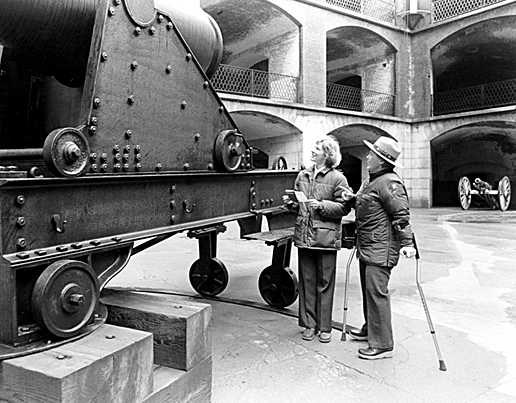
Vicki White at Golden Gate National Recreation Area, 1980. NPS History Collection.
From a refused mule ride to a ranger on horseback
In 1981, Eileen Szychowski — an experienced horsewoman with arm and leg disabilities who walks with crutches — traveled to the Grand Canyon for a mule ride to the bottom, and was refused because of her disability. She then found that none of the restaurants or tour buses were accessible, and that trails and exhibits all assumed visitors could see, hear, feel and walk.
The next day she met Jan Cutler of the Fred Harvey Company, which ran the mule tours, and explained that under the Rehabilitation Act they could ask her to show her ability but could not simply turn her away. Cutler introduced her to park staff, including Karen Berggren, the park’s special populations coordinator. Szychowski was soon hired to teach a session for the ranger skills course in which rangers experienced the canyon in wheelchairs and blindfolds, and Superintendent Richard Marks offered her a nine-month job.
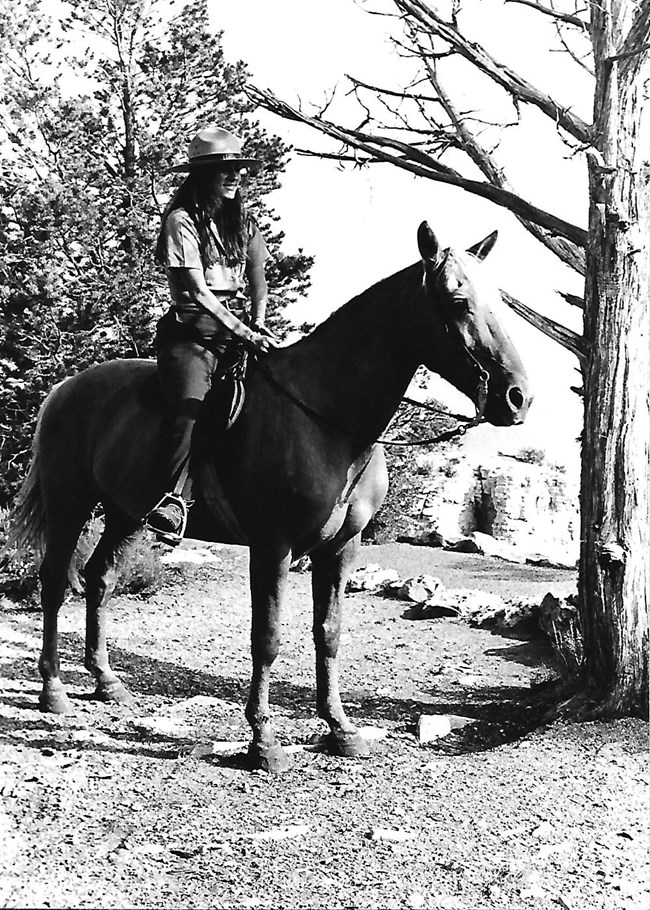
Ranger Eileen Szychowski on her horse Guenivere, Grand Canyon National Park, 1982. NPS photo by Connie Rudd.
In 1982 she returned as a ranger, advising on accessibility and working as an interpreter — riding into the canyon on her own trained horse, Guenivere, after the two passed the chief mounted ranger’s evaluation. Her uniform was quietly adapted: her own shoes, hook-and-loop fastening hidden in the shirt, a loop on the jacket zipper. Visitors, she found, did not expect a ranger to have a disability; one colleague counted her fielding comments about it 92 times in a day. She began her tours by addressing her crutches — and telling visitors the good news that people with disabilities could be rangers.
Berggren also hired Annette Wright, who was deaf, as an interpretive ranger in 1983. That year the Park Service issued Special Directive 83-3, committing to make its facilities, programs, services and concessions accessible. By 1985 the Grand Canyon welcomed blind hikers with guide dogs, wheelchair users on the paved South Rim Trail, and even river trips for some wheelchair users — a transformation in the four years since Szychowski was refused her mule ride. Lasting careers for women with disabilities in the Park Service would take further changes in attitudes and law.
Sources
Based on "Challenging The Ranger Image," National Park Service (research supported in part by a National Park Foundation grant); a work of the United States government in the public domain, with recollections and newspaper quotations of the women featured rewritten in hubnx’s own words. The source spells White’s first name both “Vicky” and “Vicki” and Elliot’s surname both “Elliot” and “Elliott”; the page uses its main spellings.
Nestas coleçõesGolden Gate National Recreation AreaGrand Canyon National ParkLassen Volcanic National ParkGeorge Washington Memorial ParkwayChickamauga & Chattanooga National Military ParkArlington House, The Robert E. Lee Memorial
Licença: CC0 1.0 (domínio público) · Adaptado de www.nps.gov
1
0
0
0

Comentários


