
Quer melhorar o conteúdo da página? Proponha uma alteração.
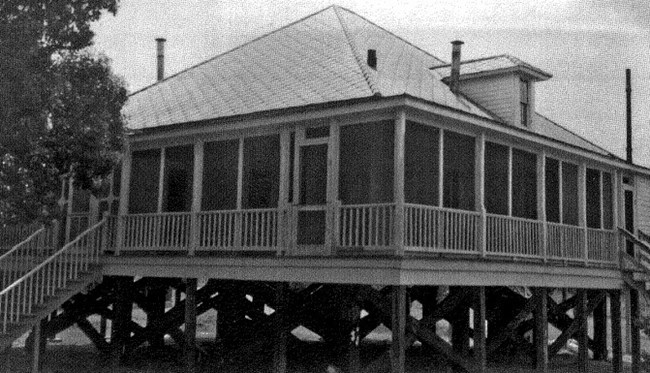
The quarantine building's southeast side in 1939. NPS photo.
Historic Fort Pulaski and the Cockspur Island Lighthouse are the best-known structures at Fort Pulaski National Monument. But an old white house on the west side of the island matters too. Built in 1912, it is now the park's headquarters — and the last surviving building of the Cockspur Island quarantine station.
Quarantine and Savannah
Quarantine protected Savannah's residents from diseases arriving by ship: vessels anchored offshore for 40 days before they were allowed into port. Several quarantine stations served the city over the years.
- The first, on Tybee Island, opened in 1767 to receive slave ships arriving from Africa. It was reached by Lazaretto Creek, between McQueen's Island and Tybee — lazaretto being another word for a quarantine station.
- Later stations stood at Oyster Island, Fort Greene and Fort Jackson.
The Cockspur Island station
| Year | Event |
|---|---|
| 1889 | The War Department licensed the city of Savannah to build a quarantine station on Cockspur Island |
| 1891 | The station opened to ships from around the world; a hospital, fumigation building and staff quarters were added over time |
| 1912 | The present building went up as the quarantine keeper's quarters, replacing an 1889 building; the two stood side by side until the older one was demolished in 1960 |
| 1924 | President Calvin Coolidge made Fort Pulaski a National Monument |
| 1934 | Civilian Conservation Corps Camp 460 arrived to restore the fort and grounds, camping just east of the station |
| 1937 | Quarantine operations ended; the War Department transferred the whole complex to the Department of the Interior, home of the National Park Service |
| March 18, 1942 | Soon after the U.S. entered World War II, Interior issued a permit to the Navy, which set up Navy Section Base #20 to guard the entrance to the Port of Savannah. The monument closed to the public for the war |
| August 1, 1947 | The park reopened |

A 1939 map of the Cockspur Island quarantine complex; the arrow marks today's park headquarters. NPS.
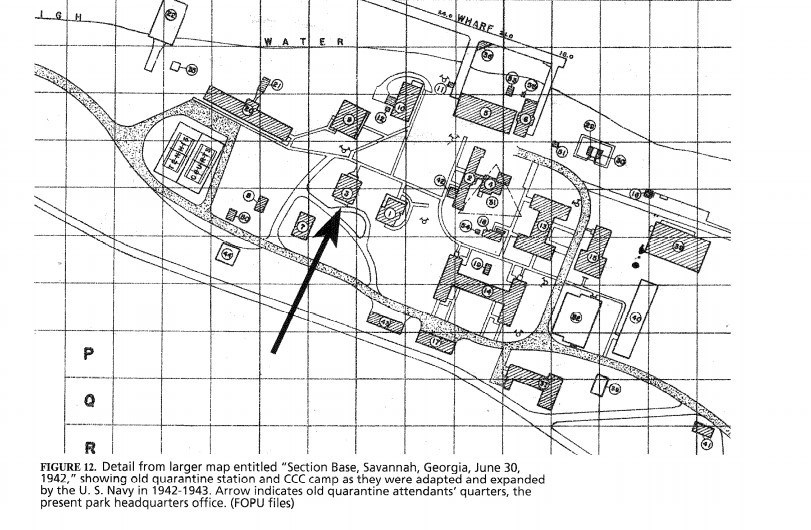
A 1942 U.S. Navy map of the quarantine station and CCC Camp 460, with today's headquarters marked. NPS.
After the war
Once Fort Pulaski reopened, the Park Service gradually tore down the rundown buildings left from the quarantine complex and the CCC camp. Only the keeper's house survived. It later served as the residence of the superintendent and chief ranger, and today houses park headquarters — with handsome interior woodwork and a fireplace in the conference room. One of the island's well-known fig trees grows in the yard, overlooking the north channel of the Savannah River.

The headquarters building's southeast side in 1950, showing the Navy's 1942 alterations. NPS.
Sources
Based on "Quarantine Station," Fort Pulaski National Monument, National Park Service, drawing on the park's Historic Structure Report (2004), Administrative History (2003) and Foundation Document (2016); a work of the United States government in the public domain.
Nestas coleçõesFort Pulaski National Monument
Licença: CC0 1.0 (domínio público) · Adaptado de www.nps.gov
1
0
0
0

Comentários


