
Quer melhorar o conteúdo da página? Proponha uma alteração.
Found mainly on public lands, whitebark pine is one of America’s most threatened and ecologically valuable tree species. A multi-agency alliance is using innovative strategies based on science to help it avoid extinction. Recent federal funding is helping.
By members of the National Park Service Five Needle Pines Team (Sarah Haas, Stefanie Wacker, and Kristin Legg)
###
About this article
This article was originally published in the "Perspectives" section of Park Science magazine, Volume 38, Number 1, Summer 2024 (August 30, 2024).

A stand of whitebark pine trees on Mt. Washburn in Yellowstone National Park. Image credit: NPS / Diane Renkin
Also in this issue
[
Acadia's Great Meadow wetland rehab
](/articles/000/great-meadow-wetland-rehab-to-reclaim-more-natural-flow.htm)
[
Saving the West's largest landscape
](/articles/000/saving-the-heart-of-the-american-wests-largest-landscape.htm)
[
Summer 2024 issue table of contents
](/subjects/parkscience/issue-summer-2024.htm)
It doesn’t get the same press as other charismatic trees like giant sequoias, but the venerable, slow-growing, long-lived whitebark pine is the sentinel of America’s western high country. Primarily dependent on the Clark’s nutcracker (a bird related to crows) for seed dispersal, you’ll find whitebark at high elevations, mostly on public lands like national forests and national parks, from the southern Sierra Nevada mountains into Canada and east to the Rockies. It’s a keystone species—one on which entire ecosystems depend—supplying valuable ecosystem services like stabilizing soils, promoting biodiversity, and providing food and shelter for wildlife.
But scientists estimate that disease and mountain pine beetle outbreaks have killed over 50 percent of U.S. whitebark pines in the last 20 years. Climate change and altered fire regimes are further stressors. Fifteen U.S. national park units, together, contain over one million acres of whitebark pine habitat. For these parks, safeguarding the trees means using strong partnerships to apply the best available science. Recent federal infrastructure investments have helped accelerate the pace of this critical work.
A Team Is Born
Indications that whitebark pine was in trouble have been around for decades. In 1991, the Great Bear Foundation of Missoula, Montana, petitioned the U.S. Fish and Wildlife Service to list the species under the Endangered Species Act. At that time, the species appeared to be in decline due to impacts from mountain pine beetles, fire suppression, and white pine blister rust. But the Fish and Wildlife Service said there was insufficient evidence to list the species as threatened or endangered. Another attempt at listing was made in 2008 by the Natural Resources Defense Council, citing similar arguments along with threats from climate change and other factors. But whitebark pine was again not afforded protection under the act. The species ultimately received threatened status in January 2023.
Collaboratively managing a single plant species across so many parks was a new and exciting development with great potential.
Despite the lack of formal protection until 2023, national park resource stewards have long recognized the need to protect whitebark pine trees. Initially, parks worked independently or with small regional teams to conserve this keystone species. By 2017, they recognized the need to work collaboratively to protect whitebark pine across its range, and the National Park Service’s Five Needle Pines Team was born. The original intent of the Five Needle Pines Team was to streamline communication between its parent agency and the U.S. Fish and Wildlife Service when the latter was deciding whether to list whitebark pine as a threatened species. But other benefits of working beyond the boundaries of each park soon became evident. Collaboratively managing a single plant species across so many parks was a new and exciting development with great potential.
The team proved so valuable it has since expanded to include parks with other five-needle pine species, many of which face the same challenges as whitebark pine.
Team members represented the entire range of the species from Yosemite National Park through Olympic and Glacier to Grand Teton. Although each park was in different stages of conserving whitebark pine, they all had something to contribute. Beth Fallon, a team member from Mount Rainier National Park, described the team as “a great community to learn from," with "experienced, knowledgeable, and enthusiastic people" who know about "science, management, and conservation solutions.” Fallon added that the team has highlighted important research that her park can use, for example, to decide how to approach whitebark conservation in wildland fire planning or to consult with the U.S. Fish and Wildlife Service to support the park’s restoration and recovery work.
The team proved so valuable it has since expanded to include parks with other five-needle pine species, many of which face the same challenges as whitebark pine. Jacob Edwards is a forester at Lassen Volcanic National Park. In addition to whitebark pine, the park has western white pine and sugar pine, both also five-needle species. “Being a part of a team that is comprised of multiple voices from different parts of the country,” Edwards said, “allows for unique perspectives and unique solutions. [It’s] one of the best parts of collaboration.”
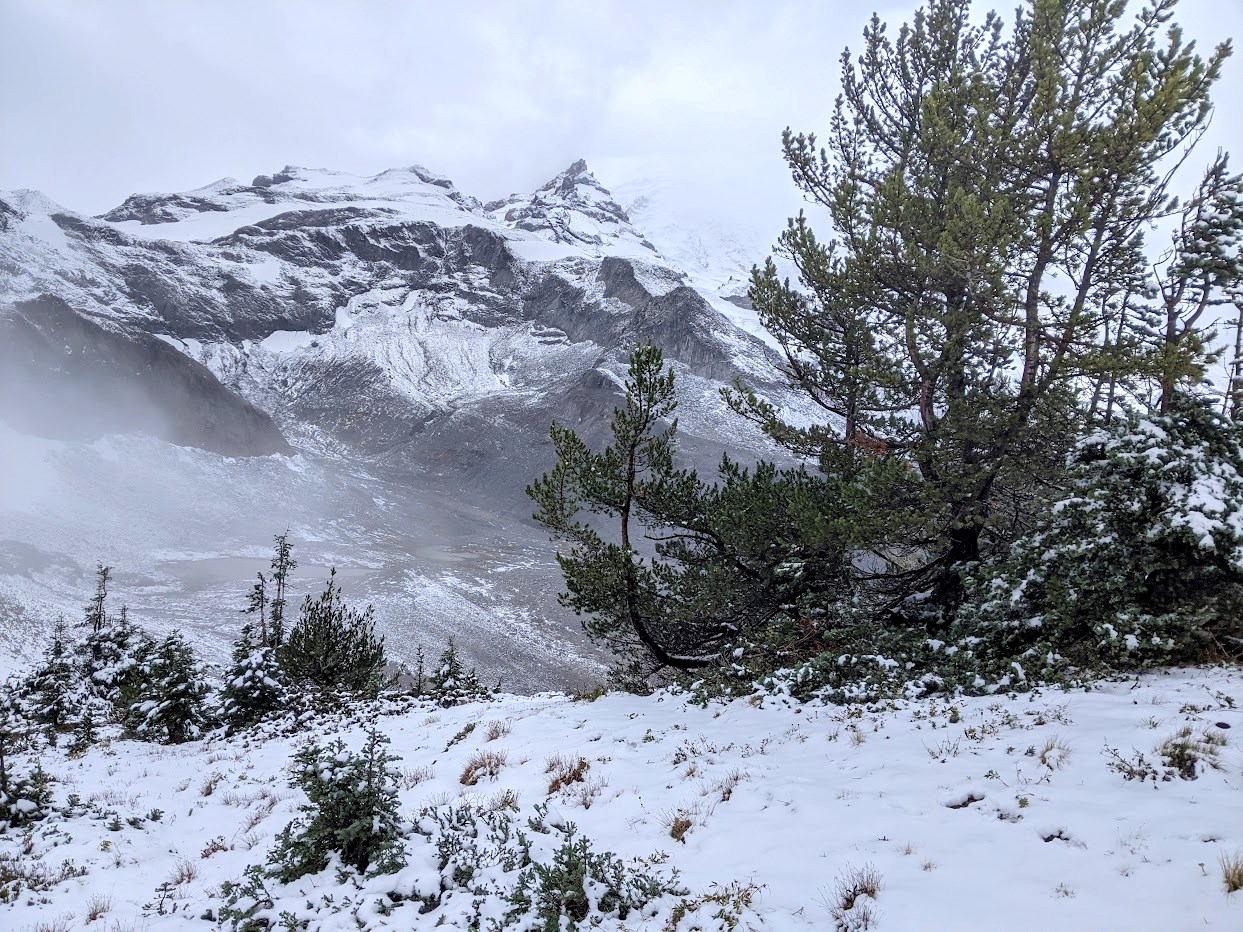
A whitebark pine tree in the winter landscape of the Panhandle Gap at Mount Rainier National Park. Image credit: NPS
Choosing and Nurturing the “Best of the Best”
While the U.S. Fish and Wildlife Service was considering whether whitebark should be listed, the Five Needle Pines Team and others in the whitebark pine conservation community began working on a plan to restore the species: the National Whitebark Pine Restoration Plan. The team partnered with land management agencies and tribal nations to identify “core areas” of whitebark pine—those where the species has the highest probability of long-term survival. The core area nominations were based on long-term monitoring data, research, and local knowledge. The team used several criteria to determine core areas in parks, such as stand condition, location, and how much the core areas contributed to the long-term resilience of the species. Another criterion was the feasibility of carrying out restoration actions. The goal was to have core areas represent 20-30 percent of the whitebark pine in each unit to ensure the species’ survival across its range.
Land managers have focused on improving the resiliency of these core areas. In addition to other strategies, they’re collecting and planting genetically proven rust-resistant seeds and seedlings.
To date, land managers have focused on improving the resiliency of these core areas. In addition to other strategies, they’re collecting and planting genetically proven rust-resistant seeds and seedlings in existing stands affected by white pine blister rust, mountain pine beetle, or wildland fire. These seeds and seedlings have a higher likelihood of survival than those without resistance. Protecting trees that generate rust-resistant seeds is thus central to whitebark pine’s long-term survival. This strategy is based on decades of research by scientists at the U.S. Forest Service’s Dorena Genetic Resource Center.

Wire mesh cages covering whitebark pine cones to protect them from predation. Once the cones are mature and open, restoration workers will remove the cages, harvest the cones, and use the seeds to grow seedlings. Image credit: NPS
Clark’s nutcrackers are also indispensable to the trees’ survival, as these birds are its primary means of dispersing seeds across the land. The fundamental goal of the National Whitebark Pine Restoration Plan is to restore whitebark pine communities within core areas to foster healthy populations that produce enough cones to attract Clark’s nutcrackers. The birds can then collect and disperse rust-resistant seeds, propagating resilient whitebark pine seedlings to regions outside core areas, as they have for thousands of years. Over time, these natural processes will restore whitebark pine across its range. But for this ambitious project to be successful, parks must continue collaborating with each other and their partners. This will enable them to optimize shared resources and benefit from strategic funding initiatives.

A Clark's nutcracker with a pine seed in its mouth at Craters of the Moon National Park & Preserve. These birds are the primary way in which whitebark pine seeds are dispersed. But they eat the seeds of many different pine species, so if whitebark pine seed production is subpar, the birds may abandon whitebark pine stands for other areas with more food. Image credit: NPS
Tools for Success
Climate modeling tools have helped scientists predict changes in the habitat ranges of North American trees due to climate change. The models indicate that warming temperatures will reduce whitebark pine’s available habitat over the next 100 years. To help park managers cope with this, the National Park Service’s Inventory and Monitoring Division, Climate Change Response Program, and partners are developing park-specific climate predictions and models. Partners include federal and state agencies, university scientists, and non-profits such as the Whitebark Pine Ecosystem Foundation, American Forests, Northern Rockies Conservation Cooperative, and the Arbor Day Foundation.
This type of planning depends on decades of dedicated research and data collection as well as ongoing modeling work using complex meteorological datasets.
When incorporated in the agency’s “Resist-Accept-Direct” framework (a service-wide blueprint for responding to “rapid, irreversible ecological change”), the models should help resource-strapped parks make realistic, strategic decisions that have a greater chance of succeeding. This type of planning depends on decades of dedicated research and data collection as well as ongoing modeling work using complex meteorological datasets. But exciting new tools like machine learning and remote sensing can help scientists select suitable restoration sites more efficiently.
Poised for Action
By the time the Bipartisan Infrastructure Law and Inflation Reduction Act were signed into law, the Five Needle Pines Team had been collaborating on whitebark pine conservation for years. Those infrastructure investments gave parks the opportunity to put into practice work that the team, participating parks, and partners had already envisioned.
The team’s strategies created an easy way to quickly respond to new funding opportunities. Nine parks in the west received over two million dollars to identify rust-resistant trees and core areas, collect and plant rust-resistant seed and seedlings, and monitor restoration activities. This built on 20 years of research and management actions at several parks.
###
Narrative description of whitebark pine distribution map
Brief description:
A base map of the western United States with pastel colors indicating the surface management agencies. Overlain is a map of whitebark pine distribution depicted with a magenta striped pattern. The highest whitebark pine concentrations are in central Idaho, western Montana, northwestern Wyoming, and along the Cascade Range through Washington and Oregon.
In-depth description:
A map of the Pacific west showing the following states: Washington, Idaho, Montana, Oregon, Wyoming, California, and Nevada.
Pastel colors on the map depict surface management agencies in the following colors:
- Yellow - Bureau of Land Management (BLM)
- Purple - National Park Service (NPS)
- Light Green - U.S. Forest Service (USFS)
- Dark Green - U.S. Fish and Wildlife Service (USFW)
- Orange - Bureau of Indian Affairs (BIA)
- Blue - State
The colors are distributed across the map with high concentrations of BLM land in Nevada, southeastern Oregon, southwestern Utah, and Wyoming. The second highest concentration is USFW land located along the Cascade Range through Washington, Oregon, and California as well as the Bitterroot Range in central Idaho and western Montana.
A magenta striped pattern indicates whitebark pine distribution. This distribution is concentrated in central Idaho, western Montana, northwestern Wyoming, and along the Cascade Range through Washington and Oregon. Smaller patches of whitebark pine appear in the Sierra Nevada Range in California, the Olympic Range in Washington, and smatterings in northeastern Nevada and northeastern Oregon.
Landscape-Scale Partnerships Are Key to Trees’ Survival
The tree’s naturally slow growth rate (25 to 50 years just to produce cones), loss of cone-producing trees, and impacts from white pine blister rust make it clear that we need to intervene at the landscape scale for whitebark pine to survive. Integrating across boundaries brings land managers together, increasing opportunities to share data, organize funding, and coordinate restoration actions. Cross-boundary cooperation is essential, for example, for managing wildland fire in whitebark pine habitat and learning of new threats.
Science is fundamental to the success of management actions to conserve this species, but having the resources to carry out these actions is also important.
Whitebark pine has been a part of the North American landscape for thousands of years. Its loss could have untold impacts on the ecosystems it inhabits. Science is fundamental to the success of management actions to conserve this species, but having the resources to carry out these actions is also important. With the help of recent infrastructure funding, the strong partnerships within and between the National Park Service, other land management agencies, and non-governmental organizations are accelerating our ability to save this keystone tree in the nation’s national parks.
###
Acknowledgments
The authors would like to thank the current, past, and future members of the National Park Service’s Five Needle Pines Team. These individuals work together and across boundaries to give us all hope in whitebark pine conservation. These individuals contributed to this article by providing quotes, insights, and reviews. We would also like to thank our partners within and external to the National Park Service who demonstrate that collaborations and diversity of thought make us better and stronger. And of course, whitebark pine, one the majestic stalwarts of high elevations in North America.
About the authors

Sarah Haas is an ecologist whose current position is deputy chief of Science and Resource Management at Grand Canyon National Park. Image credit: NPS / Sarah Haas

Stefanie Wacker is a restoration ecologist with the National Park Service’s Biological Resource Management Division. Image credit: NPS / Stefanie Wacker
Kristin Legg is program manager and ecologist of the National Park Service’s Greater Yellowstone Network.
Where this belongs
- Crater Lake National Park
- Devils Postpile National Monument
- Glacier National Park
- Grand Teton National Park
- Lassen Volcanic National Park
- Mount Rainier National Park
Where this page came from
This page was imported from National Park Service. Produced by the U.S. National Park Service and, as a work of the United States government, in the public domain.
Nobody has written it yet — it is the source material at a new address, which is why search engines are asked to skip it and why no one earns from it. It is up for grabs: take it on, and it is yours to rewrite and to earn from.
Nestas coleçõesGlacier National ParkCrater Lake National ParkLassen Volcanic National ParkMount Rainier National ParkGrand Teton National ParkDevils Postpile National Monument
Licença: CC0 1.0 (domínio público) · Adaptado de www.nps.gov
1
0
0
0

Comentários
Leia em seguida


