
Viu algo para melhorar? Proponha uma alteração.
Esta página é pública.
Related Materials
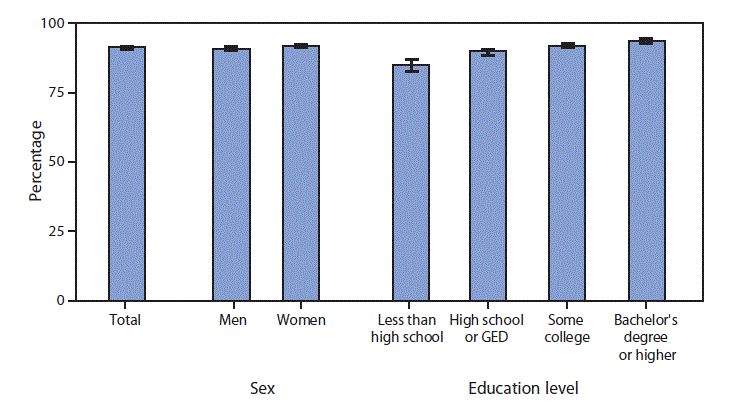
Abbreviation: GED = general educational development certificate.
- With 95% confidence intervals indicated by error bars.
† Based on the response to survey questions that asked “How often did your health care providers tell or give you information about your health and health care that was easy to understand? Would you say always, most of the time, some of the time, or none of the time?” Response categories “always” and “most of the time” were combined and displayed. Adults who had not seen a doctor in the past 12 months were excluded from these estimates.
§ Estimates were based on household interviews of a sample of the civilian, noninstitutionalized U.S. population and were derived from the National Health Interview Survey Sample Adult component.
In 2017, 91.6% of adults aged ≥25 years easily understood information from their health care providers most or all of the time. The percentage of adults who easily understood health care information most or all of the time increased as education level increased. Adults who had completed a bachelor’s degree or higher were the most likely to understand their health care providers at least most of the time (93.9%), whereas those without a high school diploma were the least likely (85.2%). Men (91.0%) were somewhat less likely than women (92.1%) to have easily understood information from providers most or all of the time.
Source: National Health Interview Survey, 2017. https://www.cdc.gov/nchs/nhis.htm.
Reported by: Alicia Jen; Carla Zelaya, PhD, czelaya@cdc.gov, 301-458-4164.
Where this page came from
This page was imported from Centers for Disease Control and Prevention. Material produced by the Centers for Disease Control and Prevention is a work of the United States government and is in the public domain.
Nobody has written it yet — it is the source material at a new address, which is why search engines are asked to skip it and why no one earns from it. It is up for grabs: take it on, and it is yours to rewrite and to earn from.
Licença: CC0 1.0 (domínio público) · Adaptado de www.cdc.gov
Comentários