Viu algo para melhorar? Proponha uma alteração.
Esta página é pública.
| 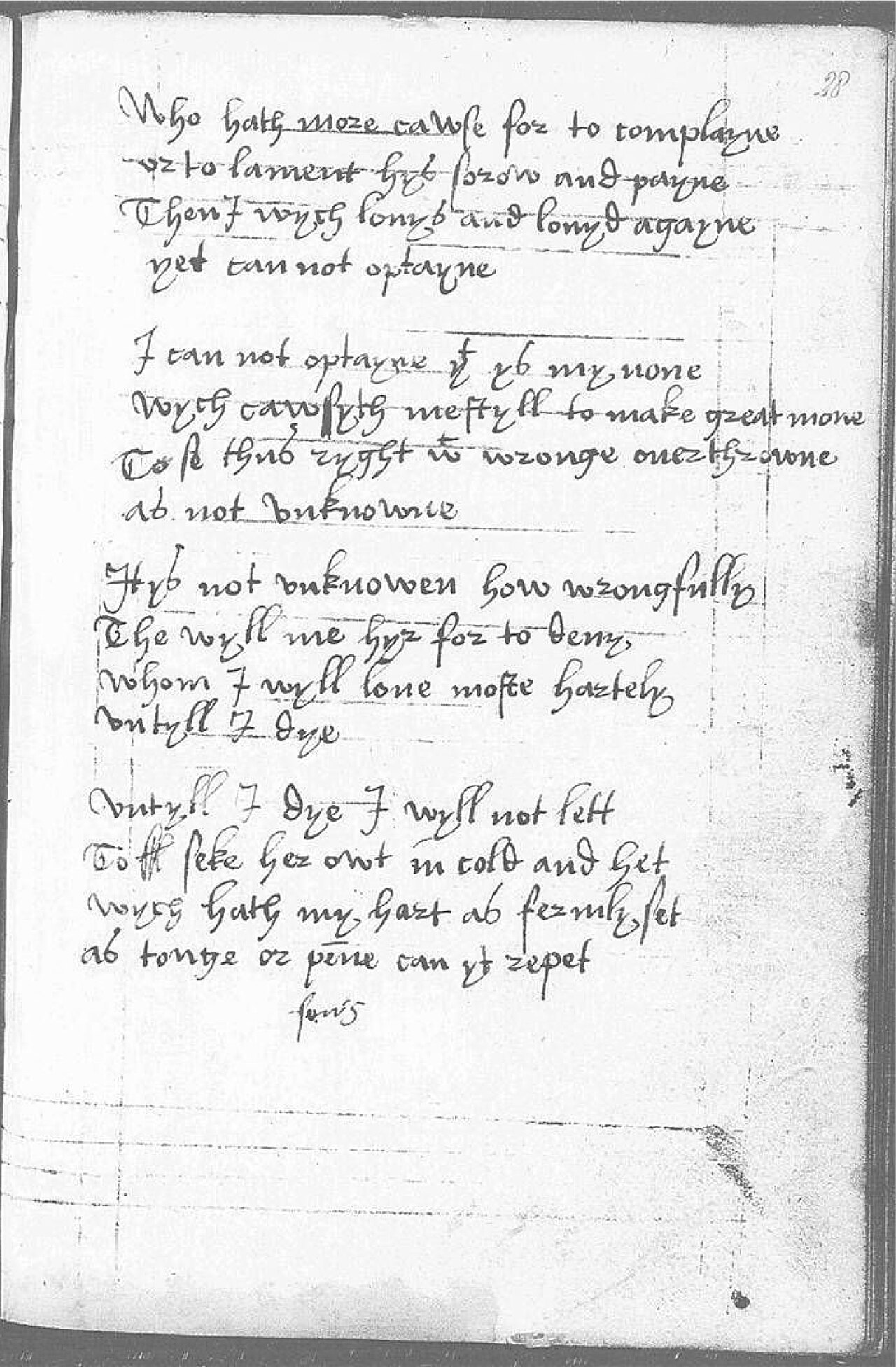
The Devonshire Manuscript facsimile 28r (Image: DMSEG, CC BY-SA 3.0) |
| --- |
|---|
f. [28r]
1 Who hath more cawse for to complayne
2 or to lament hys sorow and payne
3 Then I wych louys and louyd agayne
4 yet can not optayne
5 I can not optayne that{{th}+t+} ys my none
6 Wych cawsyth me styll to make great mone
7 To se thus ryght with{w+t+} wronge ouerthrowne
8 as not vnknowne
9 It ys not vnknowen how wrongfully
10 The wyll me hyr for to deny
11 whom I wyll loue moste hartely
12 vntyll I dye
13 vntyll I dye I wyll not lett
14 To ss1 seke her owt in cold and het
15 wych hath my hart as fermly set
16 as tonge or pen{_e}ne can yt repet
finis
Notes & Glosses
- The crossout is indistinct.
Commentary
Attributed to Lord Thomas Howard,1] this poem was entered into the Devonshire Manuscript by [TH2. Lines 8-9 allude to the injustice of the speaker’s situation and his entourage's knowledge of his plight. The phrase “my none” resonates with “my none swete wyfe” in the preceding poem, “Alas that men be so vngent” (27v).
Works Cited
Where this page came from
This page was imported from Wikibooks. From “The Devonshire Manuscript” on Wikibooks, by its contributors, under CC BY-SA 4.0. Changed here: set as a page; navigation and edit links left out; each image under its own licence, credited in its caption.
Nobody has written it yet — it is the source material at a new address, which is why search engines are asked to skip it and why no one earns from it. It is up for grabs: take it on, and it is yours to rewrite and to earn from.
Nestas publicaçõesThe Devonshire Manuscript
Licença: CC BY-SA 4.0 · Adaptado de en.wikibooks.org
Comentários