
Есть что улучшить? Предложите правку.
"Brook trout are the canary in the coal mine," says Dave Demarest, a wildlife and fisheries biological science technician at Shenandoah National Park in Virginia — and a lifelong angler who started fishing at three. Just as canaries once warned miners of dangerous gas, brook trout signal changes in cold-water streams. And in Shenandoah and other Eastern parks, where brook trout matter for recreation, culture and ecology, the warning signs are flashing red.
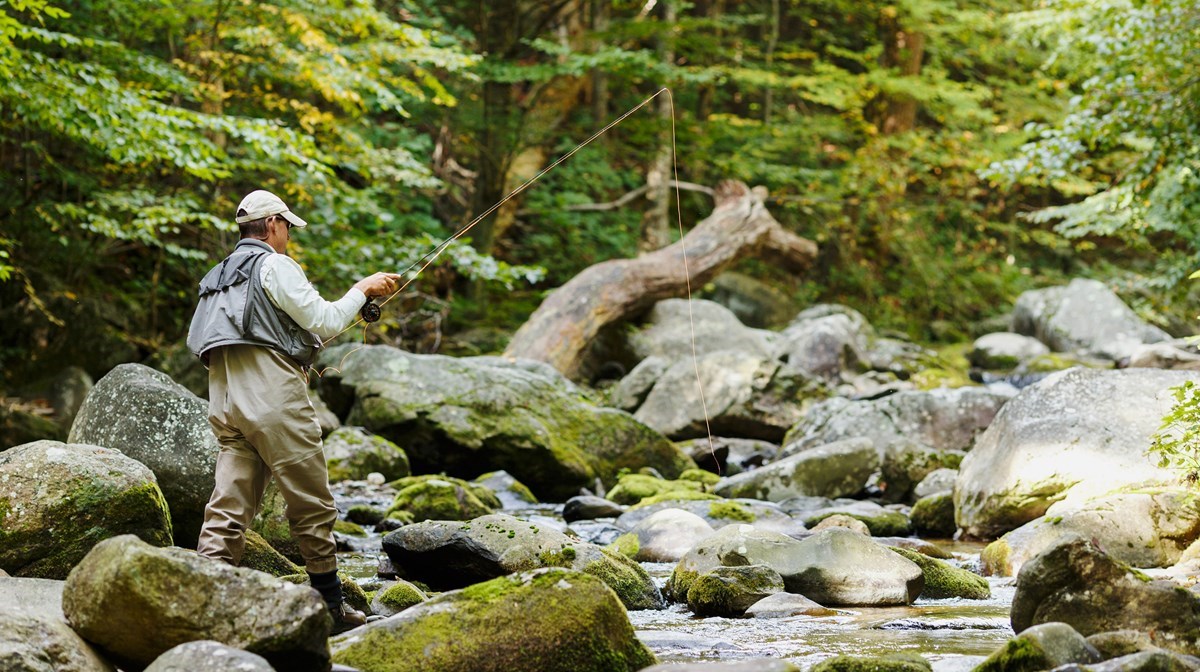
Shenandoah National Park has more than 90 mountain streams, many with brook trout. Credit: National Park Service.
What's happening
- In two-thirds of Shenandoah's streams, brook trout numbers have dropped by an estimated 50% over the past 25 years. In some, they have vanished.
- About 15% of the park's streams show increases — especially those with acid-sensitive geology or heavy past damage from acid rain, which seem to be recovering somewhat.
- The fish are retreating uphill. "Our brook trout are pushing upstream from the lower elevation waters at the park boundary," Demarest says. "We are the top of the watershed, and they are cold-water fish. They can only go so far upstream to find cold water."
No definitive cause has been found in Eastern parks, but climate change is a likely factor. Brook trout need cold, stable water, found at higher elevations and near groundwater springs. Declines elsewhere are often blamed on farming or degraded land, which are unlikely culprits inside a national park; as air and water temperatures rise nationwide, warming streams are suspected.

A stream in Great Smoky Mountains National Park. Credit: National Park Service.
Measuring the problem
By the end of October 2024, Demarest will have installed temperature loggers at 47 fish-monitoring sites across Shenandoah. The park has monitored brook trout since the 1980s — "a long-standing inventory and monitoring program," says Evan Childress, the park's chief of natural and cultural resources — and about 102 sites have been sampled periodically, giving the project a baseline.
Parks count trout by electrofishing: a battery and probes send a current through the water that briefly stuns fish so they can be netted, counted and released unharmed.

Brook trout are good indicators of stream health. Credit: National Park Service / U.S. Geological Survey.
A plan for Eastern parks
With Inflation Reduction Act funding, the Park Service — with Childress coordinating alongside U.S. Geological Survey scientists — is studying brook trout in four parks and building a strategy for the whole eastern United States, in three phases:
- Set priorities: parks and scientists agree on priorities and approaches for cold-water resources across Eastern parks.
- Assess status at Shenandoah, Acadia (Maine), Great Smoky Mountains (Tennessee and North Carolina) and Catoctin Mountain Park (Maryland).
- Plan action: park-specific plans with concrete steps toward conserving cold-water resources.
Streams that get too warm may no longer support brook trout, but they can still teach lessons for protecting others. "We can identify and prioritize streams that are going to be better suited for the species — even under the stress of climate change — and take actions to make sure they are protected from other kinds of disturbance," Childress says, such as keeping invasive species from disrupting the forests around streams whose future looks relatively good.

A stream in Shenandoah National Park. Credit: National Park Service / Anne Marie Pippin.
Why it matters
"Anglers love getting out there — seeing and catching fish," says Childress. Brook trout help draw visitors whose spending supports local communities. In 2023, 1.6 million visitors to Shenandoah spent an estimated $114 million in nearby communities, supporting 1,350 local jobs and $60.8 million in labor income.
Sources
Based on "Brook Trout on the Brink," by Anna Petr (October 2024), National Park Service; a work of the United States government in the public domain.
В изданияхAcadia National ParkCatoctin Mountain ParkShenandoah National ParkGreat Smoky Mountains National Park
Лицензия: CC0 1.0 (общественное достояние) · По материалам www.nps.gov
1
0
0
0

Комментарии


