
For more than half a century the floor of Drakes Estero, a 2,500-acre estuary in the middle of Point Reyes National Seashore in California, was covered in oyster-farm debris. After it was cleared, the Park Service watched the eelgrass come back — faster and thicker than anyone expected. Then, in 2021, a young sea otter released 118 miles to the south swam all the way up the coast and turned up there, raising the prospect that otters could return and make the eelgrass stronger still.

Drakes Estero from the air, with harbor seals on the central sandbar. NPS / Sarah Codde
An estuary worth saving
Drakes Estero spreads into five branching bays where the Pacific meets freshwater creeks and the land of the Point Reyes Peninsula. Estuaries like it are among the most productive places on Earth — nurseries, feeding grounds and corridors for countless animals — and this one is one of only two marine wilderness areas in the United States. Leopard sharks, tiny comma shrimp and shy harbor seals all live there.
"Up and down the West Coast, most of the estuaries are moderately to heavily developed," says Ben Becker, a Park Service science advisor. This is one of the few with "a chance at having somewhat natural processes without too much direct human influence."
The underwater forest
The foundation of the estuary is eelgrass, a flowering plant that grows in meadows just below the surface. Taylor Ellis, a Point Reyes wildlife technician who spends his summers surveying spotted owls in the Douglas fir canopy, sees the likeness to an old-growth forest: a whole ecosystem, he says, "hidden by just a few feet of water most of the time."
- A nursery. Fish and crabs lay eggs and raise larvae among the blades; migrating birds feed there.
- A hiding place. Some animals are camouflaged to match it — including the green-and-black Taylor's sea hare, a small sea slug that shares Ellis's name — and the bay pipefish sways in time with the blades.
- A carbon store. Eelgrass takes carbon from the water, keeps some in its tissue and locks the rest into the sediment with its roots and rhizomes. By slowing the water it also lets more sediment, and more carbon, settle. An acre of eelgrass can hold two to five times as much carbon as an acre of forest, for thousands of years if left alone rather than the decades typical on land. It steadies the bottom against erosion too.
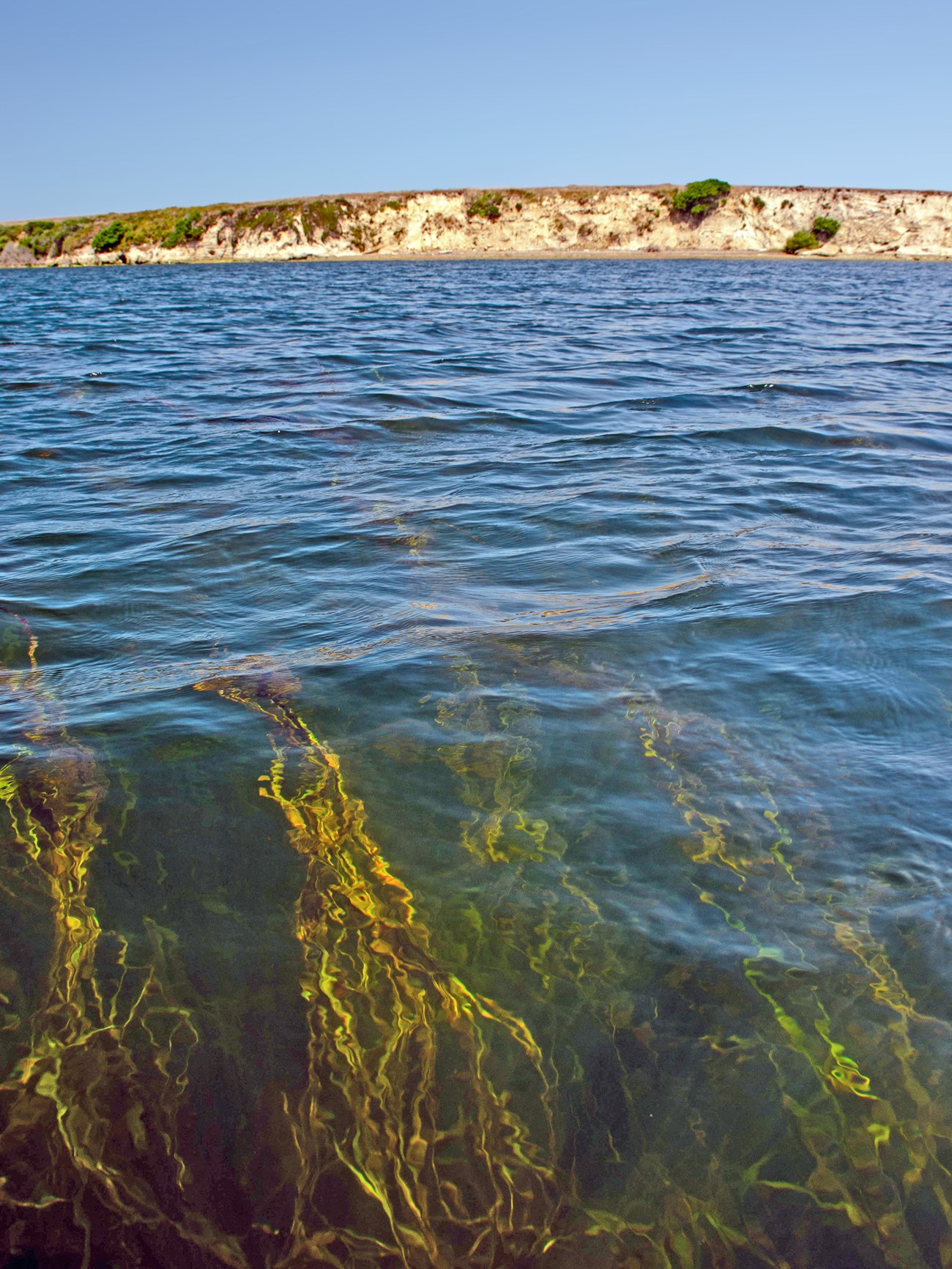
Eelgrass in Drakes Estero. NPS / Avani Fachon
The cleanup
After one of California's largest oyster farms closed in 2014, following a long and contested fight, the Park Service set about clearing the estuary with two partners, the National Park Foundation and the Point Reyes National Seashore Association.
| What came out | How much |
|---|---|
| Wooden oyster racks, many of pressure-treated wood | 95 — end to end, a line five miles long and 12 feet wide |
| Non-native Pacific oysters | millions |
| Further debris found by divers: shell, metal, racks, plastic rope, cement | 2.8 million pounds |
"There really had not been any formal or even informal surveys" of the bottom, Becker says. "We just had no idea … it was at that scale." Some of the debris had been piling up for more than 50 years.

Debris lifted from the estuary by a barge-mounted excavator in 2017. NPS
The racks had shaded out the eelgrass, and their hard surfaces were perfect for an invasive sea squirt, Didemnum vexillum ("D. vex"), which smothers eelgrass and stops it feeding and reproducing. Clearing them gave the plants room and light.
The work itself did damage — "we [were] trying to protect eelgrass, but [we had] to damage it in the process," says Sarah Codde, the park's marine biologist — so before it began, staff marked fifty monitoring plots: major-debris, wood-debris and low-debris plots, and controls with no racks at all.
Watching it come back
Every autumn Codde, Becker, Ellis and others go out by boat, string a transect tape between PVC poles, and a snorkeler photographs the eelgrass every five metres along it — eleven photos per line.

Laying the transect line, and Sarah Codde photographing along it. NPS / Avani Fachon
In the first three years after the cleanup, the photographs and aerial images showed 11,376 square feet of new eelgrass. Low-debris and wood-debris plots that had held little or none were fully grown over. "We're like, wait … are we swimming over the right area?" Codde says. "You [couldn't] really tell where the oyster rack was." The channels cut through the beds by work boats are closing up. The worst plots, those under heavy debris, have not recovered yet.


The same major-debris plot in 2016, covered in D. vex, and in 2022, full of eelgrass — with a Taylor's sea hare hidden on one blade. NPS
Why otters matter
Eelgrass and sea otters have evolved together for some 700,000 years. Beds with long-established otter populations are reported to be up to 30 percent more genetically diverse than beds without them. The reason is the otters' table manners: digging for clams, snails and crabs, they leave hundreds of small pits and break up the rhizomes. That stops the eelgrass from simply cloning itself with new shoots and pushes it to reproduce from seed, mixing its genes.
"Eelgrass beds will sexually reproduce to fill a new area, while asexual reproduction is meant to keep … the bed full," says Sarila Young, a San Francisco State University researcher. And sexual reproduction, she explains, "is … critical for resilience": a more varied population is more likely to include plants that can survive heat or other extremes. Young is now reading short stretches of eelgrass DNA from the restoration site to find out how the Drakes Estero beds are regrowing without otters.
Otter 882
In 2021 the Monterey Bay Aquarium's surrogacy programme released Otter 882, an 18-month-old southern sea otter who had been stranded as a three-week-old pup and raised at the aquarium. To her keepers' surprise and relief she survived shark-filled waters and swam 118 miles north from Monterey Bay to Drakes Estero, where otters once lived — the farthest any released otter had gone in its first two weeks.
At Elkhorn Slough, farther south, returning otters helped the eelgrass spread. Ecologists are now modelling whether Drakes Estero could support a population. Without the cleanup, it would not even be a candidate.
If you visit
- March 1 – June 30 the estuary is closed to boats, canoes and kayaks to protect harbor seals during pupping.
- Some oyster debris still washes up. A beach cleanup station run with the group All One Ocean lends reusable bags for collecting it.
- Humboldt, Mission, San Diego, San Francisco and Tomales bays hold more than 80 percent of California's eelgrass, all of them developed to some degree, and eelgrass is declining across the Northern Hemisphere. Local restoration groups welcome help.

Harbor seals are easily disturbed, especially while breeding. NPS
Sources
Written from "Biologists Restored an Estuary to Revive Eelgrass. Then an Otter Swam 118 Miles to Reach It," by Avani Skye Fachon, Park Science 38(1), Summer 2024, published by the National Park Service.
В подборкахPoint Reyes National Seashore
Лицензия: CC0 1.0 (общественное достояние) · По материалам www.nps.gov
1
0
0
0

Комментарии
Читать дальше


