
Dwight D. Eisenhower started 1942 as a newly appointed War Department planner for the Philippines and the Far East, a temporary brigadier general of three months who was little known outside military circles. By the end of the year he oversaw all Allied ground, naval and air forces, and "Ike" was practically a household name. Few of his 78 years did more to shape him. Before the seasoned, confident Eisenhower of 1944, there had to be the Eisenhower of 1942.
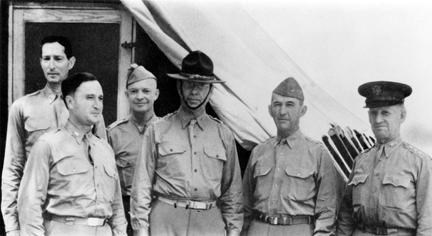
Eisenhower and other officers at the Louisiana Maneuvers, September 1941. Credit: Eisenhower Presidential Library.
A summons to Washington
When Japan bombed Pearl Harbor on December 7, 1941, Eisenhower was chief of staff of the Third Army in San Antonio, Texas. On December 12, Col. Bedell Smith called: the Army's chief of staff, Gen. George C. Marshall, wanted him in Washington. He arrived on December 14. Marshall had two reasons:
- The Louisiana Maneuvers. In August and September 1941, exercises meant to show which senior officers could handle the newly expanded Army, Eisenhower's Third Army beat the Second Army twice, and his reputation for strategy, organization and planning soared.
- The Philippines. Japan had attacked the islands eight hours after Pearl Harbor, and the situation was dire. Eisenhower knew them well: from October 1935 to December 1939 he had served there under Gen. Douglas MacArthur, military adviser to the new Philippine Commonwealth, officially as his assistant but in practice more as the adviser — dealing with President Quezon and senior U.S. Army and Navy officers, and contributing to war planning for the islands.
"We cannot save them"
After a briefing, Marshall asked for a plan. Eisenhower asked for a few hours, drafted one at a War Department desk and told Marshall the truth: the United States could not abandon the American and Filipino soldiers in the Philippines, but it could not save them. The war plans had depended on reinforcements from Pearl Harbor, now devastated, and even before the attack the Japanese navy had controlled the sea lanes from Hawaii to Manila. Instead, he proposed for the first time building up Australia, whose sea lanes to Hawaii the Allies could hold, and supplying the Philippines through it. That proposal of December 14, 1941, became the core of Allied strategy in the Pacific.
Marshall told him that too many officers kept coming to him for permission; he needed one who would decide for himself. That day Eisenhower took charge of planning for the Philippines and the Far East.
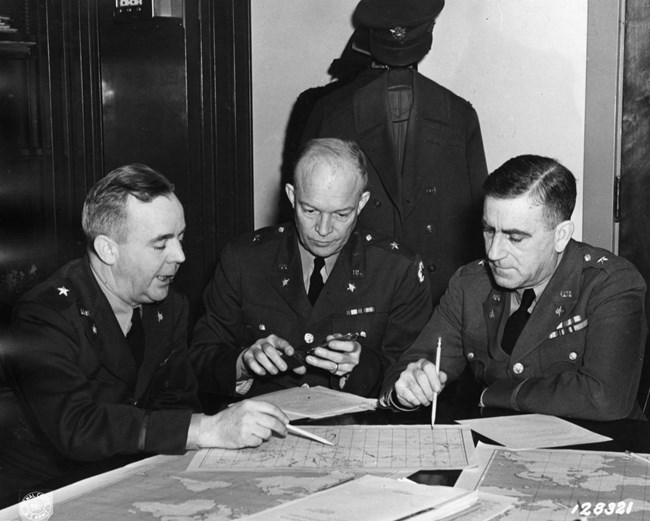
Eisenhower at the War Department in 1942. Credit: Eisenhower Presidential Library.
Rising through the War Department
Eisenhower found the department disappointing — all talk and no action, prima donnas everywhere, no common strategic objectives, and senior officers chasing small things instead of delegating. He worked until 10 p.m. every day, pushed through illness, thought big, helped reorganize the War Plans Division, and was willing to stand up to his old boss MacArthur, which Marshall liked. He labored to get aircraft and supplies to the Philippines by submarine and transport from Australia, but the U.S. and British navies would not commit carriers and other ships against Japan's control of the sea lanes to Bataan and Corregidor. When Roosevelt ordered MacArthur evacuated, Eisenhower thought Gen. Wainwright was the better general and should be the one to leave.
| 1942 | |
|---|---|
| February 16 | After only two months, Eisenhower becomes head of the War Plans Division, responsible for the whole world. He formalizes a global strategy and makes the division proactive; the reorganization he helped design becomes the Operations Division (OPD) |
| March 9 | His father, David, dies. He comforts his mother, Ida, by phone and takes thirty minutes of silence during the burial, but tells her war is not soft |
| March 27 | After a confrontation with Marshall over wartime promotions, Marshall promotes him to major general — Marshall's "stamp of approval," Eisenhower said |
| Spring | Marshall, unhappy after a trip to Britain with stalled cross-Channel planning and the American command there, sends Eisenhower for a second opinion. Eisenhower agrees, appalled by officers keeping to five o'clock quitting times and weekends and not knowing their British counterparts. His memo, "Command in England," calls for a lieutenant general who understands British organization. "You may be the man who executes it," Marshall says. "When can you leave?" |
| June 17 | His brother Roy dies unexpectedly; again Eisenhower cannot go home to Kansas for the funeral, and supports his sister-in-law financially |
| June 24 | Arrives in the U.K., after crediting his staff and thanking his mentor, retired Gen. Fox Conner |
| July 7 | Promoted to lieutenant general |
| August 6 | Named to command the Allied Expeditionary Force for the invasion of North Africa |
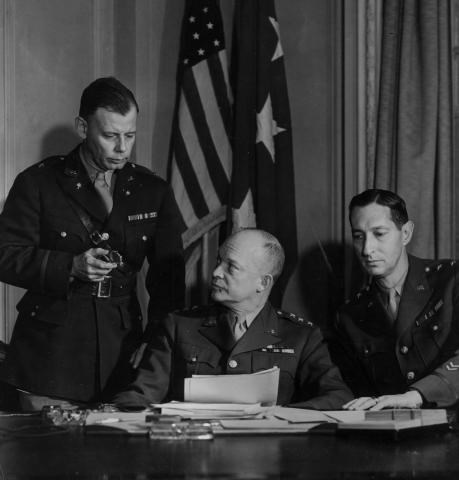
Eisenhower in London, 1942. Credit: Eisenhower Presidential Library.
In England, Eisenhower and Marshall accepted that there would be no cross-Channel invasion in 1942: there were too few landing craft, the Channel's weather was usually bad, the British feared disaster, and Britain was then the main supplier of equipment and men. Eisenhower learned to compromise with allies. He also met John Moaney, an African American soldier in a segregated Army, who had been doing vehicle maintenance when he interviewed to be Eisenhower's valet. They had much in common, and their relationship lasted thirty years; Eisenhower called him "The Indispensable Man."
Operation Torch
To keep the Soviet Union in the war, the Allies chose a realistic alternative for fall 1942: North Africa, where planners expected only token resistance. Landings began on November 8.
| Task force | Commander | Landed at |
|---|---|---|
| Western | Maj. Gen. Patton | Casablanca |
| Center | Maj. Gen. Fredendall | Oran, Algeria |
| Eastern | Maj. Gen. Ryder | Algiers, Algeria |
The goals were the Mediterranean shore of North Africa, then Tunisia and Tripoli and on to the east. The complications were political: would Vichy French forces fight the Allies, and would Spain's General Franco, who had accepted Nazi Germany's support in his civil war, stay neutral while British Gibraltar served as a base? A soldier, Eisenhower said, now had to be statesman, politician and diplomat too. He made a pragmatic choice to deal with Admiral Darlan, a fascist, to secure an armistice with all French forces in North Africa. It worked, but the "Darlan Deal" brought him wide condemnation.
The push east was delayed several times as he waited for supplies to build up and a long, wet winter set in; the Germans had supply problems too. By year's end he oversaw all Allied ground, naval and air forces, and was learning command at the highest level. The stage was set for 1943.
Sources
Based on "Eisenhower in 1942," National Park Service, part of the series Eisenhower in World War II; a work of the United States government in the public domain.
В подборкахEisenhower National Historic SiteDwight D. Eisenhower MemorialWorld War II Memorial
Лицензия: CC0 1.0 (общественное достояние) · По материалам www.nps.gov
1
0
0
0

Комментарии
Читать дальше


