
Есть что улучшить? Предложите правку.
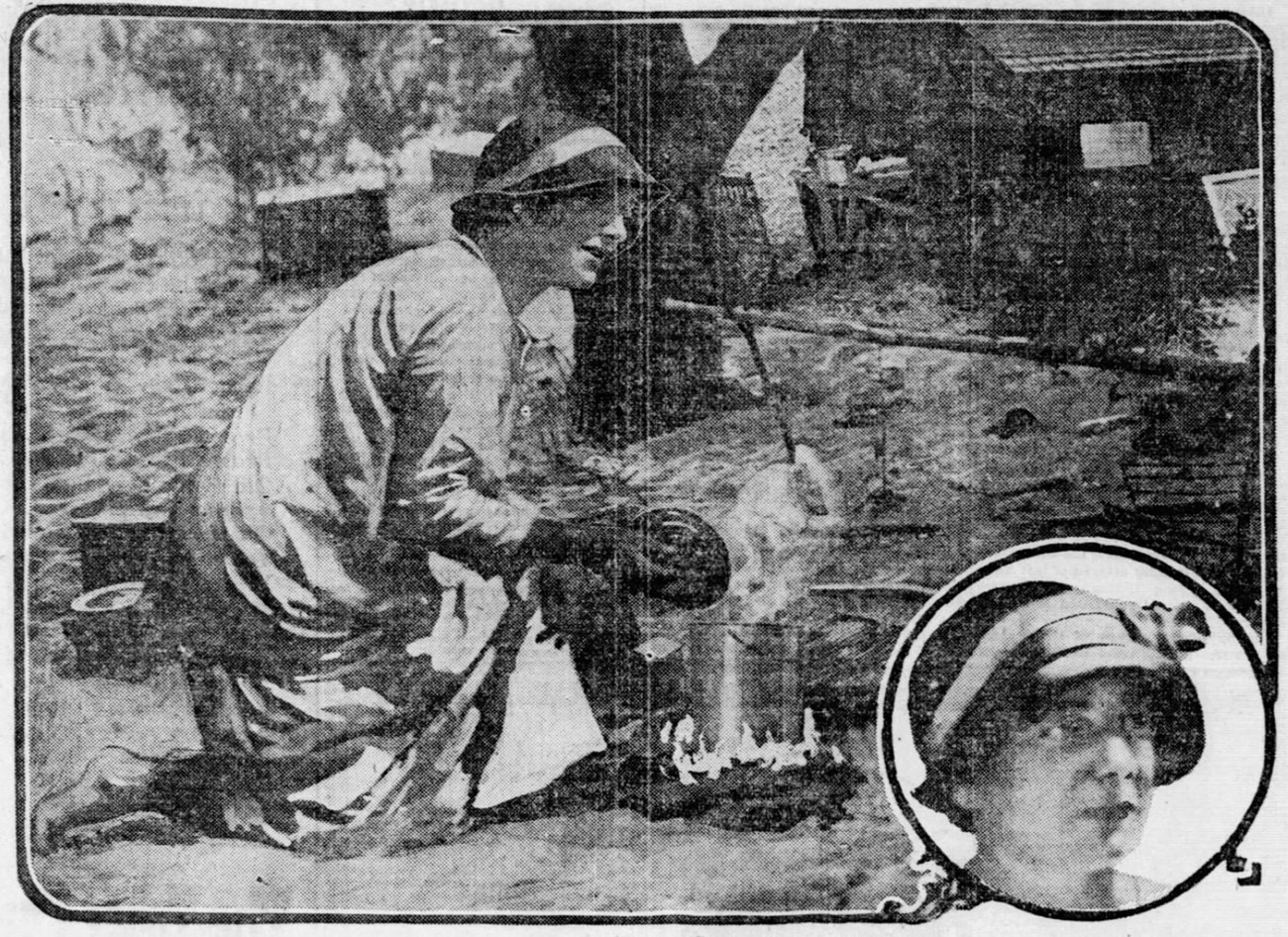
"'Diana of the Dunes' preparing a meal at her wilderness home. She does all her cooking over a fire built in the open. The hut, deserted by fishermen, in which she sleeps, is shown in the background." Chicago Tribune, July 24, 1916.
On October 31, 1915, Alice Mabel Gray left Chicago. Unhappy with city life, she took the train to the Indiana Dunes in search of simplicity and solitude. The following summer a reporter, Honor Fanning, found her at her shack on Lake Michigan, and Fanning's article was reprinted in dozens of newspapers across the country.
The reporter's journey
Fanning described a place miles from any human voice, at the foot of high sand dunes, among pines and marshes, and walled off from the world by two miles of nearly impassable sand drifts and boggy ground. Fishermen had only just discovered the woman living there. Fanning claimed to be the first woman to reach her, and compared her solitude to Alexander Selkirk's on his desert island.
The nickname came from the Roman goddess Diana, the chaste huntress of mythology, who shunned men for the wilderness.
Fanning arrived at dawn to find the hut empty except for a bed of green boughs with two revolvers at its foot. Then a young woman burst out of the pine scrub: strong and lithe, clear-eyed and smiling, bare-legged, her hair cut short like a boy's, her face tanned deep brown, wearing a single garment. Startled and frightened, she asked who Fanning was, saying she must not see strangers and had hoped no one would find her. It took some time to convince her that Fanning meant well.
In her own words
Gray objected to being called a hermit or a mystery woman:
"We are all mysteries to somebody or other. I must remain a mystery to the public for a time. I came here to the wilderness to seek—well, to seek myself. I was working in Chicago, making little in the way of money, doing little of importance to the world, it seemed. I had measured myself with the world—the results were not encouraging. I came here to measure myself with nature."
She had first slept in a cave in the hills, under the stars. "I BEGAN TO LIVE," she said. "I have had ten glorious months. … I AM FREE."
Who she was
Gray admitted a few facts. She had graduated from the University of Chicago in 1903 and held a secretarial job at a large publishing house, where people expected her to have a literary career. Then one day she grew tired of the world. She packed a red Mexican blanket from her room, a few clothes and her pay envelope, with "just a few dollars in it," and came to the dunes, where there was no house in sight and only birds to greet her.
Living on driftwood
A dugout proved too cold, so she moved into a hut abandoned by fishermen. Almost everything she owned had washed up from the lake:
"Everything I have here, this chair, this cap I wear, these tins, are driftwood, drifted in from the lake—I, too, am driftwood. I got sail's cloth from a fisherman and made this thing I wear. I got rid of everything that looked like the city."
Fishermen up the beach sometimes brought her extra food from town, which she bought, and farm boys sold her eggs. She had, she said, cut the cost of living to almost nothing, 10 cents a day at most.
She expected she might go back someday. "But the city can never give me what the wilderness has given me—peace of mind, and the strength of mind to live alone."
Sources
- National Park Service, Indiana Dunes National Park, "An Early Account of Diana of the Dunes": https://www.nps.gov/articles/000/an-early-account-of-diana-of-the-dunes.htm
- Honor Fanning, "'Diana of the Dunes,' Fled from World of Men, Discloses Mystery of Weird Life to Woman Writer," The Fort Wayne News and Sentinel, August 1, 1916, page 11.
- National Park Service, "Alice Gray": https://www.nps.gov/people/alice-gray.htm
В изданияхIndiana Dunes National Park
Лицензия: CC0 1.0 (общественное достояние) · По материалам www.nps.gov
1
0
0
0

Комментарии


