
Nine girls in long Western dresses stand at tables, ironing, in a bare laundry room while a white matron looks on. It looks like an ordinary afternoon. But every girl in the picture had been taken from her family. The photograph, probably by the superintendent, Frank Fuller Avery, was made at the Fort Spokane Indian boarding school in Washington State — the only one of the 408 federal Indian boarding schools set up between 1819 and 1969 that the National Park Service now owns and manages.
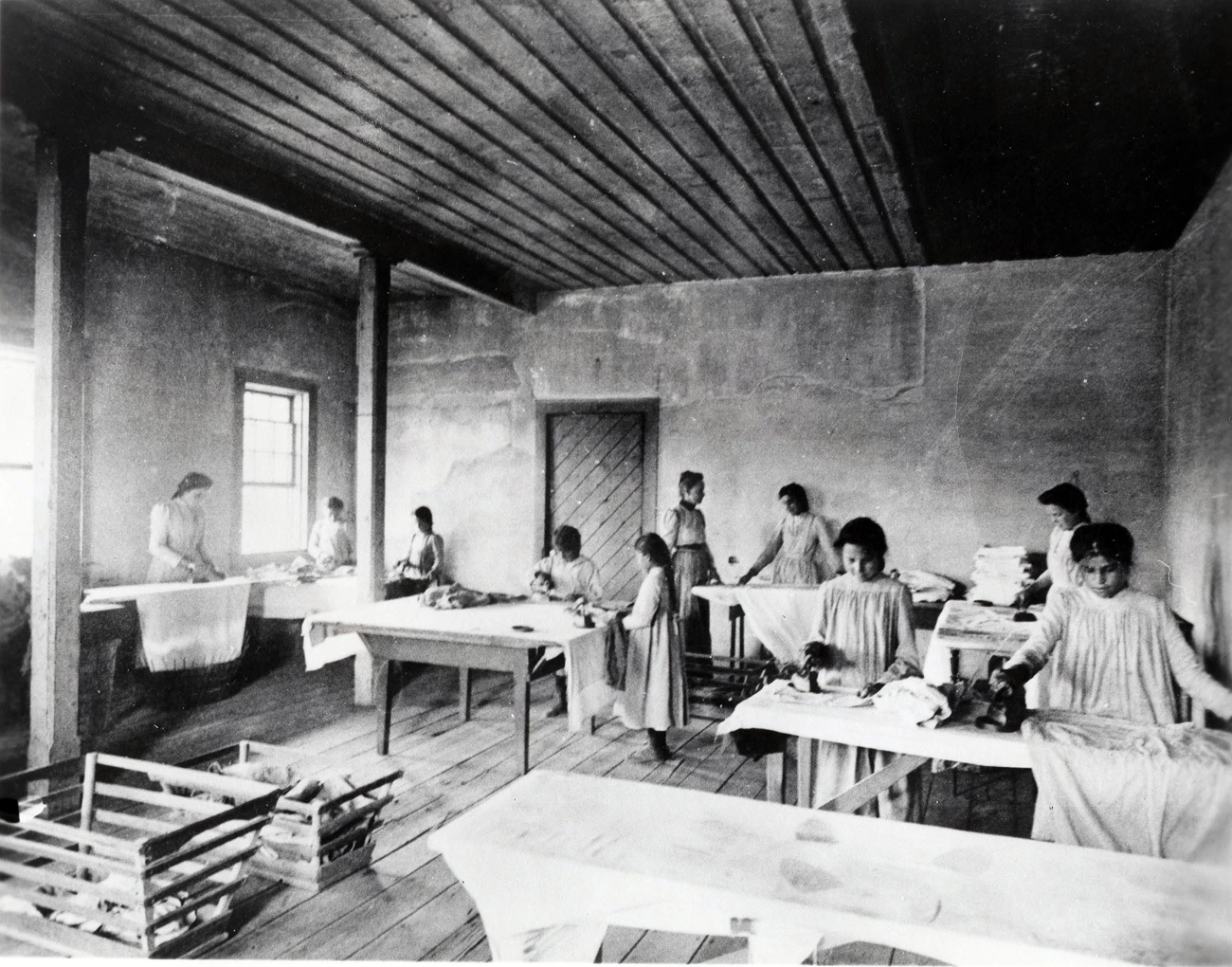
Girls ironing in the laundry at Fort Spokane. The photographer is unknown, probably Superintendent Frank Fuller Avery. Credit: National Park Service collections (LARO 2246).
"I have never forgotten how the steam in the laundry made me sick; how standing and ironing for hours made my legs ache far into the night," recalled Irene Stewart, a Navajo girl sent to a boarding school in Arizona. "I think this is why the boys and girls ran away from school; why some became ill; why it was so hard to learn. We were too tired to study."
From fort to school
Fort Spokane was founded in 1880 as a military post to keep the Confederated Tribes of the Colville and the Spokane Tribe of Indians on their reservations and away from arriving white settlers. From 1900 to 1907 it was a boarding school. Its surviving buildings are part of Lake Roosevelt National Recreation Area.
Before the school, children on the Colville and Spokane Reservations grew up among relatives, in a web of family ties and obligations that connected them to kin and to the land. With the boarding school open, the Colville Indian Agency closed the local reservation day schools and threatened to jail parents who did not send their children — some as young as five, some as far as 60 miles away.
Making a "fixed home"
The aim was to "Americanize" the children by erasing their Native identity, including their ties to their ancestral lands.
- Bodies. On arrival, children were bathed, their soft buckskin clothing thrown away and replaced with wool and cotton, and the braids boys had grown since birth cut off. "I was homeless," Stewart wrote decades later. "No one cared for me as my old home folks had. I feared everything, especially the people and the strange facilities."
- Substitute mothers. The government hired white women as matrons — "mothers" to replace the children's own — who socialized them into mainstream American ways through surveillance and discipline.
- Military routine. The laundry was the fort's old guardhouse. Schools ran on drills, inspections, marching and rigid timetables, unlike Indigenous ways of learning that followed the sun and the seasons and mixed practice with play.
- Gendered labor. In the afternoons girls learned housework such as laundry, and boys farming and industry. At home, girls would have learned to dig camas roots with digging sticks, tan hides, make baskets and prepare food; boys to hunt, fish and make tools and weapons.
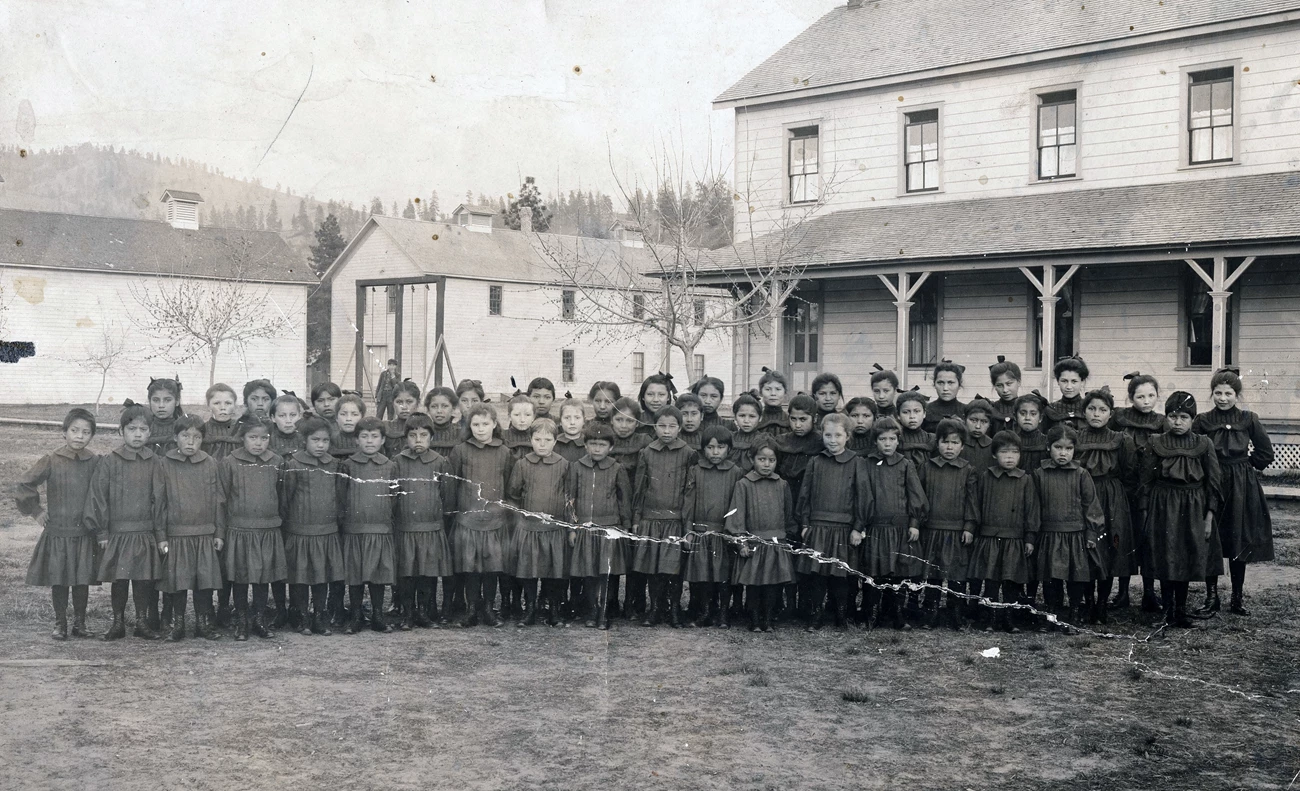
Schoolgirls, many of them Indigenous, at Fort Spokane, about 1903. Credit: National Park Service collections (LARO 3016).
Reformers claimed they were teaching the art of the "fixed home," in the hope that students would carry it back to the reservations. In practice, the vocational training prepared children to be low-wage workers, and "outing programs" placed students in white homes as servants — saving the government money and supplying cheap labor.
What the picture leaves out
The girls ironing could speak only English — their Salish was forbidden — and called one another by the American names forced on them when they arrived. They slept in large, cold dormitories without keepsakes from home. Children could be locked in the cramped solitary cells once used to punish soldiers, and illness took many young lives. As tribal members say today, the boarding school era "tore the very fabric of tribal society."
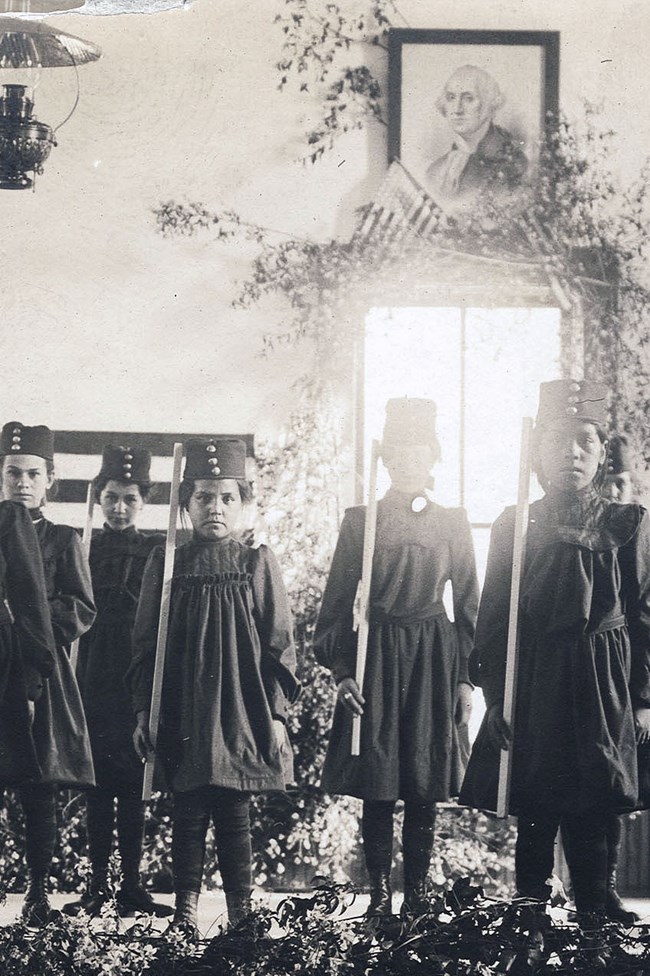
A children's program for Washington's Birthday. Credit: National Park Service collections (LARO 2228).
Nor does the photo show how the children resisted. Many ran away, despite harsh punishment if caught; others secretly kept traditions alive, telling Native stories late at night or through play at recess. In time, Colville and Spokane parents refused to send their children, and Fort Spokane had to close. Today the Colville and Spokane Tribes are helping the country reckon with this history, and reviving their ties to their homelands. "It is our Language and Culture," tribal members say, "that offers a healing process to overcome the damage of Boarding Schools for this generation and those to come."
Sources
Based on "Fort Spokane Indian Boarding School" by Nicole Martin, PhD, part of the National Park Service's Home and Homelands exhibition (Lake Roosevelt National Recreation Area), made possible in part by a grant from the National Park Foundation; a work of the United States government in the public domain. It draws on information from Colville, Spokane and nimíipuu tribal members; Irene Stewart, A Voice in Her Tribe (1980); Margaret Jacobs, White Mother to a Dark Race (2009); David Wallace Adams, Education for Extinction (2020); and the Department of the Interior's 2022 Federal Indian Boarding School Initiative report.
В подборкахHome and Homelands Exhibition: LossLake Roosevelt National Recreation Area
Лицензия: CC0 1.0 (общественное достояние) · По материалам www.nps.gov
1
0
0
0

Комментарии
Читать дальше


