Ann Carpenter, DVM1; Naomi A. Drexler, DrPH2; David W. McCormick, MD2; Julie M. Thompson, DVM, PhD2; Gilbert Kersh, PhD2; Scott P. Commins, MD3; Johanna S. Salzer, DVM, PhD2 (
Summary
What is already known about this topic?
Alpha-gal syndrome (AGS) is an emerging, tick bite–associated allergic condition characterized by a hypersensitivity to an oligosaccharide found in most mammalian meat and products derived from it. Symptoms can be life-threatening and can include anaphylaxis. Cases are increasing, although patients report limited health care provider (HCP) awareness of AGS.
What is added by this report?
HCP respondents (N = 1,500) to a nationwide survey had limited AGS knowledge: 42% were not aware of AGS, and another 35% were not confident in their ability to diagnose or manage AGS patients.
What are the implications for public health practice?
Limited HCP knowledge about AGS is concerning, especially because the number of suspected cases is increasing, and the range of the tick primarily associated with this condition is expected to expand. Improved HCP education might facilitate a rapid diagnosis of AGS, improve patient care, and support public health understanding of this emerging condition.
Tables
Related Materials
Close
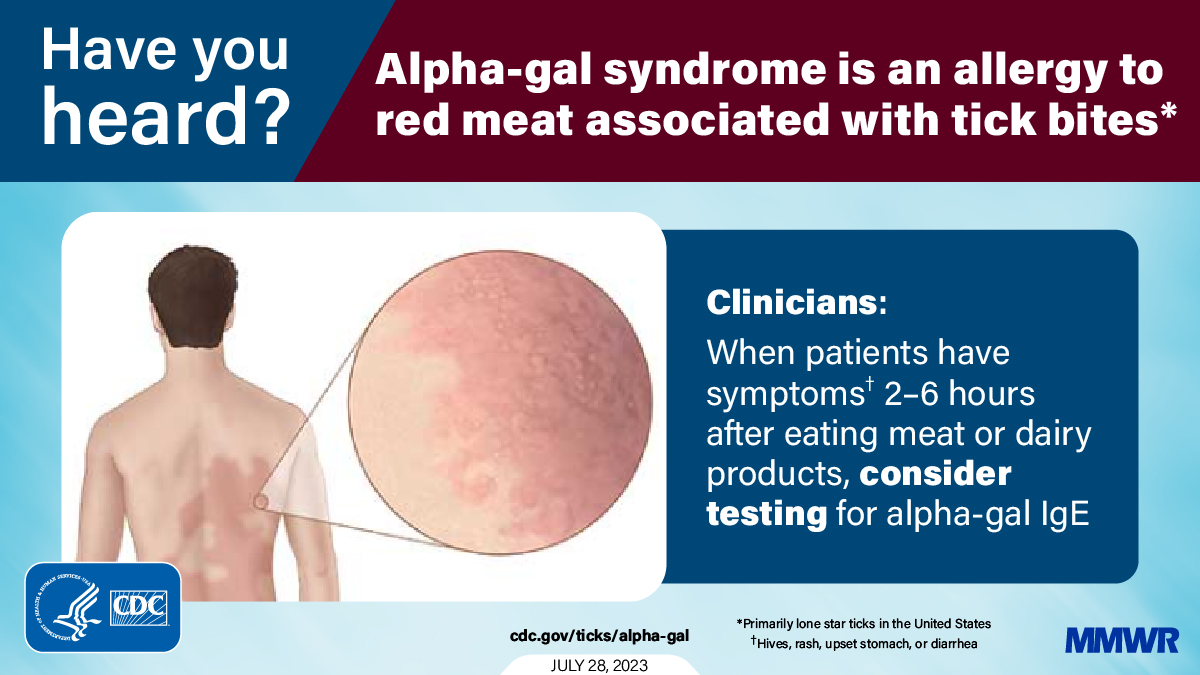
Download Image[JPG]
Abstract
Alpha-gal syndrome (AGS) is an emerging, tick bite–associated immunoglobulin E–mediated allergic condition characterized by a reaction to the oligosaccharide galactose-alpha-1,3-galactose (alpha-gal), which is found in mammalian meat and products derived from mammals, including milk, other dairy products, and some pharmaceutical products. Symptoms range from mild (e.g., a rash or gastrointestinal upset) to severe (anaphylaxis); onset typically occurs ≥2 hours after exposure to alpha-gal. No treatment or cure is currently available. Despite the potential life-threating reactions associated with AGS, most patients perceive that health care providers (HCPs) have little or no knowledge of AGS. A U.S. web-based survey of 1,500 HCPs revealed limited knowledge of AGS, identified areas for continuing medical education, and described self-reported diagnostic and management practices. Overall, 42% of surveyed HCPs had never heard of AGS, and among those who had, fewer than one third knew how to diagnose the condition. Two thirds of respondents indicated that guidelines for the diagnosis and management of AGS would be useful clinical resources. Limited awareness and knowledge of AGS among HCPs likely contributes to underdiagnosis of this condition and inadequate patient management, and underestimates of the number of AGS patients in the United States, which currently relies on laboratory testing data alone.
Introduction
Alpha-gal syndrome (AGS) is an emerging, tick bite–associated, immunoglobulin E (IgE)–mediated allergic condition characterized by a reaction to galactose-alpha-1,3-galactose (alpha-gal), a sugar molecule found in most nonprimate mammals. Evidence suggests that the reaction is primarily associated with the bite of the lone star tick (Ambylomma americanum) in the United States. Cases are most prevalent in the southern, midwestern, and mid-Atlantic United States, overlapping the range of the lone star tick (1–3). No treatment or cure is currently available. Despite the potential life-threatening reactions associated with AGS, patients perceive that health care providers (HCPs) have little or no knowledge of AGS (4). Data from a nationwide, web-based survey of HCPs in the United States (DocStyles, Spring 2022), administered by Porter Novelli Public Services, were analyzed to determine HCP knowledge relating to the diagnosis and management of AGS.
Methods
HCPs were identified from the SERMO Global Medical Panel, a physician networking platform with an opt-in, verified panel of medical professionals who receive an honorarium for participating in market research surveys. Panelists were verified using a double opt-in sign up process with telephone confirmation at their place of work.* SERMO identified a random sample of eligible providers from its main database and distributed an electronic invitation to participate in the study, including a link to the web-based survey.† The minimum number of respondents, or survey quota, was set to reach 1,500 primary care practitioners.§ Respondents were providers who actively saw patients; worked in an individual, group, or hospital practice; and had practiced for >3 years.
The analysis was limited to family practitioners, general practitioners, internists, pediatricians, nurse practitioners (NPs), and physician assistants (PAs). Frequencies and percentages were calculated, and Pearson chi-square tests were used to compare categorical variables, using SAS software (version 9.4; SAS Institute).
To assess multifactorial knowledge, a composite knowledge score was calculated for all respondents with a maximum score of 3; one point was awarded for each correct answer to the following three topics: 1) how AGS is acquired, 2) appropriate diagnosis of AGS, and 3) counseling of patients with AGS. Scores ranged from 0 (no answers correct) to 3 (all answers correct). This activity was reviewed by CDC and was conducted consistent with applicable federal law and CDC policy.¶
Results
A total of 1,500 respondents completed the survey, including 1,000 primary care physicians, 250 pediatricians, and 250 PAs and NPs. Overall, 974 (65%) respondents worked in a group outpatient practice or clinic, approximately one third worked in an individual outpatient practice (235; 16%), or in an inpatient practice or a hospital (291; 19%). The largest percentage of respondents worked in the U.S. Census Bureau South Region** (472; 32%), followed by the Northeast Region (377; 25%), and the Midwest Region (337; 22%); approximately one fifth worked in the West Region (314; 21%).
Overall, 635 (42%) respondents had not heard of AGS, and another 530 (35%) reported that they were “not too confident” about their ability to diagnose or manage patients with AGS (
Among all respondents who were aware of AGS, 416 (48%) reported that they did not know the correct diagnostic tests to order. One third of respondents (285; 33%) correctly reported that patients develop AGS after a tick bite, and approximately one third (272; 32%) reported not knowing how it was acquired. More than one half of the respondents (502; 58%) correctly identified topics on which to counsel AGS patients, such as tick bite prevention, eliminating red meat from their diet, exercising caution when receiving new medications and vaccines, and recognizing and managing anaphylaxis. Overall, 64% and 66% of respondents indicated that guidelines for the diagnosis and management of AGS, respectively, would be helpful clinical resources.
Among the 865 survey respondents who had heard of AGS, only 42 (5%; 95% CI = 3.1%–5.9%) correctly answered all three questions related to etiology, testing, and patient counseling (
Discussion
This analysis indicated a low level of knowledge among U.S. HCPs regarding the diagnosis and management of AGS, with 78% of providers having little to no knowledge of AGS. Previous assessments of AGS knowledge among HCPs in the United States were limited to small studies within individual jurisdictions but found similar patterns of an overall lack of knowledge among those surveyed (5,6).
Few HCPs reported diagnosing AGS or managing patients with AGS within the previous year, despite an annual increase in the number of tests performed and suspected AGS cases identified nationally and the number of persons who received positive test results increasing from 13,371 in 2017 to 18,885 in 2021†† (1,3). Provider knowledge of AGS etiology, testing, and patient counseling decreased as the number of patients they reported diagnosing or managing with AGS increased. This inverse association suggests that some HCPs might be incorrectly diagnosing AGS, possibly on the basis of symptoms or testing alone, and subsequently recommending dietary modifications where none are warranted. This limited provider knowledge might also lead to delayed or missed diagnosis and incorrect patient management. A growing number of resources are available for HCPs seeking additional education related to the evaluation, diagnosis, and management of patients with AGS (7,8). Diagnosis of AGS requires careful elicitation of a history in a patient with compatible symptoms, and diagnostic testing for alpha-gal–specific IgE antibodies (≥0.1 kU/L is considered a positive test result) (8). A 2015 study found that approximately one fifth (21%) of patients received a diagnosis within their first year of signs and symptoms, whereas the remaining 79% received a diagnosis in an average of 7.1 years (9). Repeated visits to HCPs and referrals to specialists might be necessary for patients to receive a proper diagnosis and care, creating a disadvantage to those patients who face challenges seeking health care in general or who lack access to specialty practitioners, such as allergists.
Limitations
The findings in this report are subject to at least two limitations. First, the findings might not be generalizable to all practicing HCPs in the United States since respondents were part of a provider panel. Second, providers might have interpreted response options differently. For example, when asked about how a patient acquires AGS, one response option was “the cause is not yet known.” Although tick bites have been widely recognized as triggering the hypersensitivity to alpha-gal (2), and “tick bites” was considered the correct response, the detailed immunologic aspects of the tick bite etiology of AGS are still being investigated. These possible differences in interpretation, as well as the nature of self-reporting, might have contributed to misclassification of responses as being correct or incorrect.
Implications for Public Health Practice
Considering the recent description of a continued increase in the number of persons receiving positive alpha-gal–specific IgE (sIgE) antibody test results, growing numbers of suspected AGS cases (3), and expanding North American ranges of the lone star tick (10), the knowledge gap found in this survey of HCPs is concerning. Currently, AGS is not a nationally notifiable condition, and understanding epidemiologic trends relies on laboratory-based surveillance (1,3). The lack of HCP knowledge of AGS is likely to lead to undertesting, further hampering knowledge of the national prevalence of AGS.§§ Increased HCP education and awareness of AGS are needed to hasten and improve the accuracy of AGS diagnoses, patient care, and the understanding of the epidemiology of this emerging condition.
Acknowledgments
Eleanor Farley Saunders, Fred Fridinger, Lyle Petersen.
Corresponding author: Ann Carpenter, pzy4@cdc.gov.
1Epidemic Intelligence Service, CDC; 2Division of Vector-Borne Diseases, National Center for Emerging and Zoonotic Infectious Diseases, CDC; 3Division of Rheumatology, Allergy, and Immunology, Department of Medicine, School of Medicine, University of North Carolina at Chapel Hill, Chapel Hill, North Carolina.
All authors have completed and submitted the International Committee of Medical Journal Editors form for disclosure of potential conflicts of interest. Scott P. Commins reports institutional support from the National Institute of Allergy and Infectious Diseases, National Institutes of Health; royalties from UpToDate, Inc.; payment or honoraria from Genentech for participation in educational events and from Regeneron for participation in an advisory meeting; and an unpaid position as president-elect of the Southeastern Allergy, Asthma, and Immunology Society. No other potential conflicts of interest were disclosed.
† Panelists were verified using a double opt-in sign-up process with telephone confirmation at place of work.
§ A total of 1,000 family or general practitioners and internists, 250 pediatricians, and 250 mid-level health care providers (nurse practitioners and physician assistants).
¶ 45 C.F.R. part 46, 21 C.F.R. part 56; 42 U.S.C. Sect. 241(d); 5 U.S.C. Sect. 552a; 44 U.S.C. Sect. 3501 et seq.
** https://www2.census.gov/geo/pdfs/maps-data/maps/reference/us_regdiv.pdf
†† The national standardized case definition accepted in 2021 by the Council of State and Territorial Epidemiologists defined a confirmed case of AGS as being in a person who met the clinical criteria and confirmatory laboratory evidence (serum or plasma sIgE specific to alpha-gal ≥0.1 IU/mL or ≥0.1 kU/L). A suspected case of AGS was defined as being in a person who had confirmatory laboratory evidence with no clinical information available. https://ndc.services.cdc.gov/case-definitions/alpha-gal-syndrome-ags/
§§ https://www.cdc.gov/ticks/alpha-gal/index.html
References
- Binder AM, Commins SP, Altrich ML, et al. Diagnostic testing for galactose-alpha-1,3-galactose—United States, 2010–2018. Ann Allergy Asthma Immunol 2021;126:411–16.e1. https://doi.org/10.1016/j.anai.2020.12.019 PMID:33422649
- Macdougall JD, Thomas KO, Iweala OI. The meat of the matter: understanding and managing alpha-gal syndrome. ImmunoTargets Ther 2022;11:37–54. https://doi.org/10.2147/ITT.S276872 PMID:36134173
- Thompson J, Carpenter A, Kersh GJ, Wachs T, Commins SP, Salzer JS. Geospatial distribution of suspected alpha-gal syndrome cases—United States, January 2017–December 2022. MMWR Morb Mortal Wkly Rep 2023;72:815–20. https://www.cdc.gov/mmwr/volumes/72/wr/mm7230a2.htm?s_cid=mm7230a2_w
- Flaherty MG, Threats M, Kaplan SJ. Patients’ health information practices and perceptions of provider knowledge in the case of the newly discovered alpha-gal food allergy. J Patient Exp 2020;7:132–9. https://doi.org/10.1177/2374373518808310 PMID:32128382
- Carson DA, Kopsco H, Gronemeyer P, et al. Knowledge, attitudes, and practices of Illinois medical professionals related to ticks and tick-borne disease. One Health 2022;15:100424. https://doi.org/10.1016/j.onehlt.2022.100424 PMID:36277108
- Hedberg C, Kaler A, Bell M. P110 knowledge and perceptions of alpha-gal syndrome among primary care physicians in Arkansas 8166. Annals of Allergy, Asthma & Immunology 2021; 127(Suppl 4):S42. https://doi.org/10.1016/j.anai.2021.08.128
- McGill SK, Hashash JG, Platts-Mills TA. AGA clinical practice update on alpha-gal syndrome for the GI clinician: commentary. Clin Gastroenterol Hepatol 2023;21:891–6. https://doi.org/10.1016/j.cgh.2022.12.035 PMID:36958889
- Commins SP. Diagnosis & management of alpha-gal syndrome: lessons from 2,500 patients. Expert Rev Clin Immunol 2020;16:667–77. https://doi.org/10.1080/1744666X.2020.1782745 PMID:32571129
- Flaherty MG, Kaplan SJ, Jerath MR. Diagnosis of life-threatening alpha-gal food allergy appears to be patient driven. J Prim Care Community Health 2017;8:345–8. https://doi.org/10.1177/2150131917705714 PMID:28447914
- Raghavan RK, Peterson AT, Cobos ME, Ganta R, Foley D. Current and future distribution of the lone star tick, Amblyomma americanum (L.) (Acari: Ixodidae) in North America. PLoS One 2019;14:e0209082. https://doi.org/10.1371/journal.pone.0209082 PMID:30601855
| Survey question (total no. of responses) | No. (%) | 95% CI |
|---|---|---|
| Where do you practice? (1,500) | ||
| Group outpatient clinic or practice | 974 (65.9) | 63.5–68.3 |
| Individual outpatient practice | 235 (15.9) | 14.1–17.8 |
| Inpatient practice or hospital | 291 (18.2) | 16.3–20.2 |
| Where is your practice located? (by U.S. Census Bureau region, 1,500) | ||
| South | 472 (31.5) | 29.1–33.9 |
| Northeast | 377 (25.1) | 22.9–27.3 |
| Midwest | 337 (22.5) | 20.4–24.6 |
| West | 314 (20.9) | 18.8–23.0 |
| How confident are you in your ability to diagnose and manage patients with AGS? (1,500) | ||
| Very confident | 74 (4.9) | 3.8–6.0 |
| Somewhat confident | 261 (17.4) | 15.5–19.3 |
| Not too confident | 530 (35.3) | 32.9–33.7 |
| I have not heard of this condition | 635 (42.3) | 39.8–44.8 |
| You have diagnosed a patient with AGS. Which of the following topics would you counsel them on? † (865) | ||
| Tick bite prevention | 31 (3.6) | 2.4–4.8 |
| Eliminating red meat from their diet | 148 (17.1) | 15.0–19.6 |
| Caution with new vaccines or medications | 60 (6.9) | 5.2–8.6 |
| Recognizing and managing anaphylaxis | 124 (14.3) | 12.0–16.6 |
| All of the above § | 502 (58.0) | 54.7–61.3 |
| Following a detailed patient exam, which of the following tests would you order to confirm an AGS diagnosis? † Select all that apply. (865) | ||
| sIgE to alpha-gal § | 252 (29.1) | 26.1–32.1 |
| Allergy skin test | 122 (14.1) | 11.8–16.4 |
| PCR | 107 (12.4) | 10.2-14.6 |
| IgG to alpha-gal | 191 (22.1) | 19.3–24.9 |
| Not sure | 416 (48.1) | 44.8–51.4 |
| How does a patient get AGS? † (865) | ||
| From a tick bite § | 285 (33.0) | 29.9–36.1 |
| Genetic predisposition | 54 (6.2) | 4.6–7.8 |
| Immune complex–mediated | 90 (10.4) | 8.4–12.4 |
| Eating too much red meat | 39 (4.5) | 3.1–5.9 |
| The cause is not yet known | 125 (14.5) | 12.6–16.9 |
| Don’t know | 272 (31.5) | 28.4–34.6 |
| In the past 12 months, how many of your patients reported a recent exposure to ticks? (865) | ||
| 0 | 142 (16.4) | 13.9–18.9 |
| 1–5 | 343 (39.7) | 36.4–43.0 |
| 6–19 | 242 (28.0) | 25.0–31.0 |
| 20–100 | 125 (14.5) | 12.2–16.9 |
| >100 | 13 (1.5) | 0.1–2.3 |
| In the past 12 months, how many patients have you diagnosed or managed with AGS? (865) | ||
| 0 | 674 (77.9) | 75.1–80.7 |
| 1–5 | 136 (15.7) | 13.3–18.1 |
| >5 | 55 (6.4) | 4.7–8.0 |
| 6–19 | 44 (5.1) | 3.6–6.6 |
| 20–100 | 8 (0.9) | 0–2.0 |
| >100 | 3 (0.4) | 0–1.0 |
| What additional resources would be helpful in treating and managing patients with AGS? Select all that apply . (865) | ||
| Online training modules | 708 (47.2) | 43.9–50.5 |
| CDC guidelines on diagnosis of AGS | 955 (63.7) | 60.5–66.9 |
| CDC guidelines on management of AGS | 982 (65.5) | 62.3–68.7 |
| List of products containing alpha-gal | 620 (41.3) | 38.0–44.6 |
| Website content for health care providers | 807 (53.8) | 50.5–57.1 |
| No additional resources are needed | 84 (5.6) | 4.1–7.1 |
- Administered by Porter Novelli.
† Evaluated together to generate a composite knowledge score.
§ Correct response.
| Characteristic | No. (%) of questions answered correctly | Mean (SD) | Total | Chi-square, p-value | ||||||||||
|---|---|---|---|---|---|---|---|---|---|---|---|---|---|---|
| 0 | 1 | 2 | 3 | |||||||||||
| Overall composite knowledge score | 213 (24.62) | 417 (48.21) | 193 (22.31) | 42 (4.86) | 1.07 (0.81) | 865 | — | |||||||
| U.S. Census Bureau region † | ||||||||||||||
| Northeast | 48 (24.49) | 97 (49.49) | 44 (22.45) | 7 (3.57) | 1.05 (0.78) | 196 | 0.15 | |||||||
| Midwest | 50 (24.27) | 99 (48.06) | 47 (22.82) | 10 (4.85) | 1.08 (0.81) | 206 | 0.31 | |||||||
| South | 64 (21.99) | 135 (46.39) | 74 (25.43) | 18 (6.19) | 1.16 (0.84) | 291 | Ref | |||||||
| West | 51 (29.65) | 86 (50.00) | 28 (16.28) | 7 (4.07) | 0.95 (0.79) | 172 | 20 | 50 (20.2) | 121 (49.0) | 57 (23.1) | 19 (7.7) | 1.18 (0.84) | 247 (28.6) | Ref |
| Total | 213 | 417 | 193 | 42 | 1.07 (0.81) | 865 | 0.06 | |||||||
| Provider type | ||||||||||||||
| Pediatrician | 28 (21.5) | 49 (37.7) | 37 (28.5) | 16 (12.3) | 1.32 (0.95) | 130 (15.0) | Ref | |||||||
| FP | 68 (25.0) | 137 (50.5) | 57 (21.0) | 10 (3.7) | 1.03 (0.78) | 272 (31.5) | 100 | 2 (66.7) | 1 (33.3) | 0 (—) | 0 (—) | 0.33 (0.58) | 3 (0.4) | 0.11 |
| Total | 213 | 417 | 193 | 42 | 1.07 (0.81) | 865 |
- Administered by Porter Novelli.
† https://www2.census.gov/geo/pdfs/maps-data/maps/reference/us_regdiv.pdf
Where this page came from
This page was imported from Centers for Disease Control and Prevention. Material produced by the Centers for Disease Control and Prevention is a work of the United States government and is in the public domain.
Nobody has written it yet — it is the source material at a new address, which is why search engines are asked to skip it and why no one earns from it. It is up for grabs: take it on, and it is yours to rewrite and to earn from.
Лицензия: CC0 1.0 (общественное достояние) · По материалам www.cdc.gov
1
0
0
0

Комментарии
Читать дальше