
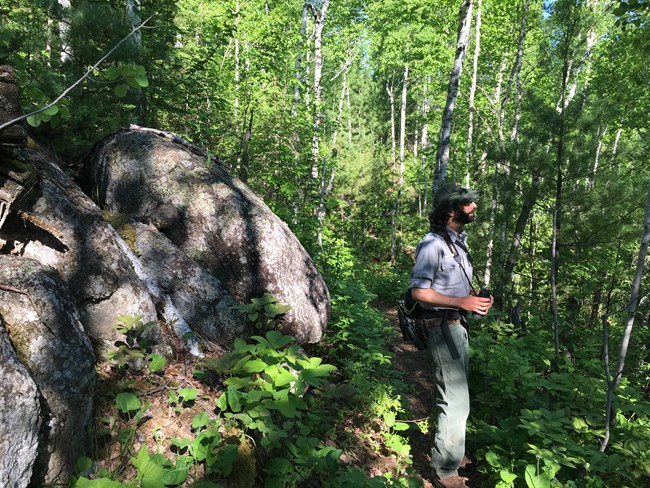
Listening for birds between Lake Richie and the Greenstone Ridge. NPS photo.
On Isle Royale, in Lake Superior, the dawn chorus may be changing its cast. The four songbirds heard most often on the island are the Nashville Warbler, the White-throated Sparrow, the Winter Wren and the Ovenbird. Between 2014 and 2018, three of those four declined, and projections for mid-century suggest some of the island's northern birds will leave it altogether.
How the birds are counted
The National Park Service has monitored songbirds on Isle Royale — Minong, in Ojibwe — since 1994. The island's habitats support 89 nesting songbird species. Every June, observers stop for five minutes at each of 130 points along eight trails, including on Passage Island, during the first four hours of daylight, and record every bird they see or hear.
What 2014–2018 showed
| Trend, birds per square mile per year | Statistically significant? | |
|---|---|---|
| Nashville Warbler | −6, the largest decline | no |
| Yellow-bellied Flycatcher | about −3 | yes — the only species that was |
| Successional and scrub species (flickers, chickadees) | −5 | yes |
| Shrub and low-canopy foragers (thrushes) | −3 | yes |
| Insectivores (warblers, flycatchers) | −2 | yes |
| Woodland species — most of the island's birds | −2 | yes |
Of the four commonest birds, only the White-throated Sparrow did not decline. Three groups of species showed increases, none of them significant.
Who may leave, and who may arrive
A 2018 study of how bird ranges respond to climate change across the national park system (Wu and others, PLoS ONE) projected a high turnover of species on Isle Royale by 2041–2070 if emissions keep rising. It made no prediction for the four commonest birds, but it expects some current summer residents to fare worse: the American Robin, Least Flycatcher, Mourning Warbler and Swamp Sparrow. The Gray Jay, an emblem of the boreal forest, is projected to disappear from the island in summer, following that forest north into Canada. The Wood Thrush and the Brown Thrasher may arrive.
Climate is only half of it. A bird needs its habitat to move with it: the Wood Thrush prefers a different forest from the one the island's Swainson's and Hermit Thrushes live in now, and the Brown Thrasher wants drier, shrubbier country than Isle Royale has today. Birds will go on singing at dawn; some of the singers may be new.
Sources
Written from the National Park Service's "Songbirds of Minong: Monitoring at Isle Royale, 2014–2018", a work of the United States government in the public domain, based on Roberts and others (2021), Songbird monitoring in the Great Lakes Network parks: 2014–2018 (NPS/GLKN/NRR—2021/2217), and Wu, Wilsey, Taylor and Schuurman (2018), PLoS ONE 13(3): e0190557.
В подборкахIsle Royale National Park
Лицензия: CC0 1.0 (общественное достояние) · По материалам www.nps.gov
1
0
0
0

Комментарии
Читать дальше


