
Хотите улучшить содержимое страницы? Предложите правку.
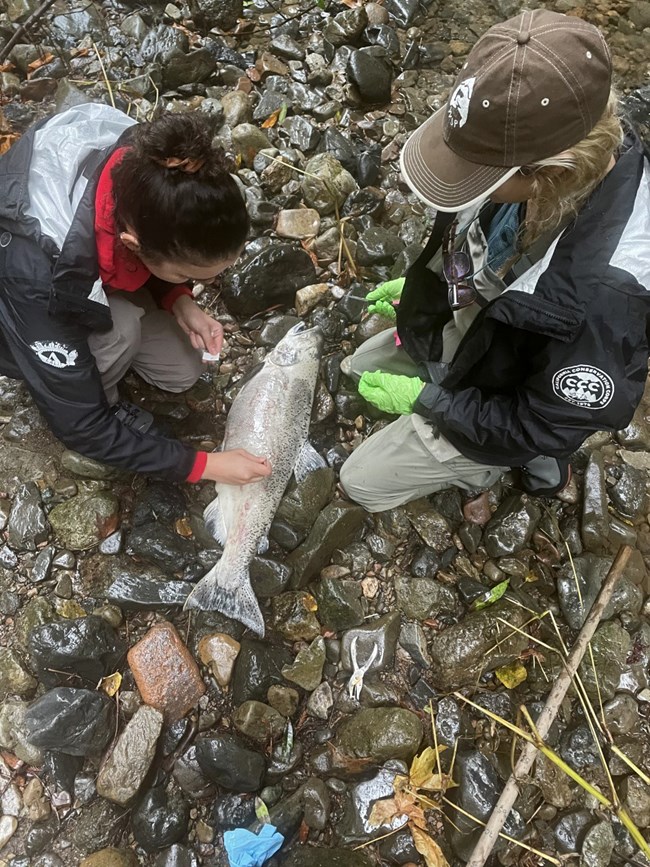
Watershed Stewards Program members Natale Urquhart and Tara Blake take a scale sample from a female Chinook carcass in Redwood Creek; scales go to a lab to be aged. NPS / Elek Yozie
In the autumn of 2021, Redwood Creek, Olema Creek and Pine Gulch all hosted adult Chinook salmon — called king salmon for their size — for the first time in monitoring history.
A record run
By December 2, the National Park Service's San Francisco Bay Area Network fisheries crew had recorded more than 80 Chinook in the creeks it monitors — more than 70 in Redwood Creek alone. The record for Lagunitas Creek, the nearest creek with a regular spawning run, was 65, in 2018–2019.
These kings probably spent their youth in a hatchery and were released as young smolts, most likely into San Francisco Bay by the California Department of Fish and Wildlife (CDFW). After growing up in the Pacific, they used their strong homing sense to find fresh water to spawn in. So far, spawning fish — including some not identified to species — had dug 20 nests, called redds, in Redwood Creek and 4 in Olema Creek.
Reading the carcasses
After spawning, salmon die. Surveyors look for their white carcasses against the dark creek gravel, and from each Chinook they take:
| Sample | What it's for |
|---|---|
| Scales | age, at a lab |
| Tissue | genetic analysis — which watershed the fish came from |
| The head, from hatchery fish (which lack a small fin on the back) | handed to CDFW to recover the coded wire tag put in the snout when the fish was young |
From coho carcasses they also remove the otoliths — calcium deposits in the inner ear, inside the skull — whose growth rings, like a tree's, give the fish's age. By early December they had sampled nearly 25 carcasses, with many more expected.
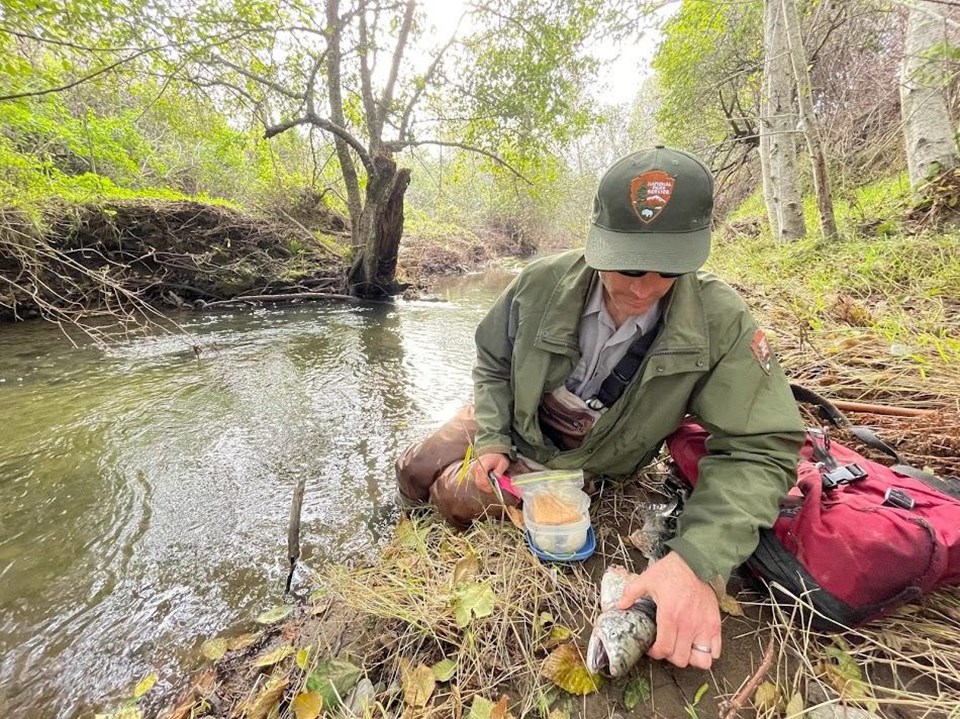
Fishery biologist Michael Reichmuth takes a tissue sample from a Chinook carcass on Redwood Creek, for a genetics lab to work out which watershed the fish came from. NPS / Tara Blake
Into the winter, the crew hoped to see more coho return to the streams where they were born — while keeping watch on this unusual influx of kings.
More: the network's salmonid monitoring, the Pacific Coast Science & Learning Center's coho and steelhead pages and blog.
Sources
Based on "Kings Continue to Make a Splash in Bay Area Streams," by Tara Blake and Natale Urquhart, Bay Area Nature & Science Blog, National Park Service, December 2, 2021; a work of the United States government in the public domain; rewritten in hubnx's own words.
В подборкахGolden Gate National Recreation AreaPoint Reyes National SeashoreMuir Woods National Monument
Лицензия: CC0 1.0 (общественное достояние) · По материалам www.nps.gov
1
0
0
0

Комментарии


