
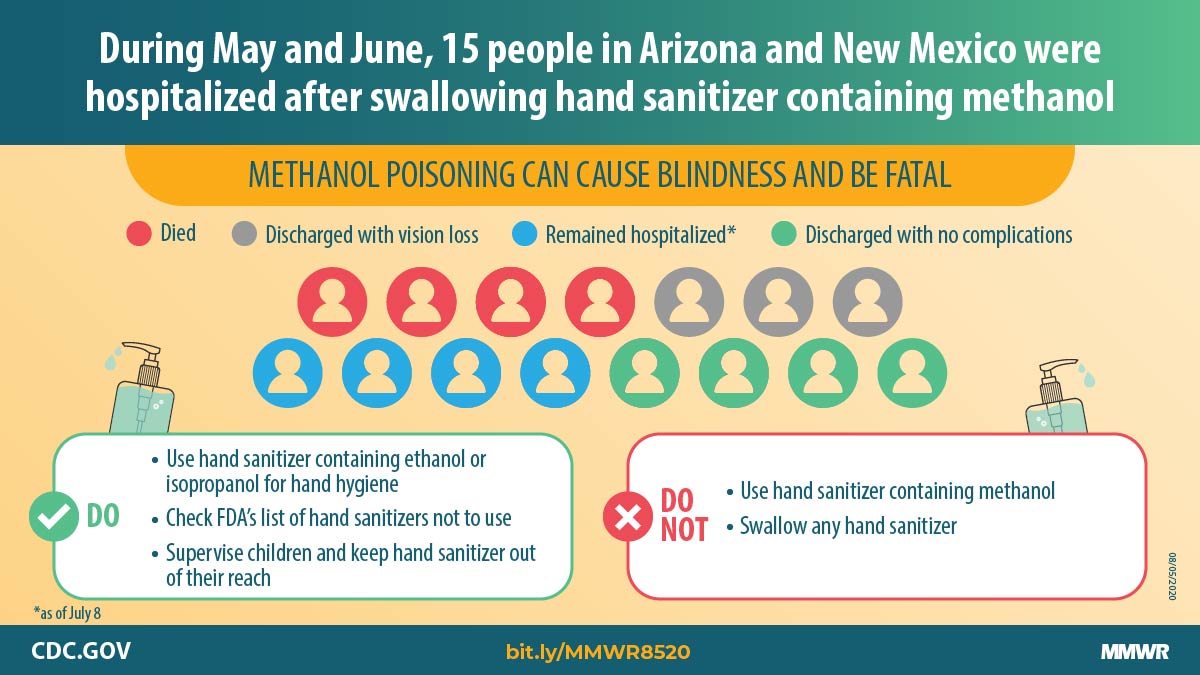
Hand sanitizer is supposed to contain ethanol or isopropanol — never methanol, which the U.S. Food and Drug Administration does not allow in it at all. In 2020, with sanitizer everywhere because of COVID-19, some products imported into the United States turned out to contain methanol. Between May 1 and June 30, 2020, 15 people in Arizona and New Mexico were poisoned after swallowing it. Four died; three left hospital with impaired vision.
CDC
Why methanol is different
Poisoning with methanol begins much like drunkenness from ethanol — headache, blurred vision, nausea, vomiting, abdominal pain, loss of coordination and a lowered level of consciousness. What follows is far worse: methanol can cause severe acidosis, seizures, blindness and death.
CDC recommends sanitizer with at least 60% ethanol or 70% isopropanol when soap and water are not at hand — in health care, 60–95% alcohol. Even ethanol sanitizer is dangerous to swallow: deaths have been reported in people with alcohol use disorder.
How the cases were found
On June 30, 2020, public health partners in both states told CDC about the poisonings, eleven days after an FDA alert (June 19) named specific sanitizers containing methanol. CDC worked with Arizona's and New Mexico's health departments and poison centers to review poison-center calls and medical records. A case was anyone who sought care in either state in May or June with methanol detectable in the blood and a history of exposure to hand sanitizer.
One patient
A 44-year-old man came to a health care facility with newly impaired vision, after drinking an unknown amount of hand sanitizer over the previous few days.
| Finding | Result |
|---|---|
| Blood methanol | 97 mg/dL |
| Anion gap | 32 mEq/L — metabolic acidosis |
| Serum bicarbonate | under 6 mEq/L |
| Arterial pH | 7.09 |
He had seizures, was treated with fomepizole (which blocks methanol's conversion into its toxic products) and hemodialysis, and after six days in hospital went home with near-total vision loss.
Who is at risk
- Young children, who may swallow sanitizer by accident.
- Adolescents and adults with alcohol use disorder, who may drink it as a substitute for alcohol.
- Absorption through the skin is possible but rare, and depends on the form, dose, concentration and how long and how widely it touches the skin.
What to do
- Never swallow hand sanitizer of any kind; keep it out of children's reach and supervise children who use it.
- Check products against the FDA's list of sanitizers consumers should not use. By July 15, 2020, the FDA had found 67 containing methanol, all being recalled.
- A product on the list should be stopped at once and disposed of as hazardous waste — not flushed or poured down a drain.
- Anyone exposed who has worrying symptoms should seek medical care immediately.
- Clinicians should suspect methanol in anyone with a history of swallowing sanitizer or with matching signs, and can get advice from a regional poison center: 1-800-222-1222. Health departments should work with poison centers to find cases.
Limits
Methanol poisoning is hard to diagnose: patients who are confused cannot always give a history, and some hospitals cannot test blood methanol. Cases may have been missed, and how many people were exposed is unknown.
Sources
Written from "Serious Adverse Health Events, Including Death, Associated with Ingesting Alcohol-Based Hand Sanitizers Containing Methanol — Arizona and New Mexico, May–June 2020," by Luke Yip and colleagues, Morbidity and Mortality Weekly Report 69(32), CDC; a work of the United States government in the public domain. It cites CDC hand-hygiene guidance, Emadi and Coberly (2007), Schneir and Clark (2013), Kraut and Mullins (2018), and FDA's list of hand sanitizers consumers should not use.
Лицензия: CC0 1.0 (общественное достояние) · По материалам www.cdc.gov
1
0
0
0

Комментарии
Читать дальше


