
Есть что улучшить? Предложите правку.
Grand Canyon's rocks fall into three sets — the Vishnu Basement Rocks, the Grand Canyon Supergroup and the Layered Paleozoic Rocks — separated by sharp contacts called unconformities, gaps in the rock record. Geologists have worked hard to put numbers on the time missing at these gaps, to complement what the rocks themselves record. This page draws on the National Park Service report Telling Time at Grand Canyon: 2020 Update.
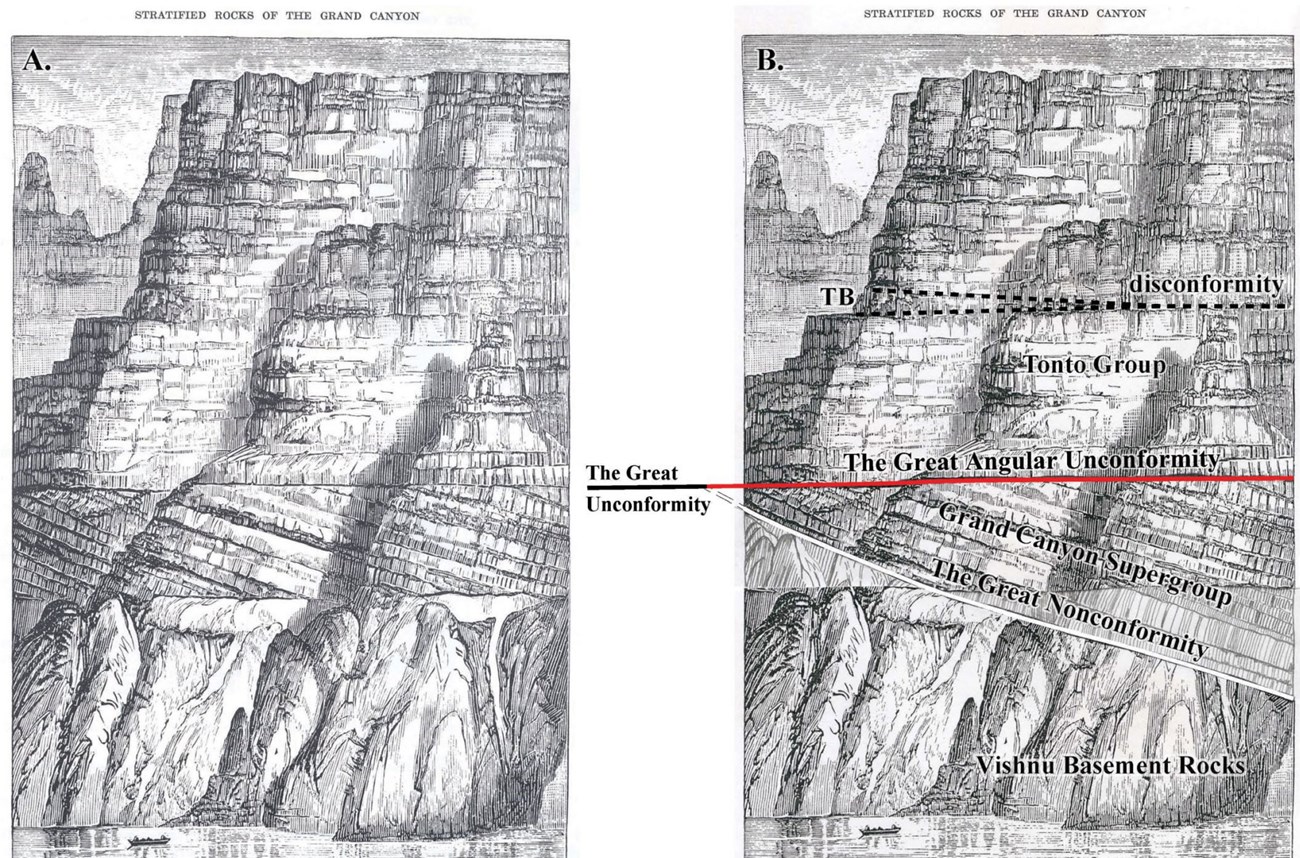
John Wesley Powell recognized the canyon's three main packages of rock in 1875 (left). The newer version (right) uses current names and adds a correction: the contact between the Vishnu Basement Rocks and the Grand Canyon Supergroup was tilted along with the Supergroup before the Paleozoic layers were laid on top. From the NPS report.
Powell already saw that each of these gaps stands for a chain of momentous events: mountains raised by tectonic forces, worn down to near sea level, and then buried under sediment as the sea advanced — a point stressed in 1969 by Eddie McKee, the canyon's leading stratigrapher and a former park naturalist.
Three great gaps
| Unconformity | Where | Time missing |
|---|---|---|
| Great Unconformity (Powell's term) | Below the Tonto Group, where the Layered Paleozoic Rocks sit directly on the Vishnu Basement Rocks | approximately 1.2 billion years |
| Great Nonconformity | Below the Grand Canyon Supergroup, where it rests on the Vishnu Basement Rocks | up to 500 million years, while the basement rocks were brought up by erosion from depths of 12 miles (20 km) |
| Great Angular Unconformity | Between the Layered Paleozoic Rocks and the tilted Grand Canyon Supergroup | up to 750 million years |
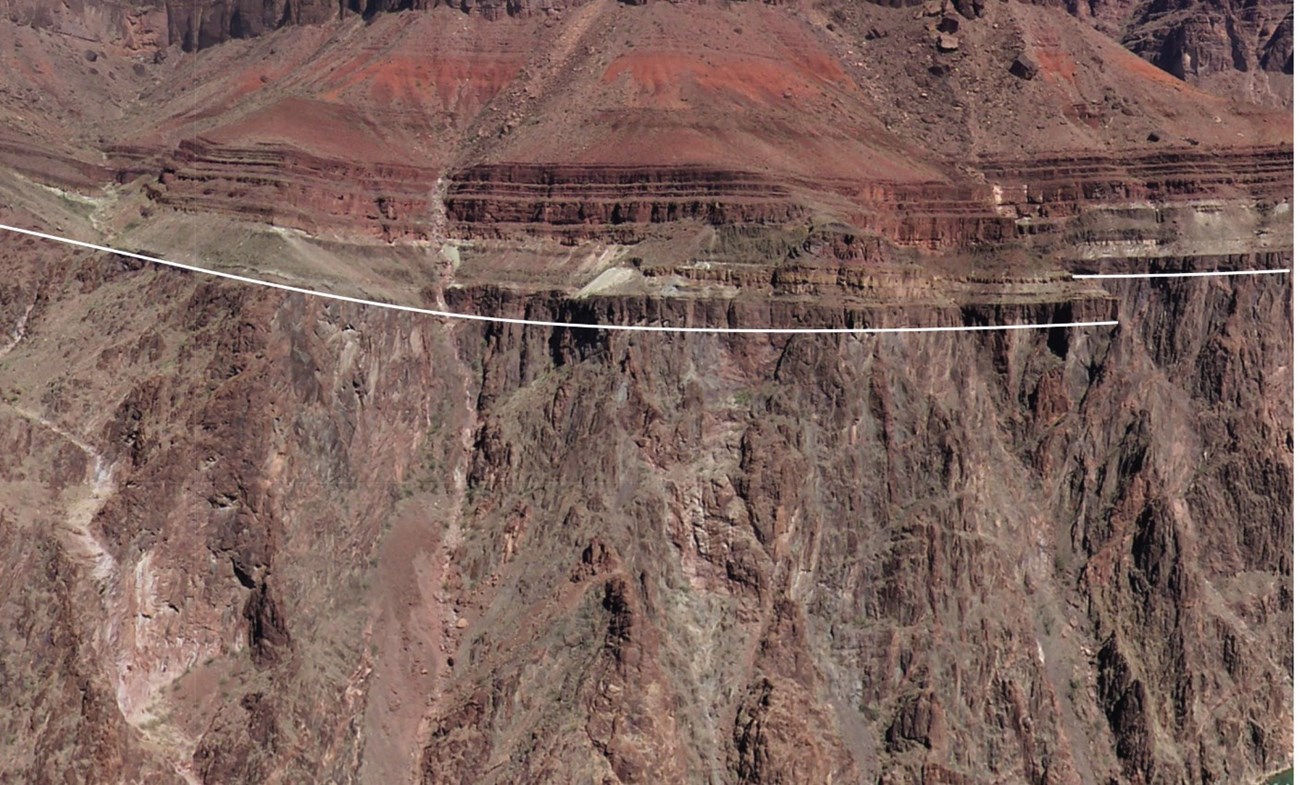
The Great Nonconformity. Image from the National Park Service's page.
All three in one view
Several rim viewpoints show all three. Looking north from Horseshoe Mesa in eastern Grand Canyon, for example, the 1.25-billion-year-old base of the Grand Canyon Supergroup sits on the 1.75-billion-year-old Vishnu Basement Rocks along the Great Nonconformity. Above, 510-million-year-old Paleozoic rocks rest on the tilted 1,100- to 1,250-million-year-old Unkar Group along the Great Angular Unconformity, with 590 to 740 million years missing there. The two erosion surfaces come together to form the Great Unconformity.
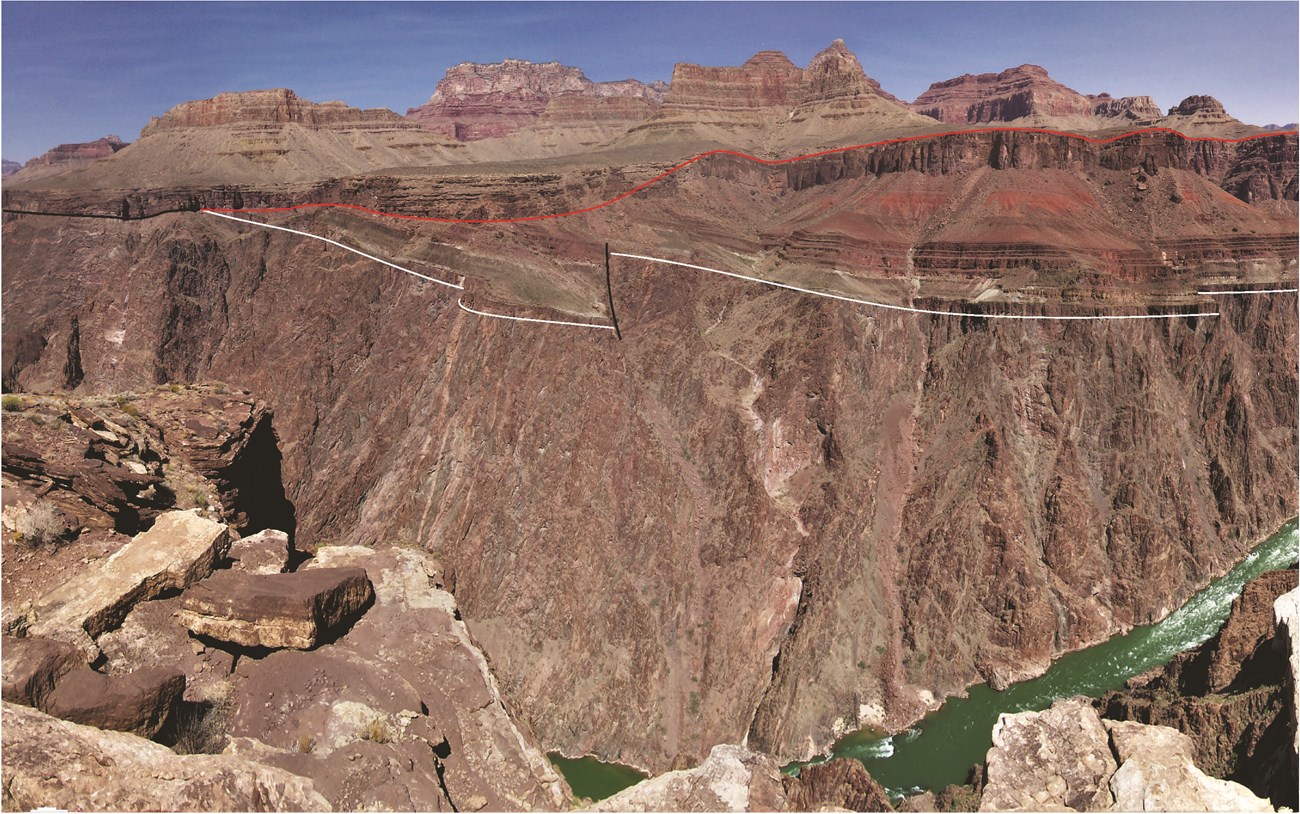
The Great Nonconformity (white line), the Great Angular Unconformity (red) and, where they meet, the Great Unconformity (black), seen from Horseshoe Mesa. NPS photo by Carl Bowman.
From the center window of the Yavapai Geology Museum, near Grand Canyon Village, you can see the Vishnu Basement Rocks in the Granite Gorge and, within the layers above, an ancient island of tilted Supergroup rock, once ringed by 505-million-year-old beach sands and finally buried by the muds of the Tonto Group.
Gaps between the layers
A disconformity is a time gap between sedimentary layers, and several separate formations of the Layered Paleozoic Rocks. Some are subtle — one in the Supai Group, between the Esplanade Sandstone and the Watahomigi Formation, shows only as a pebble conglomerate left after a spell of erosion. Others are huge: at the base of the Redwall Limestone, about 150 million years of record is missing along a flat contact that only fossil evidence reveals, though in eastern Grand Canyon channels preserve some of the missing layers.
What the gaps tell us
- More time is missing than preserved. The canyon's vertical mile of rock looks spectacularly complete, yet more of Earth's history is absent from it than recorded. Even the modern erosion surface on top of the Kaibab Formation represents 270 million years missing.
- Missing does not mean unknown. The rocks on either side of a gap reveal what happened during it. Across the Great Nonconformity, for instance, a rugged mountain landscape was worn down to a nearly smooth plain by an immense amount of erosion over an immense span of time.
- Gaps can be dated. The best ages of the rocks directly above and below an erosion surface give the missing time a number.
- Other places fill in the story. Rocks elsewhere — sometimes nearby, as where the Supergroup sits between basement and Paleozoic rocks, sometimes worldwide — show part of what happened in a given gap.
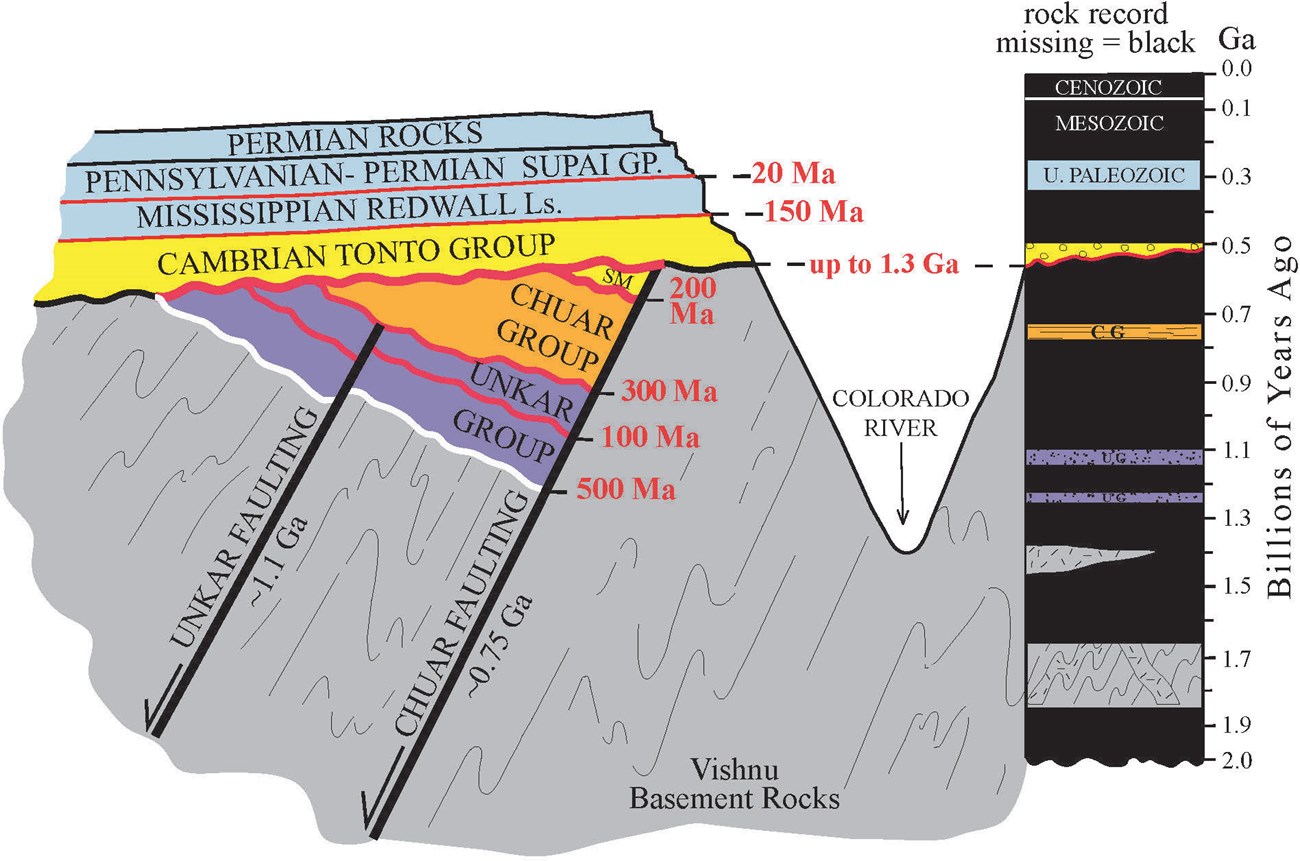
Rock and time: Grand Canyon has one of the world's most complete geologic records, yet more time is missing (black, in the right-hand column) than preserved. Not every formation and unconformity is shown. From the NPS report.
Sources
Rewritten from the National Park Service article "Missing Time at Grand Canyon National Park," part of a series adapted from Karlstrom, K., L. Crossey, A. Mathis and C. Bowman, 2021, Telling Time at Grand Canyon National Park: 2020 Update, Natural Resource Report NPS/GRCA/NRR—2021/2246 (public domain), in hubnx's own words. The article describes the Great Unconformity's 1.2 billion missing years as "about 25 percent" of Earth history in one caption and "about 30 percent" in its text; no share is given here. Photographs credited only to named photographers, one from Flickr, and the report cover are not reproduced.
В изданияхGrand Canyon National ParkTelling Time at Grand Canyon National Park
Лицензия: CC0 1.0 (общественное достояние) · По материалам www.nps.gov
1
0
0
0

Комментарии


