
A lesson for fifth graders (ages 10–11), built around one photograph: a woman in 1917 holding a banner that says what she thinks is wrong. The question it asks children is one they can answer from their own lives — have you ever spoken up when you saw someone treated unfairly?
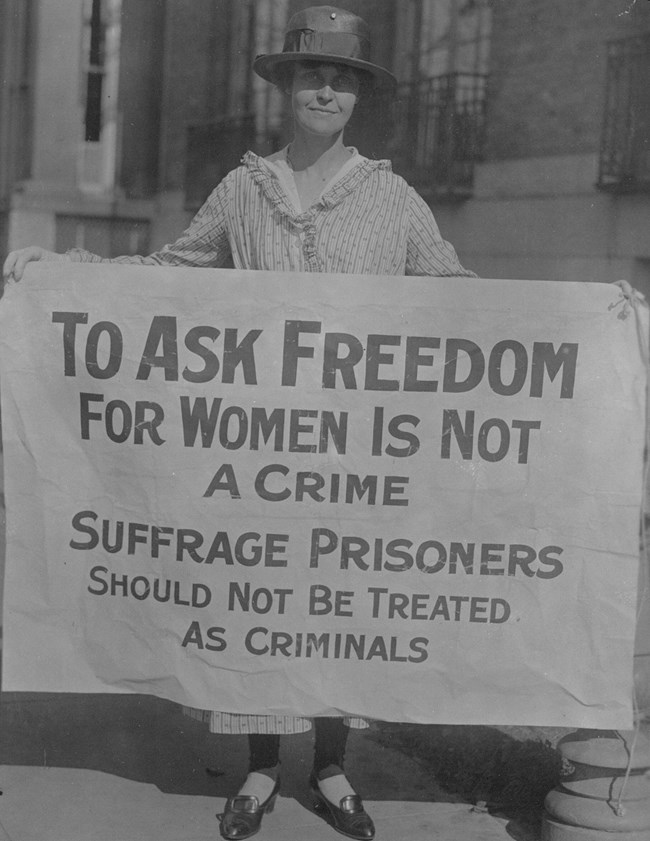
Mary Winsor in 1917. Her banner reads: "To Ask Freedom for Women is Not a Crime. Suffrage Prisoners Should Not Be Treated As Criminals." Harris & Ewing; National Woman's Party collection, Library of Congress
What children should come away with
- Empathy when people are left out or mistreated.
- A sense of their own responsibility to stand up to exclusion and prejudice.
- The courage to speak up, respectfully, when they or someone else has been wronged.
- The judgement to decide when and how to take a stand — even under pressure from friends or a group.
The story behind the photograph
- January 1917. The National Woman's Party begins a daily protest at the White House. The Silent Sentinels stand at the gates holding banners that ask President Woodrow Wilson to support a constitutional amendment forbidding states to deny women the vote.
- April 1917. The United States enters World War I. Many people are angry that the protest goes on; picketing the president in wartime is called unpatriotic.
- The arrests. Police order the women to stop. They refuse, and are arrested and jailed — more than 150 women serve time.
- Mary Winsor is one of them: 60 days in the Occoquan Workhouse for picketing, and another 10 days for being at a protest in Lafayette Square, near the White House.
- Inside. Many prisoners are cut off from their families and lawyers, fed rotten food, even beaten.
- Speaking out. The suffragists make their treatment public. Winsor's banner argues that they should never have been arrested for using their First Amendment right to protest.
Words to know
| Word | Meaning |
|---|---|
| amendment | a change, especially to a document like the Constitution |
| picket | to stand outside a place to protest or win support for a cause |
| sentinel | a guard who stands and keeps watch |
| suffrage | the right to vote |
| suffragist | a person who works for the right to vote, especially for women |
Questions for discussion
- Why do you think the suffragists were arrested?
- How does the message on Mary Winsor's banner make you feel?
- When have you been treated unfairly? What did you do?
To go further
From the National Park Service:
- The Suffrage "Prison Special" Tour
- National Woman's Party Protests During World War I
- Alice Paul's Crusade
- Alice Paul, Woodrow Wilson, and the Battles for Liberty
Elsewhere:
- Bold and Brave: Ten Heroes Who Won Women the Right to Vote, by Kirsten Gillibrand, illustrated by Maira Kalman
- She Resisted: Strategies of Suffrage, an interactive from PBS's The Vote
This lesson is one of the National Park Service's Teaching Suffrage series, made with the Hard History Project, for Belmont-Paul Women's Equality National Monument and National Mall and Memorial Parks. It follows Arrested and comes before The Prison Special and the Courage to Speak Out.
Sources
Written from "Teaching Suffrage: Suffrage Prisoners Banner," National Park Service; a work of the United States government in the public domain.
В подборкахNational Mall and Memorial ParksBelmont-Paul Women's Equality National MonumentTeaching Suffrage
Лицензия: CC0 1.0 (общественное достояние) · По материалам www.nps.gov
1
0
0
0

Комментарии
Читать дальше


