
"Slow it down and spread it out" is practically the motto of modern stream restoration. In the National Capital Area, that usually means rebuilding a single channel with boulders and step-pools that bleed off the water's energy, so that only big storms spill onto the floodplain. But there is a more radical idea, one that in cities might seem idealistic: fill the channel in entirely.
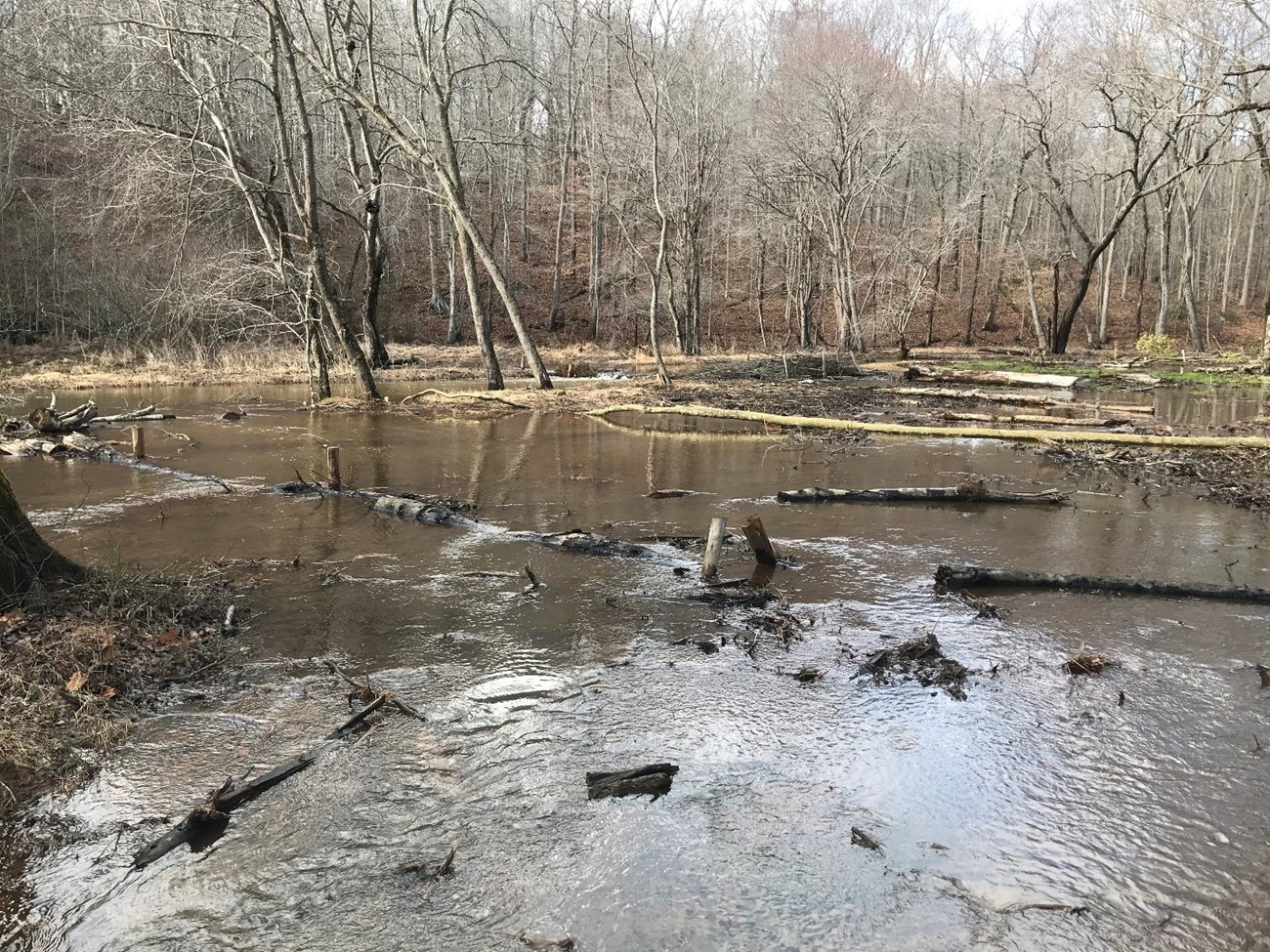
Stage 0 restoration at the downstream end of Bacon Ridge Branch at Elks Camp Barrett in Annapolis, Maryland, built by Biohabitats. Credit: Matthew Schley, National Park Service.
Stages of a stream
Stream evolution models, such as those of Simon and Hupp (1986) and Cluer and Thorne, describe streams passing through stages:
| Stage | What the valley looks like |
|---|---|
| Stage 0 | Before channelization: a forested wetland with many interweaving ("anabranching") channels |
| Stage 1 | Channelized: one stream channel carries most of the water, after a change in how much water reaches the valley or how concentrated it is |
Around Washington, D.C., Maryland and Virginia, channelization is often argued to be a direct result of colonization, as land was cleared for farms and settlement. It keeps getting worse, with more roads, sidewalks and buildings that water can't soak through; curbs, gutters, storm drains, pipes and culverts; and, with climate change, more frequent large and intense storms. Restorations like Milk House Ford and Broad Branch in Rock Creek Park, Spring House Run at the National Arboretum and Alger Park in D.C. are highly effective — but they are Stage 1 restorations, still built around a single channel.
How Stage 0 works
The existing channel is filled until it is level with the floodplain. Even the smallest storms — and the stream's everyday baseflow — then spread across the floodplain through many channels.
- Less erosion. Spread across many channels and a wide floodplain, the water has less energy at any point, so it carries less sediment and nutrient pollution downstream to the Chesapeake Bay.
- More habitat. The valley becomes a patchwork of small mounds and hollows, creating high ground and pools for mammals, fish, stream insects and more.
- Lower cost. Heavy machinery brings in fill and streambed material, but there's little reshaping of the floodplain and little use of large stone.
Where it could work
Stage 0 isn't right everywhere. Because water spreads across the whole valley, it must not raise the risk to sewer and water pipes, roads or neighbors, and the valley must be wide and gentle enough that water flowing over it won't erode the floodplain. In the National Capital Area, it is most likely in parks with fewer constraints, such as parts of Antietam, Monocacy and Prince William.
Sources
Based on "Stream Restoration Dreams: Stage Zero," by Matthew Schley, hydrologist, National Park Service National Capital Area; a work of the United States government in the public domain. It cites Simon and Hupp (1986), Cluer and Thorne, and the Third National Climate Assessment (2014).
В подборкахChesapeake & Ohio Canal National Historical ParkAntietam National BattlefieldCatoctin Mountain ParkGeorge Washington Memorial Parkway
Лицензия: CC0 1.0 (общественное достояние) · По материалам www.nps.gov
1
0
0
0

Комментарии
Читать дальше


