
The story of Jewish immigration to America usually starts in New York's tenements. Temple Aaron, in the old boomtown of Trinidad, Colorado, tells another part of it: the westward migration of Jewish immigrants from Europe between 1840 and 1924. Built in 1889, it is the second-oldest known synagogue west of the Mississippi River still in continuous use on its original site.
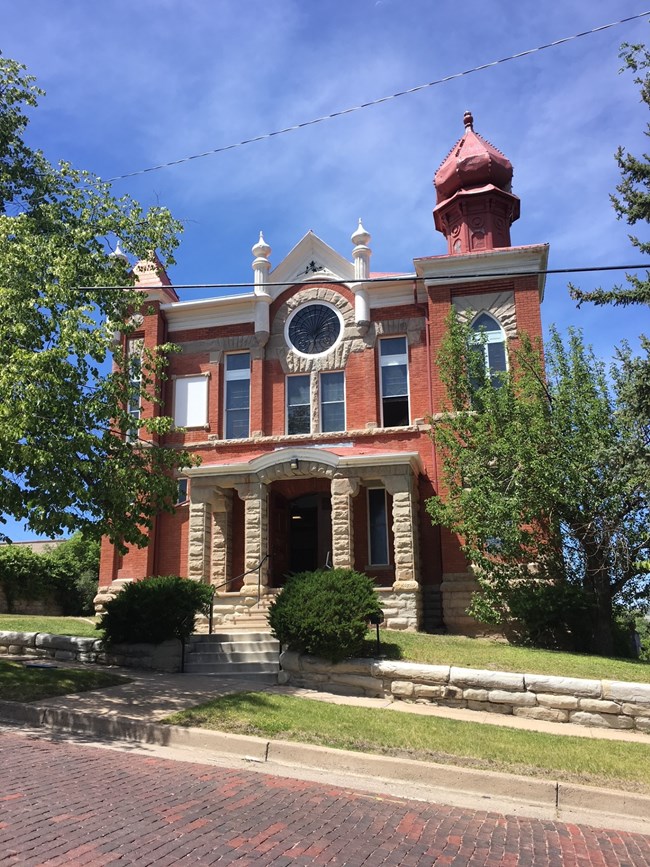
Temple Aaron from the street. Photo: Astrid Liverman/NPS.
The building was listed in the National Register of Historic Places in 1973 as part of the Corazon de Trinidad Historic District, but that listing never addressed its own significance. A 2023 National Historic Landmark nomination did, and Temple Aaron was designated on December 11, 2023.
A frontier town
Trinidad grew up on trade along the Mountain Branch of the Santa Fe Trail. It had been part of the Las Animas Mexican land grant, a heritage still visible in its adobe plazas and commercial streets. Railroads brought coal, coke, iron, brick, quarrying, smelting and cattle ranching. In 1867 Jewish merchant Abraham Jacobs extended the Denver–Pueblo stage route to Trinidad, and Richard Lacey "Uncle Dick" Wootton opened the Raton Pass Toll Gate, both spurring the town's growth.
By the late 1860s about 1,200 people of many backgrounds lived there. Between 1860 and 1871 roughly eight young Jewish men from Hanover, Bavaria, Bohemia and Alsace-Lorraine settled in the town. Meeting religious tolerance, and quick to supply the goods and investment a new town needed, they became pillars of the community:
| Founder | Role |
|---|---|
| Maurice Wise | Thought to be the first permanent Jewish resident; arrived in 1867 and opened a small general store on Main Street |
| Samuel Jaffa | Merchant; elected the town's first mayor in 1876 |
| Solomon (Sol) Jaffa | City alderman; with his brother built the opera house, one of Trinidad's leading cultural institutions |
The Jaffas and other founders also led fraternal organizations. Building the temple in 1889 showed how fully Trinidad's Jews had been accepted into the town, and how much economic and civic leadership they held.
Building the temple
Congregation Aaron was organized in July 1883 in Sol Jaffa's home, and over the next few years drew worshippers from Las Vegas, Elizabethtown and Raton in New Mexico, and Walsenburg, Colorado. By 1887 it was planning a building of its own.
The noted firm Bulger & Rapp designed it in the Moorish Revival style, then very popular with Reform congregations as a way of linking their modern practice to an ancient Middle Eastern past. Set on gray sandstone on a steeply sloping corner lot, the red brick building was designed to dominate its site, borrowing from many revival styles: an onion-domed tower, small minarets, pointed arches and brightly colored stained glass.
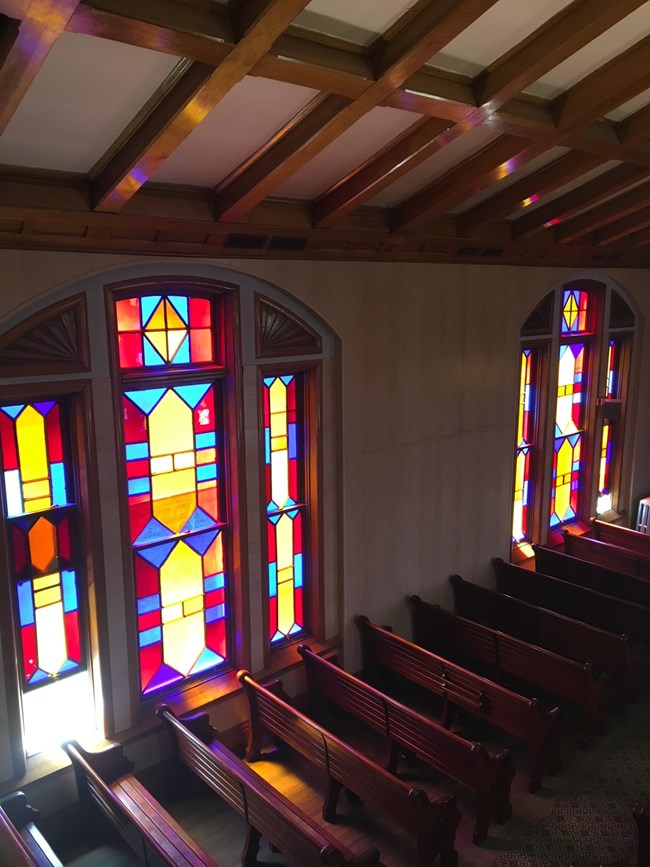
Light through the sanctuary's stained glass. Photo: Astrid Liverman/NPS.
Architect Isaac Hamilton Rapp laid the cornerstone in a public ceremony on June 18, 1889. Rapp (1854–1933) went on to design buildings across Trinidad and the Southwest, especially in New Mexico, where he is credited with originating the "Santa Fe style."
Rabbi Freudenthal
The congregation's new rabbi, Leopold Freudenthal, gave a stirring address at the cornerstone ceremony. Born in Germany in 1848, he earned a doctorate at Heidelberg University before emigrating. Unusually, he had not been ordained in Europe, though he may have attended Hebrew Union College in Cincinnati, in the Reform tradition. He was chaplain of the Iowa State Legislature when Congregation Aaron, then 54 families, hired him. Services were held in Hebrew, German and English. Freudenthal drew the congregation more fully into Reform Judaism and served it until his death in 1916.
Still in use
Very few synagogues of this age west of the Mississippi are still used by Jewish congregations, so Temple Aaron has few true peers. Through the mid- and late twentieth century, founders' descendants and families such as the Gottliebs, the Sanders, and Kathryn and Leon Rubin kept it running. More than 130 years after it was built, the small congregation still serves worshippers from Colorado's Front Range and northern New Mexico.
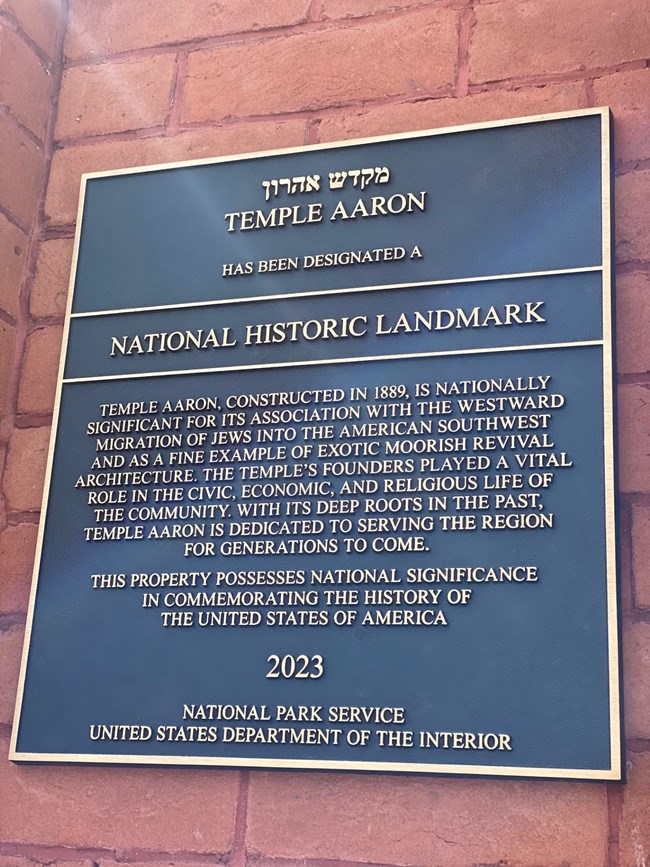
The National Historic Landmark plaque. Photo: Astrid Liverman/NPS.
Sources
Based on "Trinidad's Temple Aaron," National Park Service, drawn from the National Historic Landmark nomination by Rachel Leibowitz, PhD; rewritten in hubnx's own words.
В подборкахNational Register and National Historic Landmarks Celebrate Jewish Heritage Month
Лицензия: CC0 1.0 (общественное достояние) · По материалам www.nps.gov
1
0
0
0

Комментарии
Читать дальше


