
Хотите улучшить содержимое узла? Попробуйте сделать запрос на редактирование.
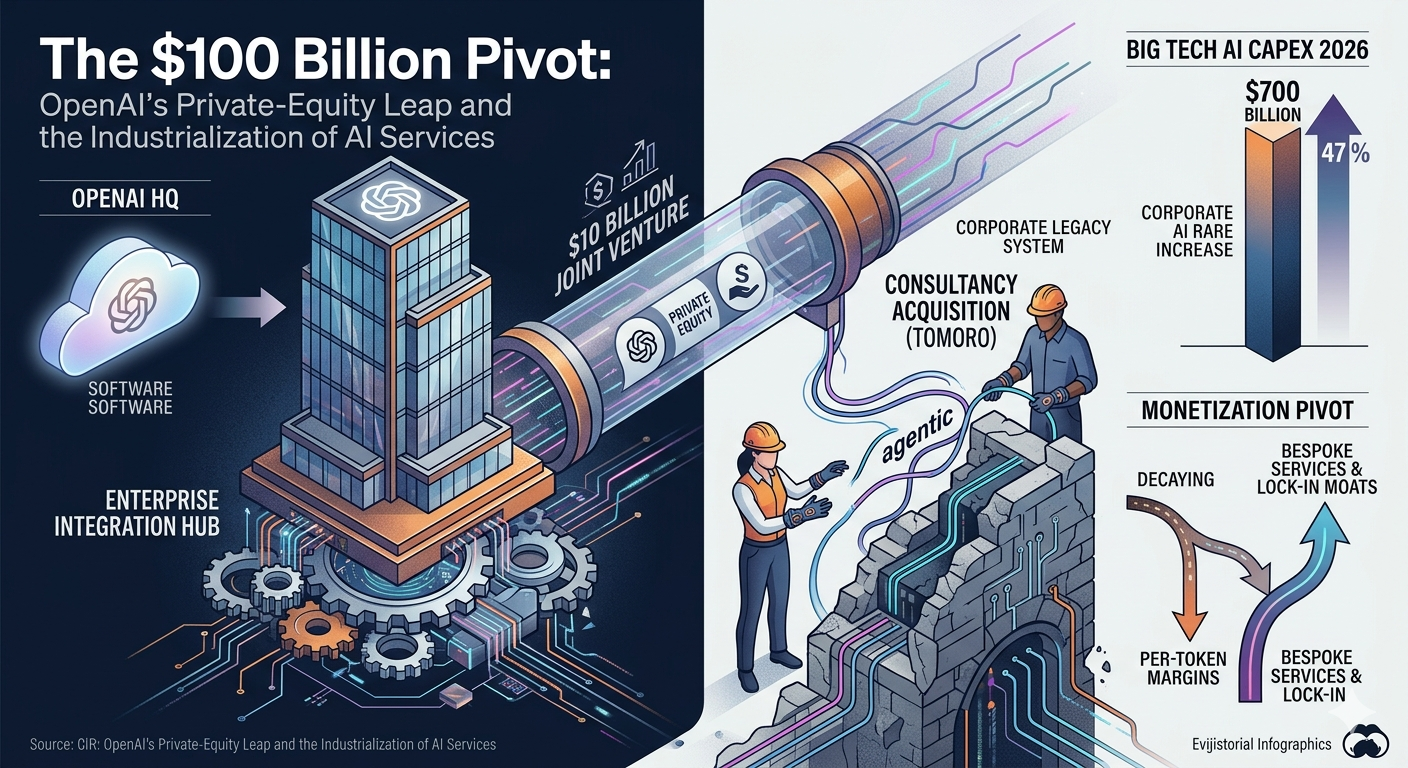
On May 12, 2026, OpenAI fundamentally shifted the landscape of the artificial intelligence industry by launching a $10 billion private-equity joint venture and acquiring the specialist consultancy Tomoro. This dual-pronged maneuver marks the end of the "model-only" era and the beginning of the "industrialized deployment" era. By integrating 150 forward-deployed engineers from Tomoro, OpenAI is transitioning from a software provider into a full-stack industrial partner capable of bespoke enterprise integration. This move comes as new financial disclosures reveal OpenAI is on track to save $97 billion through 2030 via a restructured infrastructure agreement with Microsoft. Simultaneously, the broader "Big Tech" sector—comprising Alphabet, Amazon, Meta, and Microsoft—has confirmed capital expenditure projections of $700 billion for 2026 alone, an 77% year-over-year increase. The significance of today’s news lies in the "monetization pivot." As the performance gap between frontier models converges, the competitive advantage is shifting from raw intelligence to the ability to integrate AI into legacy corporate infrastructure. OpenAI’s entry into private equity and professional services signals a defensive hedge against falling per-token margins and a strategic offensive to lock in enterprise "moats." For the broader economy, this indicates that the AI boom is entering its "implementation phase," where the value is extracted not from the lab, but from the radical reconfiguration of global labor and energy grids.
The Shift to Physical and Human Infrastructure
For the past three years, the AI narrative has been dominated by "scaling laws"—the idea that more data and more compute inevitably lead to more capable models. However, as of May 2026, the industry has reached a point of diminishing returns in pure model differentiation. Today’s acquisition of Tomoro by OpenAI is the clearest evidence yet that the bottleneck has shifted from "intelligence" to "integration."
Tomoro, a consultancy known for its "agentic" workflow designs, brings 150 engineers who do not build models, but rather build the "connective tissue" between AI and corporate ERP (Enterprise Resource Planning) systems.^^ This move mirrors the historical trajectory of the software industry, specifically the rise of IBM Global Services or Accenture. By bringing these capabilities in-house, OpenAI is acknowledging that selling API access is no longer sufficient to sustain its $100 billion+ valuation. It must now guarantee business outcomes.
The $97 Billion Microsoft Subsidy and Capex Realities
Deep-research filings released today clarify the financial mechanics keeping the AI "arms race" solvent. OpenAI’s latest deal with Microsoft is projected to save the startup $97 billion in compute costs over the next four years.^^ This is not merely a discount; it is a fundamental restructuring of the relationship between silicon, electricity, and intelligence.
However, this "subsidy" is set against a backdrop of staggering industry-wide spending. The 2026 capital expenditure (Capex) figures for the "Big Four" (Alphabet, Amazon, Meta, Microsoft) have reached $700 billion.^^ To put this in perspective, this exceeds the annual GDP of most G20 nations. This spending is increasingly concentrated in three areas:
- Custom Silicon: Moving away from NVIDIA-only reliance to in-house TPU and MaIA chips.
- Energy Acquisition: Buying "behind-the-meter" nuclear and geothermal power to bypass the crumbling public grid.^^
- Agentic Frameworks: Moving from chatbots to "agents" that can autonomously execute multi-step tasks.
The Energy Crisis: "The Nvidias of Power"
A critical sub-plot in today's news is the repricing of the American energy grid.^^ Data center electricity demand is now growing five times faster than global consumption. Today’s market data shows capacity prices in the PJM Interconnection (serving the US Mid-Atlantic) have spiked from $30 to $300 per megawatt-day.
This has created a new class of "AI Winners": the infrastructure providers. Companies like GE Vernova, which has sold out its gas turbine production through 2030, are becoming the new gatekeepers.^^ The "Big Tech" firms are responding by becoming energy companies themselves, negotiating long-term power-purchase agreements (PPAs) that insulate them from the price shocks hitting mid-tier software firms.
Competitive Landscape: Converging Intelligence
Reports from the Stanford 2026 AI Index, released in tandem with today’s news, confirm that the performance delta between OpenAI’s GPT-5.5, Google’s Gemini 3, and Anthropic’s Claude 4 has effectively converged. In a world of "commodity intelligence," the winner is the one who controls the data loop.
OpenAI’s $10 billion joint venture is designed to fund the "last mile." While startups like Cerebras (which today boosted its IPO range to $5.5 billion) focus on the hardware, and Kuaishou (spinning off Kling AI at a $20 billion valuation) focuses on creative media, OpenAI is positioning itself as the "Operating System of the Enterprise."
Economic Implications: The Margin Compression
The "Tech Journalist" perspective must focus on the looming margin compression. While legacy software companies (SaaS) operated at 80-90% gross margins, AI-native companies are struggling at 50-60% due to the persistent "inference tax"—the cost of electricity and chips required for every single query.^^
OpenAI’s pivot into private equity and high-end consulting is a direct response to this margin pressure. By owning the consultancy that implements the software, they can capture the high-margin "services" revenue that typically goes to third parties.
Conclusion
May 12, 2026, marks the day the AI industry "grew up." The era of speculative research is being replaced by a hard-nosed, capital-intensive industrial era. OpenAI is no longer just a lab; it is a private-equity-backed industrial conglomerate.^^ The $700 billion being poured into this sector is now chasing real-world automation, and the acquisition of human engineering talent (Tomoro) is proving to be just as vital as the acquisition of H100 GPUs. For the newsletter reader, the takeaway is clear: the "AI Trade" has moved from the chipmakers to the power-takers and the system-shapers.
1
0
0
0

Комментарии