
Хотите улучшить содержимое узла? Попробуйте сделать запрос на редактирование.
On May 14, 2024, the technology landscape shifted fundamentally as Google delivered its keynote at I/O 2024, responding directly to OpenAI’s release of GPT-4o just 24 hours prior. The defining story of the day is the transition from "AI as a chatbot" to "AI as a universal agent," characterized by native multimodality and real-time reasoning. Google’s centerpiece, Project Astra, represents a significant leap in functional AI. It is a "universal assistant" capable of seeing, hearing, and remembering context through a smartphone camera or smart glasses. Unlike previous iterations that relied on separate models for vision and speech, Astra utilizes a single, natively multimodal architecture to achieve sub-second latency, allowing for human-like fluid conversation about the physical world. Simultaneously, Google announced the rollout of AI Overviews to hundreds of millions of users in the U.S. search results, marking the most radical change to the web ecosystem in decades. By synthesizing complex queries into direct answers, Google is moving away from its traditional role as a "librarian" of links to a "concierge" of information. This move has sparked intense debate regarding the "zero-click" future and its impact on the open web's incentive structure. On the technical front, Google introduced Gemini 1.5 Flash, a model optimized for speed and efficiency, and doubled the context window of Gemini 1.5 Pro to 2 million tokens. This allows the AI to process entire codebases or hours of video in a single prompt. Today’s developments signify that the "AI arms race" has moved past the stage of speculative demos. With Google embedding Gemini across Android, Workspace, and Search, and OpenAI pushing the boundaries of emotive interaction, the industry has officially entered the era of the Universal Interface, where the barrier between human intent and machine execution has nearly evaporated.
The Architectural and Economic Shift of May 14, 2024
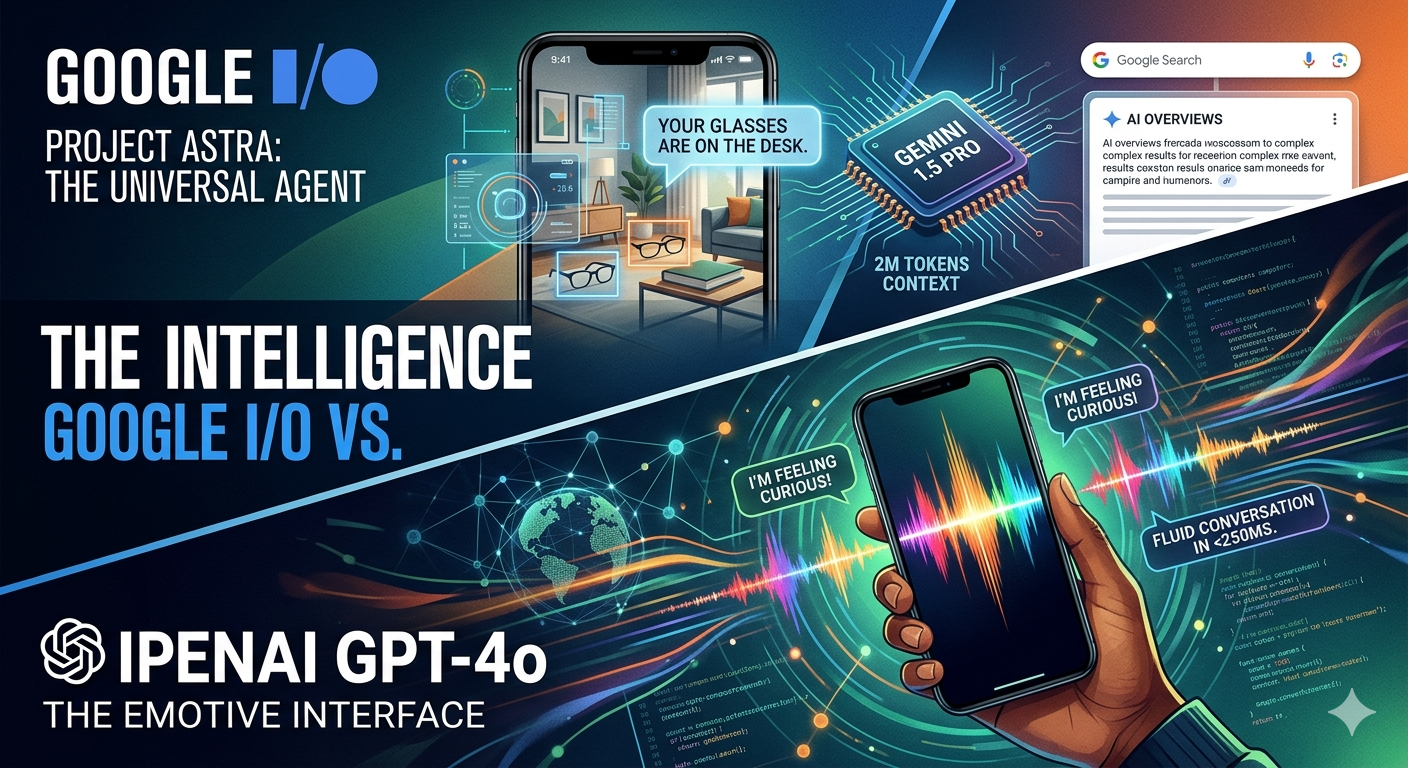
The Strategic Context: A 24-Hour Duel
The significance of May 14 cannot be understood without acknowledging the tactical timing of the industry's two titans. OpenAI’s "Spring Update" on May 13 introduced GPT-4o, a model that turned the AI into a "Her"-like companion with near-zero latency and emotional inflection. Google’s response at I/O was not just a product announcement; it was a demonstration of "scale vs. agility." While OpenAI showed the world a better soul for the machine, Google showed the world the machine’s new nervous system, integrated into the products that billions of people already use.
Project Astra: The End of the "Latency Gap"
For years, AI interactions felt disjointed because of the "pipeline" approach: a model to hear (ASR), a model to think (LLM), and a model to speak (TTS). Project Astra eliminates these silos.
- Spatial Intelligence: During the I/O demo, Astra identified where a user left their glasses by "remembering" a video feed from minutes earlier. This is not just data retrieval; it is spatial and temporal reasoning.
- The Wearable Rebirth: Astra provides the strongest argument yet for the return of smart glasses. When the AI can see what you see in real-time, the smartphone becomes a secondary peripheral.
The Search Revolution: AI Overviews and the Publisher Crisis
The integration of "AI Overviews" into the core Google Search experience is perhaps the most significant economic story of the day.
- The User Benefit: Users get immediate answers to "N-th degree" questions (e.g., "Find a yoga studio with 4.5 stars within 10 miles that also offers beginner classes on Tuesdays").
- The Publisher Threat: If Google provides the answer on the Search Generative Experience (SGE) page, the incentive for users to click through to the source website diminishes. This threatens the ad-revenue model that has sustained digital journalism for twenty years.
Technical Frontiers: The 2-Million Token Context
Google’s expansion of the Gemini 1.5 Pro context window to 2 million tokens is a direct shot at the limitations of RAG (Retrieval-Augmented Generation).
- Infinite Memory: A 2-million token window allows a developer to drop an entire library of documentation or a massive codebase into the prompt. The model no longer needs to "search" for relevant snippets; it "knows" the entire corpus simultaneously.
- Gemini 1.5 Flash: Recognizing that "big" models are expensive and slow, Google launched "Flash." It is designed for high-volume, low-latency tasks like summarization and chat, proving that the future of AI is a tiered ecosystem of specialized models rather than a single "one size fits all" giant.
Android 15 and the "AI-First" OS
Android is being rebuilt around the "Gemini Nano" on-device model.
- On-Device Privacy: By processing sensitive data (like detecting scam calls in real-time) locally on the device, Google is addressing the privacy concerns that have plagued cloud-based AI.
- The Multimodal Assistant: Gemini is replacing Google Assistant. The transition from a command-based system ("Set a timer") to a context-based system ("Summarize this PDF on my screen") changes the smartphone from a tool into a collaborator.
The Infrastructure of Tomorrow
May 14, 2024, will be remembered as the day the "AI Summer" turned into the "AI Autumn"—a period of harvest. The experimental phase is over. The technology has matured into a multimodal, real-time, and ubiquitous layer of the modern digital stack. The competition between Google’s ecosystem and OpenAI’s raw intelligence is no longer about who has the best chatbot, but who can become the primary interface for human productivity.
As we look at the fallout of today's announcements, the question for the industry moves from "What can AI do?" to "How will we pay for the web when the AI does everything?" The technical hurdles are falling; the societal and economic ones are just beginning to rise.
1
0
0
0

Комментарии