
Хотите улучшить содержимое узла? Попробуйте сделать запрос на редактирование.
The high-profile alliance between Silicon Valley’s premier AI startup and the world’s most valuable consumer tech company is fracturing. According to a blockbuster Bloomberg report, OpenAI has retained an external law firm to explore formal legal action against Apple, including the potential issuance of a breach-of-contract notice. The dispute stems from a deep-seated frustration within OpenAI that the landmark 2024 deal—which integrated ChatGPT into Apple Intelligence—has completely failed to deliver the expected user growth, prominence, and billions in subscription revenue. OpenAI executives allege that Apple has "buried" ChatGPT within the Siri interface, forcing users to explicitly invoke the chatbot rather than delivering a seamless, proactive experience. Internal research shows most iPhone users completely bypass the integration in favor of the standalone ChatGPT app. Compounding tensions, Apple is transitioning to a multi-provider ecosystem for iOS 27—recruiting Google Gemini and Anthropic’s Claude—which effectively strips OpenAI of its privileged status. While OpenAI prefers a quiet resolution, the company is reportedly preparing its legal framework to pivot if renegotiation talks remain stalled.
The Breakdown of Silicon Valley's Most Ambitious AI Marriage
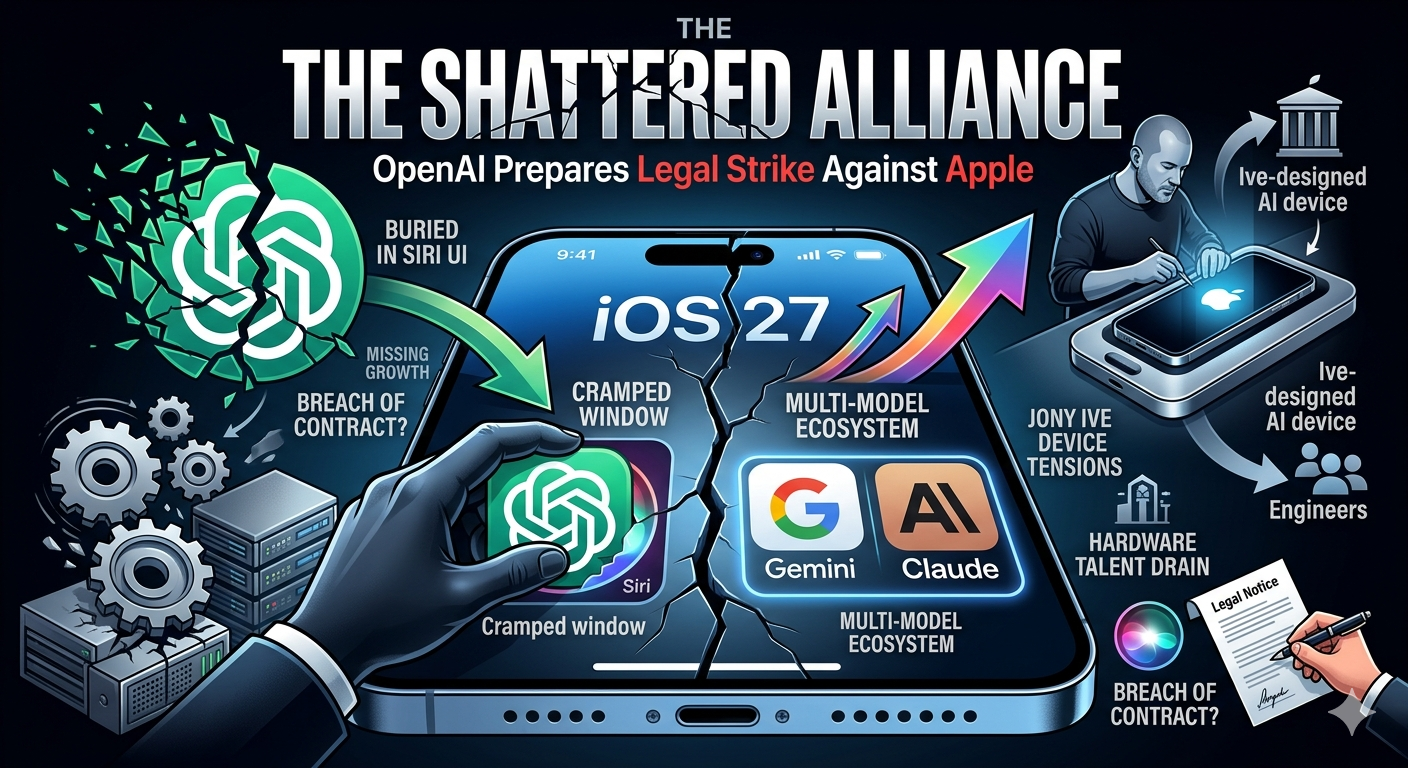
The Safari Illusion: Broken Financial and Product Expectations
When Apple and OpenAI unveiled their partnership at the Worldwide Developers Conference (WWDC) in June 2024, it was framed internally as the next "Google-Safari deal"—a transformative distribution agreement that would funnel hundreds of millions of Apple users directly into OpenAI's ecosystem. OpenAI took a massive "leap of faith," projecting that its front-row placement on the iPhone would generate billions of dollars in recurring annual subscription revenue.
Two years later, the commercial reality has fallen drastically short. Under the non-monetary baseline of the agreement, Apple did not pay OpenAI to use its models; instead, both sides relied on mutual strategic benefits. OpenAI expected customer conversion, while Apple gained an immediate AI stopgap while its in-house systems lagged.
However, OpenAI alleges Apple did not hold up its end of the product bargain. "We have done everything from a product perspective," an anonymous OpenAI executive told Bloomberg. "They have not, and worse, they haven't even made an honest effort."
The "Buried" UI: How Apple Restricted ChatGPT
According to OpenAI’s internal research, the actual implementation of ChatGPT within iOS is so constrained that users rarely encounter it naturally. The friction points driving the legal dispute include:
- Manual Invocation: Instead of Siri intelligently utilizing ChatGPT to enhance native workflows, users must explicitly mention or approve the handoff to "ChatGPT" before OpenAI's models are triggered.
- Diluted Brand Experience: When ChatGPT does generate an answer, the results are routinely truncated and displayed inside a "cramped window" within the UI. OpenAI argues this interface damages consumer perception, leaving users with a skewed impression of the model's true capabilities.
- The Standalone Preference: Because the built-in integration is so heavily restricted, iPhone owners overwhelmingly prefer to open the standalone ChatGPT app, entirely bypassing Apple's native features.
The Rise of Competitors and the Hardware Cold War
The relationship has deteriorated beyond software design. Apple has spent the last year solidifying an alternative AI architecture. It recently finalized a massive $1 billion-per-year agreement with Alphabet Inc. to bring Google Gemini models into the fold to power the next generation of Siri. With iOS 27 set to introduce Anthropic's Claude alongside Gemini, ChatGPT is being demoted from an exclusive, tier-one collaborator to just another commoditized utility provider.
Simultaneously, a hardware cold war has broken out between Cupertino and San Francisco. OpenAI’s massive $6.5 billion acquisition of a hardware startup co-founded by legendary former Apple design chief Jony Ive has set off alarm bells in Cupertino. OpenAI has aggressively poached upwards of 40 key hardware engineers from Apple, leveraging multi-million dollar compensation packages that far exceed Apple's standard pay scales. Apple views OpenAI's device ambitions as a direct, long-term threat to the iPhone ecosystem.
           [ THE PARTNERSHIP FRICTION ]
   OpenAI Grievances             Apple Grievances
┌───────────────────────┐     ┌───────────────────────┐
│ • Buried Siri UI      │     │ • Data Privacy Doubts │
│ • Missing Subscriptions│ VS │ • Jony Ive AI Device  │
│ • Lower Tier in iOS 27│     │ • Talent Poaching     │
└───────────────────────┘     └───────────────────────┘
Legal Strategy: A Breach**-of-Contract Notice**
To handle this high-stakes dispute, OpenAI has brought in an outside elite law firm to map out its aggressive options. Rather than diving straight into an immediate courtroom battle, the current strategy focuses on issuing a formal breach-of-contract notice to Apple. This legal maneuver acts as a severe shot across the bow designed to force Apple back to the negotiating table to alter the terms of the integration.
The timing of any potential public litigation is tightly constrained. OpenAI's legal resources are heavily extended as Sam Altman navigates a bruising, highly public courtroom trial against Elon Musk. Sources indicate OpenAI is unlikely to file a full, standalone lawsuit against Apple—one of the wealthiest corporate entities on Earth—until the Musk litigation concludes.
The Realities of Big Tech Ecosystems
The unfolding battle between OpenAI and Apple highlights a foundational rule of the tech industry: platform distribution always wins over pure software innovation. OpenAI built the world's most recognizable LLM, but Apple owns the physical glass through which over two billion active users interact with the digital world.
By keeping ChatGPT tightly boxed in, Apple successfully used OpenAI to absorb the market pressure of the early AI boom while quietly preparing its long-term, multi-model infrastructure. For OpenAI, the legal escalation is a desperate, necessary play to avoid being relegated to a invisible background API. For tech journalists and industry analysts, it serves as a stark reminder that in the AI era, strategic alliances are fleeting, and ecosystem control is absolute.
1
0
0
0

Комментарии