
Хотите улучшить содержимое страницы? Предложите правку.
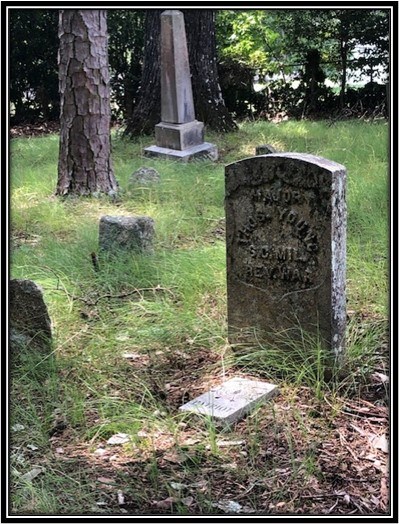
Thomas Young's grave. NPS photo
Thomas Young was born in Laurens District, South Carolina, on January 17, 1764, and grew up in Union District, where his family moved soon after. He became a farmer and married twice — first Lettie Hughes, then, after her death, Sarah Cunningham. One family genealogy credits him with eleven children.
A civil war in the backcountry
After the British took Charleston in May 1780, South Carolina's war among its own people turned savage. General Nathanael Greene wrote to Alexander Hamilton in 1781:
"the Whigs and Tories persecute each other, with little less than savage fury. There is nothing but murder and devastations in every quarter."
Loyalists, long held down, rallied to the King; Tory militias, backed by the British army, struck at patriot Whigs deep in the backcountry. South Carolina militia Major Joseph McJunkin remembered that not one Whig corps was under arms in the state and "the cause of liberty is desperate." Neighbors turned on neighbors, and the line between soldier and civilian vanished.
His brother's death
In early June 1780, Colonel Thomas Brandon gathered patriot militia at Fairforest Creek, near present-day Union. His men caught a local loyalist informer, Adam Steedham — "a pet Tory," McJunkin called him. Steedham escaped or was let go and led the loyalist officer William "Bloody Bill" Cunningham to Brandon's camp, which Cunningham raided just after sunrise on June 8, 1780. Among the dead, wounded and captured at Brandon's Defeat was Thomas's brother John Young; the two were very close in age.
Steedham fled to Georgia and came back months later. Thomas was waiting. In his memoir, published in 1843, Young wrote that his brother's death was why he joined the militia:
"I do not believe I had ever used an oath before that day, but then I tore open my bosom, and swore that I would never rest till I had avenged his death. Subsequently, a hundred tories felt the weight of my arm for the deed, and around Steedham's neck I fastened the rope as a reward for his cruelties."
After Steedham's execution he joined Brandon's company.
Kings Mountain
Young's first fight was at Stallions' Plantation in 1780. With Brandon's company, in Colonel Benjamin Roebuck's division, he fought at Kings Mountain on October 7, 1780, where British Major Patrick Ferguson and his loyalists were defeated:
"Awful indeed was the stench of the wounded, the dying, and the dead on the field, after the carnage of that dreadful day."
He guarded prisoners on the march into North Carolina and saw loyalist prisoners tried and hanged at the Biggerstaff Plantation.
Hammond's Store
Back in South Carolina, Young joined General Daniel Morgan's army of Continentals and militia at Grindal Shoals. Morgan sent Lieutenant Colonel William Washington's 3rd Continental Dragoons, with South Carolina mounted troops, after a loyalist force called the Georgia Horse Rangers, whose raids Washington described to Greene in December 1780:
"The distress of the Women and Children stripp'd of everything by plundering Villains cries aloud for redress."
Washington caught them near Hammond's Store and destroyed them. Young rode in with Brandon, Major James McCall and Major Benjamin Jolly, and came through unhurt. Not yet 17, he was already hardened; he later recalled, with amusement, a boy of fourteen or fifteen who, jeered at for a dunking while crossing the Tiger River, swore to kill a man that day — and did, chasing a Tory around a corn crib and cutting him down. War is harsh, and innocence is its first casualty.
Cowpens, on his 17th birthday
On January 17, 1781 — his 17th birthday — Young was with Morgan's army at Cowpens, in Major Jolly's South Carolina Mounted Militia. Against Morgan's roughly 1,500 troops came Lieutenant Colonel Banastre Tarleton with 1,100 of Britain's best troops in the southern colonies.
As the British infantry charged the American line, Jolly's horsemen burst from the woods:
"We made a most furious charge, and cutting through the British cavalry, wheeled and charged them in the rear."
The mounted militia broke 50 British Legion dragoons, drove them off, and struck the charging 71st Highlanders from behind. Caught in a textbook double envelopment, Tarleton's army fell apart. The battle lasted about half an hour; Tarleton escaped with about 200 survivors.
Wounded and captured
Young joined the 20-mile pursuit, ran into a British cavalry patrol, and was caught when his horse gave out:
"I drew my sword and made battle. I never fought so hard in my life. I knew it was death anyhow, and I resolved to sell my life as dearly as possible."
He took saber cuts to his hand, arm, forehead, both shoulders and the back of his head. As a prisoner, a loyalist named Littlefield who knew him nearly killed him — until twenty British dragoons drew their swords and drove Littlefield off, cursing him as a coward for trying to kill an unarmed boy and prisoner.
Brought before Tarleton, Young found him "a very fine looking man, with rather a proud bearing, but very gentlemanly in his manners." Tarleton questioned him about Washington's cavalry and the mounted militia, had his wounds treated, and promised to parole him at General Cornwallis's camp. That night Young and another American prisoner escaped: a redcoat whose loot they had helped hide looked the other way.
To the end of the war
After weeks recovering on a farm, Young rejoined Brandon for the siege of Fort Motte and the taking of Orangeburg, raided British horse stables near Bacon's Bridge with Captain Boykin, then rode with Brandon and Jolly to Greene's siege of Ninety Six. When British troops lifted that siege, he went home to Union District as a scout.
- His own cousin, the Tory William Young, offered 100 gold guineas for his capture and delivery to Ninety Six. No one collected.
- Captured a last time by "Outliers" — notorious plunderers and murderers — he was freed unharmed by one of them, a man his company had once held prisoner and treated well.
Young served in the militia until the Treaty of Paris was signed in September 1783, then went home to farm. He died on November 7, 1848, and is buried in the Old Presbyterian Church Cemetery in Monarch, South Carolina.
Sources
Based on "Thomas Young," National Park Service (Cowpens National Battlefield, Kings Mountain National Military Park, Ninety Six National Historic Site and Overmountain Victory National Historic Trail), which draws on Young's 1843 memoir, the memoirs of Joseph McJunkin, and the papers of Nathanael Greene; a work of the United States government in the public domain. The article gives Young's age as 15 in the summer of 1780, which does not fit its own birth date of January 17, 1764, so that age is left out here.
В подборкахCowpens National BattlefieldKings Mountain National Military ParkNinety Six National Historic SiteOvermountain Victory National Historic Trail
Лицензия: CC0 1.0 (общественное достояние) · По материалам www.nps.gov
1
0
0
0

Комментарии


