
What should the National Park Service preserve? Who decides what is important, whether a building serves the agency's mission, who owns an object or a story? Not everything can be saved, and what one generation values, another may not. Few places show those choices as starkly as Independence National Historical Park in Philadelphia.
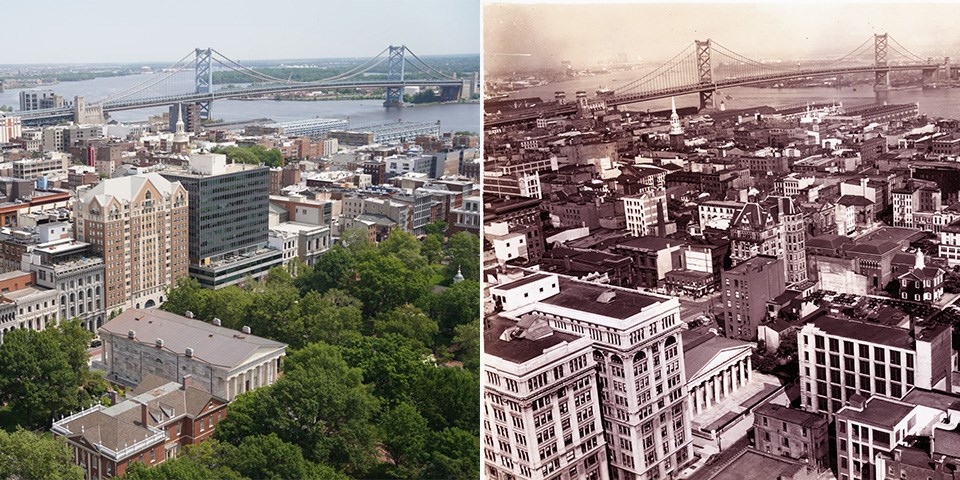
The park's surroundings in 1952 and 2010. The columned Second Bank of the United States, center left, helps show how much changed. Credit: National Park Service.
The park, created in 1948, secured Independence Hall and many buildings around it. But the neighborhood around them was a 20th-century city of impressive offices and banks. City and state groups had already begun deciding what to keep and what to demolish, and many hard choices remained.
Two visions
Designing a national park in a city nearly three hundred years old took creativity, and everyone had a different picture of what it should look like.
| Judge Edwin Lewis and the National Park Shrines Committee | Architect Charles Peterson | |
|---|---|---|
| Role | Crucial in passing the legislation that created the park | A Park Service planner, founder of the Historic American Buildings Survey, and a 20-year NPS veteran |
| Vision | Visitors strolling colonial streets past original and recreated colonial homes on the way to Independence Hall and the Liberty Bell | Keep the later city: small courtyards, gardens, historic streets and brick sidewalks linking the 1770s landmarks with newer neighbors |
| What it meant | Demolishing many buildings from after 1800 | Preserving the area's history as Philadelphia's government and financial center and the port district of the "Workshop of the World" — rather than a "fairy tale" 1770s |
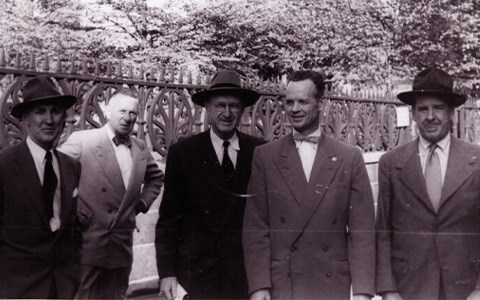
Charles Peterson (right) with other NPS officials, 1951. Credit: National Park Service.
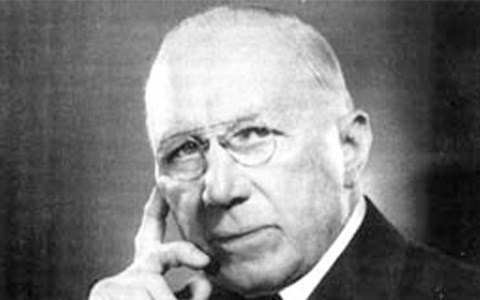
Judge Edwin Lewis. His firm vision was vital to winning support for the park, and a point of conflict when it came to planning it. Credit: National Park Service.
Peterson drew up several plans and won support from architects nationwide and groups in the city. But Lewis, the City of Philadelphia and a shifting Park Service mission settled it: the landscape would evoke the years 1774 to 1800. Demolition intensified.
One survivor predated the park: the Second Bank of the United States, built in 1816 — too late for Lewis's 1770s — had been the first building the Park Service preserved there, in 1939, and escaped demolition.
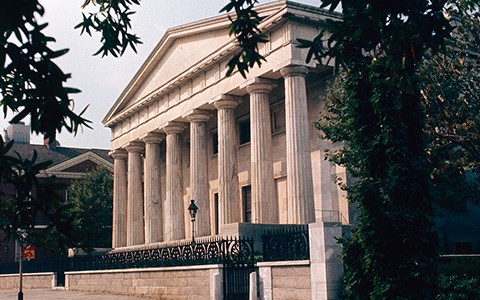
The Second Bank of the United States. Credit: National Park Service.
Landmarks that fell
Architects, residents and historians still count these buildings among Philadelphia's notable contributions to architecture:
| Building | What made it notable | Fate |
|---|---|---|
| Guarantee Trust and Safe Deposit Company | One of Chestnut Street's grandest, its ornate towers looming before Carpenters' Court; built with as little wood as possible to be fireproof | Demolished 1957 to open the view of Carpenters' Hall |
| Provident Life and Trust Building | At 4th and Chestnut, it grew from a small bank over the decades | Demolished 1956, photographed by NPS historical architect Penelope Batcheler |
| Drexel Building | Ten stories over Old City Hall at 5th and Chestnut, on the site of the American Philosophical Society's original Library Hall; built around a bank whose owner wouldn't sell | Demolished 1956; the Signers Garden and a reconstructed Library Hall stand there now |
| Jayne Building | Eight stories in 1850 — one of the first "skyscrapers" in the United States; lost its tower to fire in the 1870s. Peterson fought for it | Demolished; the Museum of the American Revolution now occupies the site |
| Penn Mutual Building | At 3rd and Chestnut, built the same year as the Jayne Building; one of the country's first cast-iron buildings | Demolished 1956 |
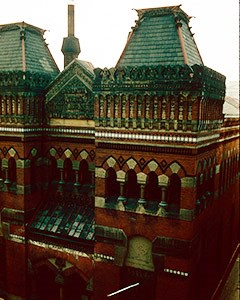
The Guarantee Trust and Safe Deposit Company building. Credit: National Park Service.
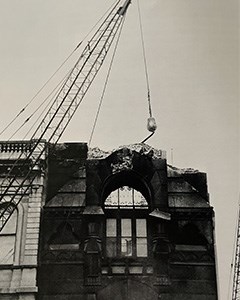
The Provident Life and Trust Building during demolition, 1956. Credit: National Park Service.
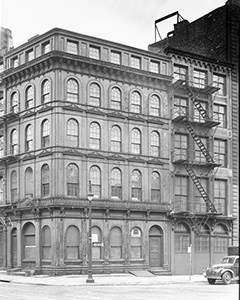
The Penn Mutual Building. Credit: Library of Congress.
What remains, and what was learned
Some of Peterson's ideas survive: visitors can explore the park's courtyards, small gardens and public squares along brick sidewalks, and the early-19th-century marble facades of the Second Bank and the Merchants' Exchange are favorite photo backdrops. Today's landscape resembles neither the 1950s nor the 1770s.
The Park Service learned from the sweeping changes of the 1950s. Major changes to the park's landscape — removing, adding or substantially altering buildings — now require broad community input, as the agency works with local communities to preserve urban neighborhoods and landscapes.
Sources
Based on "What Was Lost?", Independence National Historical Park, National Park Service; a work of the United States government in the public domain.
В подборкахIndependence National Historical Park
Лицензия: CC0 1.0 (общественное достояние) · По материалам www.nps.gov
1
0
0
0

Комментарии
Читать дальше


