
From the fall 2021 issue of The Oasis, the twice-yearly newsletter of the National Park Service's Mojave Desert Network (MOJN) Inventory and Monitoring Program.
The white-nose fungus in the Southwest
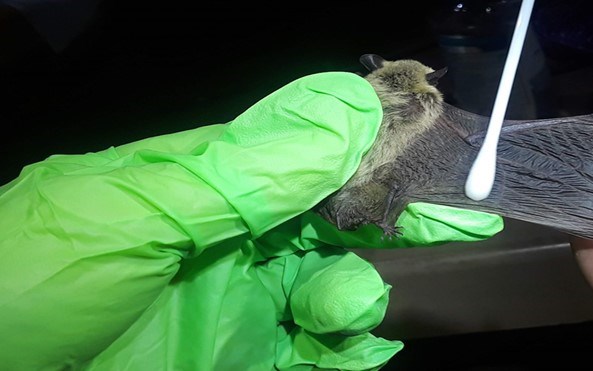
Swabbing a bat's wing to sample microorganisms, including the white-nose fungus. Credit: National Park Service / Kimber Godfrey.
White-nose syndrome is caused by a cold-loving fungus, Pseudogymnoascus destructans (Pd), that grows on the faces and wings of hibernating bats. The irritation wakes them more often than normal to groom it off, burning fat reserves they need to survive until spring; many don't. The fungus can also damage wing skin enough to affect flight.
With National Park Service Emerging Diseases funding, Alice Chung-MacCoubrey of the Klamath Network and Allen Calvert of the Mojave Desert Network have led surveillance across northern and southern California. That work produced California's first "inconclusive" detection of Pd in 2018, followed by more in northern California in 2019 and 2021. An inconclusive result means the lab found the fungus, but at levels too low to confirm.
In 2021, inconclusive results turned up for the first time at Mojave Desert Network parks in southern California and northwestern Arizona — a surprise, since no nearby area had known positives. It may mean the fungus has arrived in southern California.
| Park | Bats with inconclusive results |
|---|---|
| Death Valley National Park | 1 |
| Grand Canyon-Parashant National Monument | 1 |
| Mojave National Preserve | 3 |
| Joshua Tree National Park | 3 |
In all, 126 bats were sampled across the four parks. Nevada parks couldn't be sampled because bat handling was delayed over concerns about passing COVID-19 to bats. Two of the four species with inconclusive results — the California myotis and the canyon bat — weren't previously known to carry the fungus.
Detecting the fungus doesn't mean the disease is present, and its effect on local bats is unknown. New NPS Biological Resources Division funding will greatly expand sampling in 2022, coordinated across the region. Because hibernation sites are hard to find in the West, the network will also keep up acoustic surveys, which can reveal whether a species is being detected less often — and then help target research on whether white-nose syndrome or another threat is to blame. More is in the bat monitoring project brief and on the NPS bats website.
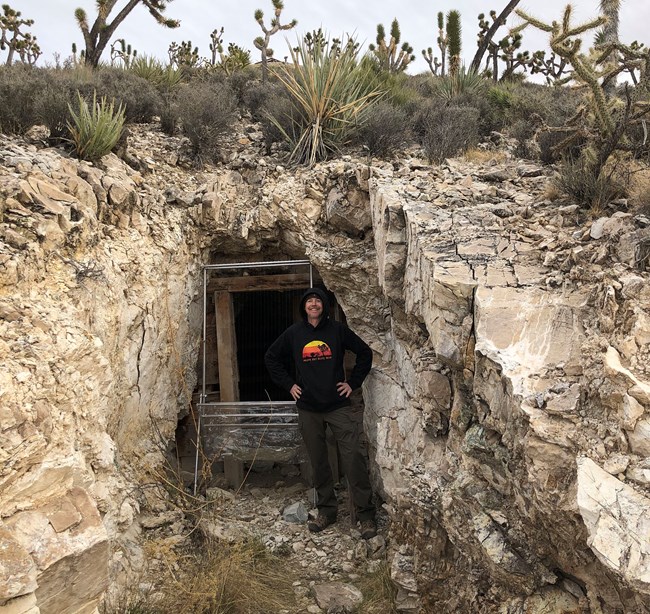
Program manager Allen Calvert with a harp trap for catching bats leaving an abandoned mine in Mojave National Preserve. Credit: National Park Service / Kimber Godfrey.
Aspen monitoring begins at Great Basin
Aspen grow in two network parks, Great Basin National Park and Grand Canyon-Parashant. Beyond their famous golden fall color, aspen stands support a rich variety of plants and animals — and where aspen have declined, researchers have seen declines in other species too.
After pilot data were collected at Parashant in 2019 and the monitoring protocol was revised, crews surveyed the first panel of plots at Great Basin in September 2021: 54 plots at Baker Creek (41), Lexington Creek (6) and Decathon Canyon (7). See the aspen project overview.
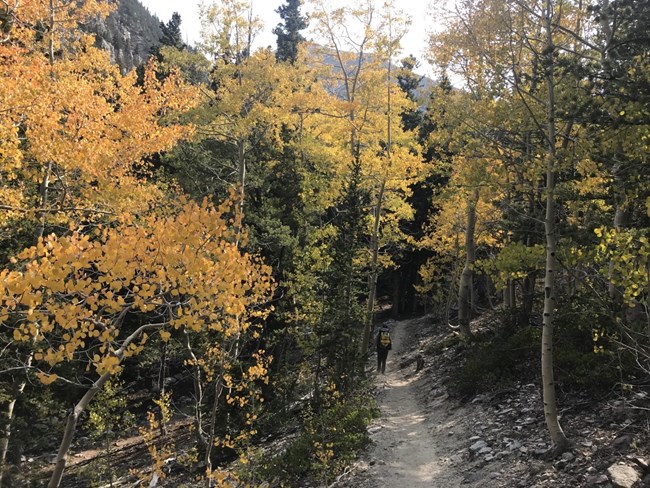
A monitoring crew member in an aspen forest at Great Basin National Park. Credit: National Park Service / Logan Combs.
Open, reproducible data
Physical scientist Jennifer Bailard, data manager Mark Lehman and data scientist Sarah Wright published a data release for the network's streams and lakes monitoring, 2009–2020. It includes raw and calculated data as CSV files — simple, machine-readable and usable without proprietary software — and an interactive report with quality-control checks, summaries and visualizations, all generated by scripted R code. That makes future reports faster and the workflow transparent and reproducible, and it's the model for publishing the network's spring monitoring data.
New project briefs cover a Bat Blitz at Great Basin, integrated uplands monitoring and streams and lakes monitoring.
A first virtual symposium
With COVID-19 ruling out an in-person meeting, the network held its second science symposium — its first virtual one — on November 16–17, 2021, in sessions of four hours or less. Attendance peaked at 76, and at least 12 government, academic and private organizations took part. U.S. Fish and Wildlife Service research ecologist Jennifer Wilkening opened with a keynote on the Resist-Accept-Direct framework for resource managers; 13 more talks came from the Park Service, Bureau of Land Management, U.S. Geological Survey and universities, along with three NPS posters. The agenda and abstracts are public.
Sources
Based on "The Oasis Newsletter: Fall 2021," Mojave Desert Network Inventory and Monitoring Program, National Park Service; a work of the United States government in the public domain.
В подборкахGreat Basin National ParkDeath Valley National ParkLake Mead National Recreation AreaJoshua Tree National ParkMojave National PreserveGrand Canyon-Parashant National Monument
Лицензия: CC0 1.0 (общественное достояние) · По материалам www.nps.gov
1
0
0
0

Комментарии
Читать дальше


