

The saguaro bloom of spring 2021. NPS / Tani Hubbard.
In May 2021 the saguaros around Tucson did something almost nobody had seen: they flowered not just in a crown at the top, as usual, but all the way down their trunks and arms, and even on tiny new buds. Park Service scientists in the Sonoran Desert Network think the answer lies not in that spring's weather but in the water stored in the soil the years before — and the same thinking is changing how desert parks plan for a hotter, drier future.
Why did the saguaros bloom like that?
The bloom followed an unseasonal flowering in autumn 2020 and came after Tucson's hottest summer and second-driest monsoon on record, on top of years of drought. Some long-time observers read it as a stress response. The longer record suggests something else.
- More adults. A surge of young saguaros from the 1960s to the early 1990s means many are now reaching flowering age at Saguaro National Park — even though new recruitment has collapsed in the past 25 years of drought. The 2020 saguaro census found young plants mainly where soils hold more water.
- Soil is a bank account. Plants do not drink rain; they draw water from the soil. The Park Service's water-balance model starts with precipitation, subtracts runoff, drainage and evaporation, and estimates what is left for plants.
- A strong link. At a site on Saguaro's Cactus Forest Loop Drive, April soil moisture explains 88 percent of the year-to-year variation in plant greenness since 2001 — far more than rainfall or temperature.

April soil moisture against plant greenness (NDVI), 2001–2021, with the "pivot point" where plants get the water they need to hold steady. NPS.
April 2021 was dry. But 2019 and 2020 were well above the pivot point — the amount of water needed to keep vegetation in average condition. Long-lived plants respond to years, not seasons, and many trees need several good years to build the reserves for a mass seeding. Perhaps saguaros do too.
Whether the bloom produces a new generation depends on what comes next: early summer rain, then a couple of cooler, wetter years. The network has flagged the bloom in its Climate Analyzer, which will alert managers if the same run of conditions recurs. Photographs of the bloom on the network's social media reached about 515,000 people.
Planning for what can be saved

Southwestern parks are already losing ground: whole pinyon-juniper woodlands killed by bark beetles or drought, fiercer fires and floods, less snow, more erosion. Managers increasingly have to choose what to save and what to let go — decisions that are scientifically hard and emotionally painful.
Climate Smart Conservation is a process that helps. Scientists and managers work through, together and in rounds, what climate change could do to a park's resources, test scenarios against data, and pick the actions most feasible and effective with the park's means. Since a first workshop in Moab, Utah, in 2016, parks across the West have used it — to restore grasslands and pinyon-juniper in Southeast Utah, and for streams and whitebark pine in Greater Yellowstone.
The tools also answer narrower questions. At Montezuma Castle National Monument, a water-balance model asked whether Wet Beaver Creek will keep supplying the park's water right:
| Future | Years with enough low flow to meet the water right |
|---|---|
| 1980–2020 | 70% |
| 2050–2100, warm and wet | likely met |
| 2050–2100, hot and dry | 30% |
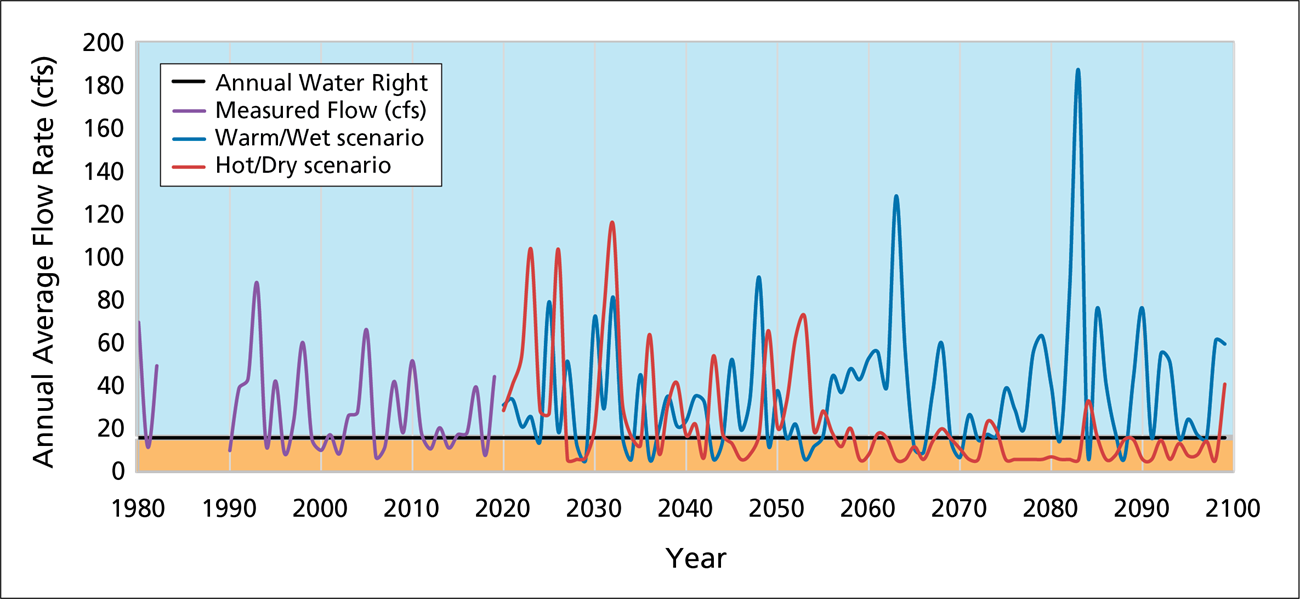
Projected average flow of Wet Beaver Creek: warm and wet (blue) against hot and dry (red). NPS.
When rain falls matters as much as how much. Light showers evaporate; big soaking rains recharge the soil; violent storms run off before they sink in. Those violent storms are becoming more common — so even if the water right holds, the cottonwoods and sycamores along the creek may not.
Sources
Written from The Heliograph, Summer 2021, newsletter of the National Park Service Sonoran Desert Network and Desert Research Learning Center, a work of the United States government in the public domain.
В подборкахChiricahua National MonumentCasa Grande Ruins National MonumentCoronado National MemorialMontezuma Castle National MonumentFort Bowie National Historic SiteGila Cliff Dwellings National Monument
Лицензия: CC0 1.0 (общественное достояние) · По материалам www.nps.gov
1
0
0
0

Комментарии
Читать дальше


