
Ser du något att förbättra? Föreslå en ändring.
At Herring Cove Beach, part of a parking lot has crumbled into the ocean. Sea level rise and intense storms are reshaping Cape Cod's shore, and the park's staff live with the consequences. So when Cape Cod National Seashore rebuilt its beach facilities, it put solar panels on them.
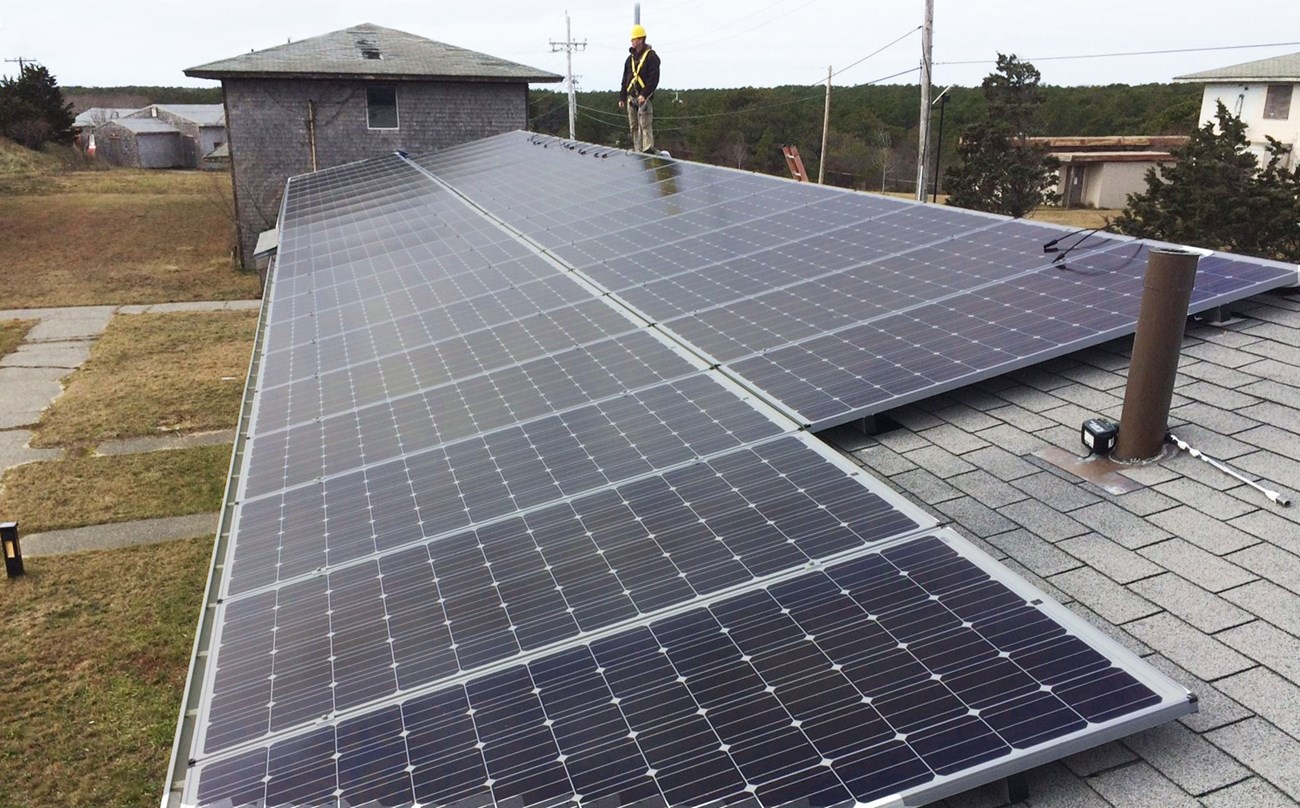
Solar panels on a park roof at Cape Cod. Credit: NPS.
Why a park is cutting its emissions
The National Park Service is charged with conserving landscapes "unimpaired for the enjoyment of future generations" (NPS Organic Act, 1916). As people keep burning fossil fuels, climate change intensifies, and so do its effects on places like Cape Cod. Because greenhouse gas emissions are part of the problem, cutting them is part of the answer, and the NPS promotes that through the Green Parks Plan and the Climate Friendly Parks Program.
As a Climate Friendly Park, Cape Cod took an inventory of its emissions and wrote an action plan in 2011 to shrink them. Its planners have used that plan as a starting point ever since, and renewable energy has been their main tool.
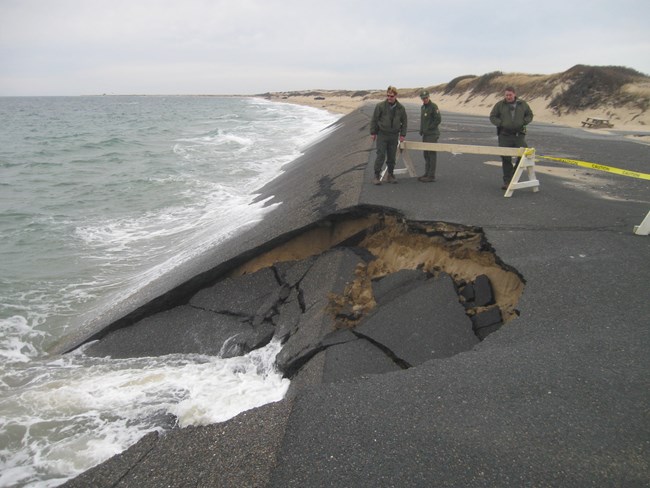
Erosion from sea level rise broke apart this part of the parking lot at Herring Cove Beach. Credit: NPS/Karst Hoogeboom.
Three arrays, three opportunities
| Where | Size | How it happened |
|---|---|---|
| Herring Cove Beach | 15 kW | added to the plans when the facility had to be rebuilt |
| Nauset Light Beach | 15 kW | the same: built into the new construction |
| Highlands Center | 30 kW, on two buildings | a new project, planned when a new sustainability funding source appeared |
All three are connected to the local electric grid. Their power goes into the grid and supplies local buildings, and the park receives credits that reduce its electric bill. Setting that up with the local energy company took a long time, but it was worth it.
One year at the Highlands Center
| In its first year, the Highlands Center arrays | |
|---|---|
| generated | more than 31,000 kilowatt-hours — enough to keep a 100-watt bulb lit for more than 35 years |
| saved | $5,130 on the park's electric bill |
| avoided | 22.1 metric tons of greenhouse gases, compared with making the same power from fossil fuels — as much as a gas-powered car emits over 57,600 miles, or almost twenty drives from San Francisco to New York City |

NPS Photo.
What comes next
Herring Cove and Nauset Light are two of Cape Cod's most popular beaches, with millions of visitors a year, so the arrays are on show to all of them; at the Highlands Center, visiting scientists and students see them too. The park hopes the example travels home with them.
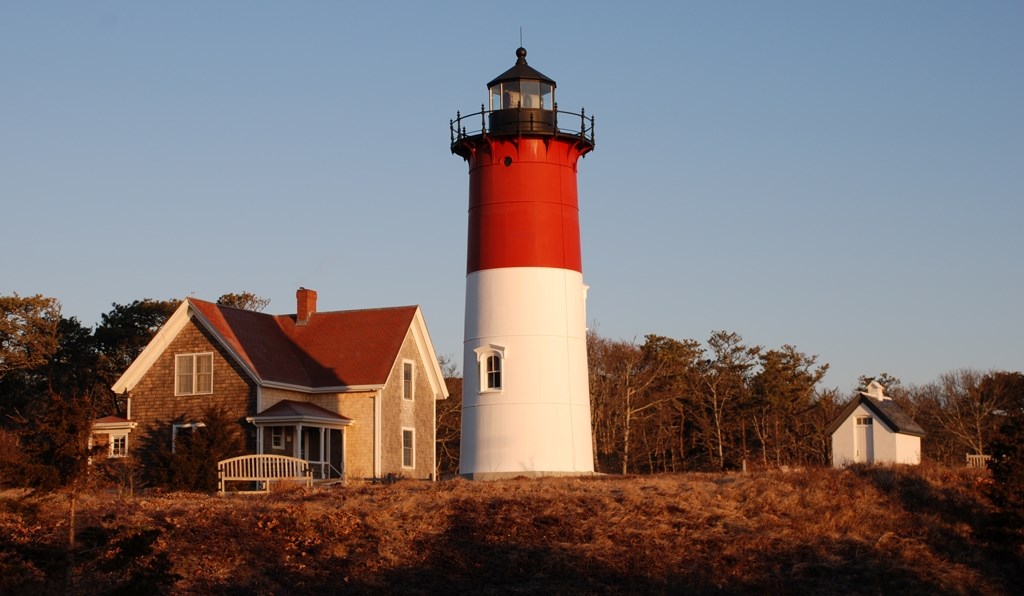
The lighthouse at Nauset Light Beach. Credit: NPS.
The planners are not finished. In 2022, when the National Park Foundation Sustainability Fund opened, they proposed solar arrays for the park headquarters and maintenance buildings. If completed, the project should supply nearly all the energy those two buildings need, bringing them close to net-zero energy use.
Sources
Based on "Case Study: Cape Cod's Solar Arrays" by Claire Baker, NPS Climate Change Response Program (2024), a work of the United States government in the public domain, drawing on an interview with Lauren McKean of Cape Cod National Seashore. Equivalences from the U.S. Department of Energy and the EPA Greenhouse Gas Equivalencies Calculator (2023). Pictures an earlier version of this page left out were restored on 2026-09-26.
I dessa publikationerCape Cod National Seashore
Licens: CC0 1.0 (allmän egendom) · Bearbetat efter www.nps.gov
1
0
0
0

Kommentarer


