
Ser du något att förbättra? Föreslå en ändring.
CDC has recommended routine, opt-out HIV testing in health care since 2006, and the U.S. Preventive Services Task Force (USPSTF) has rated it an "A" preventive service since 2013 (updated in 2019) — so since early 2014 the Affordable Care Act has required insurers to cover it with no deductible or copay. All adolescents and adults should be tested at least once. Yet a CDC analysis of national survey data found that HIV tests were still done at only a tiny fraction of outpatient visits.
How often visits included an HIV test
The study covered visits by males and non-pregnant females aged 13–64, leaving out people already diagnosed with HIV and pregnant women, who are routinely tested.
| Setting | Visits a year (average) | HIV test done | Trend |
|---|---|---|---|
| Physician offices (2009–2016) | 516 million | 0.63% | no increase |
| Community health centers (2009–2014) | 37 million | 2.65% | rose sharply: 0.76% → 2.41% |
| Emergency departments (2009–2017) | 87 million | 0.55% | rose slightly: 0.22% → 0.72% |
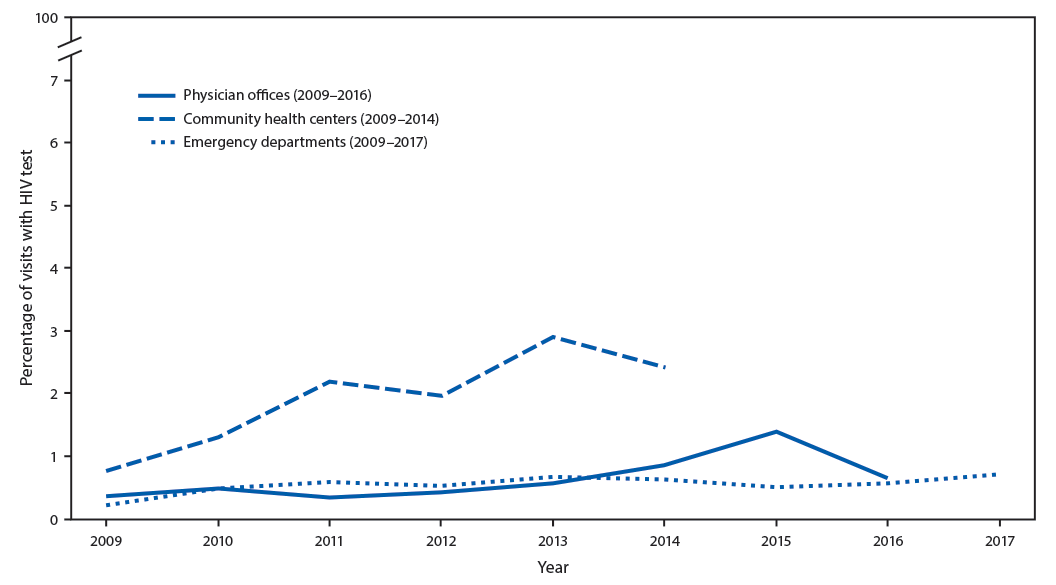
The 2015 physician-office estimate was not statistically stable; the health center trend covers physicians only. Image from CDC's report
Who was tested
| Group | Physician offices | Health centers | EDs |
|---|---|---|---|
| Age 20–29 | 1.71% | 5.08% | 0.62% |
| Age 50–64 | 0.21% | 1.36% | 0.45% |
| Black | 1.51% | 4.30% | 1.07% |
| Hispanic | 1.20% | 3.10% | 0.81% |
| White | 0.37% | 1.79% | 0.28% |
| Metropolitan areas | 0.67% | 3.08% | 0.63% |
| Non-metropolitan areas | 0.28% | 0.93% | 0.11% |
| Primary care physicians | 1.09% | 2.47% | — |
| Other specialties | 0.15% | 0.82% | — |
Testing was most common among people in their 20s at offices and health centers, higher for Black and Hispanic patients than for white patients everywhere, and lower outside cities.
When a test was most likely
- At preventive-care visits to offices and health centers.
- At any visit where blood was drawn (venipuncture) — an easy moment to add an HIV test.
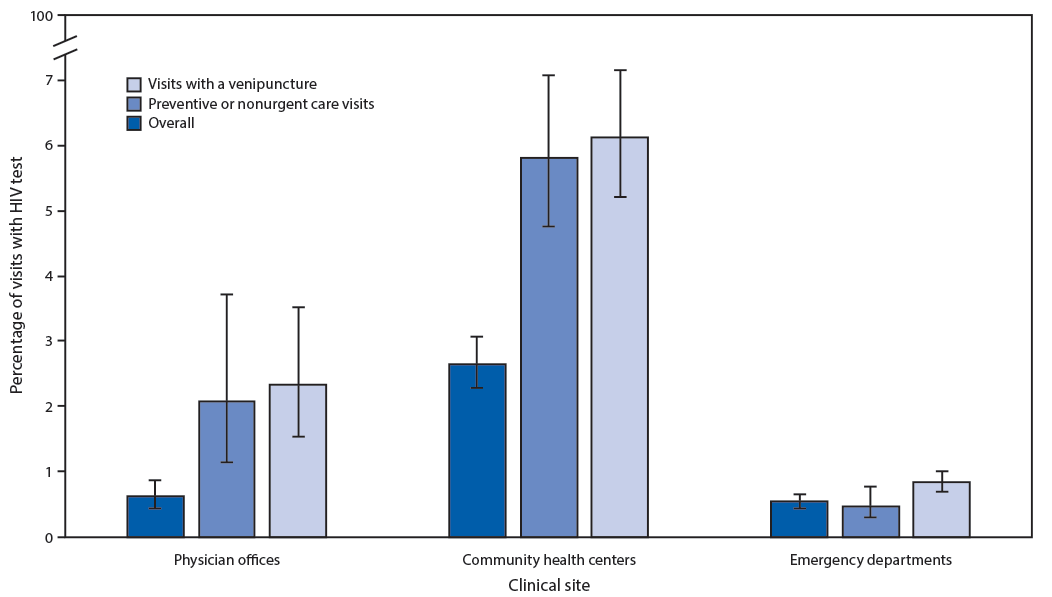
Image from CDC's report
By insurance, testing rose among:
| Group and setting | Change |
|---|---|
| Privately insured, health centers | 1.55% (2009–2012) → 2.67% (2013–2014) |
| Medicaid, physician offices | 0.39% → 0.84% → 1.35% (2015–2016) |
| Medicaid, health centers | 1.86% → 3.05% (2013–2014) |
It did not rise for privately insured patients at physician offices, or for either group in EDs.
Why health centers did better
Community health centers serve people with some of the highest rates of undiagnosed HIV. The Health Resources and Services Administration (HRSA) has pushed HIV testing in primary care, has collected testing data since 1999, and since 2014 has made it a quality measure that federally qualified and look-alike health centers must report. Some centers also use clinical decision support to prompt testing.
Physician offices didn't improve even after cost-sharing was dropped — suggesting the barrier isn't cost but things like relying on busy clinicians to remember to order the test.
Why it matters
In 2019, the U.S. Department of Health and Human Services launched Ending the HIV Epidemic: A Plan for America (EHE), aiming to end the U.S. epidemic by 2030. Testing is the first step — to find people with HIV and connect them to care, and to identify HIV-negative people at high risk who could benefit from preexposure prophylaxis (PrEP).
| EHE target by 2025 | Where things stood in 2018 |
|---|---|
| ≥95% of HIV infections diagnosed | about 86% of people with HIV knew it |
| PrEP for ≥50% of people who need it | about 18% were prescribed it |
What would help
- Electronic health record prompts that order an HIV test for patients who need one, and standing orders for routine opt-out testing.
- Don't miss non-preventive visits. Young Black and Hispanic men and people who inject drugs, who face higher risk, may rarely come in for checkups but do come in for other reasons. One model found that tripling testing at outpatient visits by Black and Hispanic men aged 18–39 would test nearly all of them by 39.
- Test at least once, and every year or more often for people at higher risk from sex or injection drug use.
- Focus on the EHE's first-phase jurisdictions, which have the most new diagnoses.
Limits: the surveys count visits, not people, so one person may be tested more than once; recent samples were small; sampling designs changed during the period; and health center data stop at 2014.
Sources
Based on Karen W. Hoover, Ya-Lin A. Huang, Mary L. Tanner, Weiming Zhu, Naomie W. Gathua, Marc A. Pitasi, Elizabeth A. DiNenno, Suma Nair and Kevin P. Delaney, "HIV Testing Trends at Visits to Physician Offices, Community Health Centers, and Emergency Departments — United States, 2009–2017," MMWR, volume 69, Centers for Disease Control and Prevention, using the National Ambulatory Medical Care Survey and National Hospital Ambulatory Medical Care Survey; a work of the United States government in the public domain.
Licens: CC0 1.0 (allmän egendom) · Bearbetat efter www.cdc.gov
1
0
0
0

Kommentarer


