
Vill du förbättra sidans innehåll? Föreslå en ändring.

A bee from the genus Andrena. NPS / Christina Martin
After you finish a delicious meal, it’s customary to thank the cook. But did you ever think to thank a bumblebee? In the US, we have pollinators to thank for one out of every three bites of food we eat. Plants depend on pollen transport to produce fruits, seeds, and young plants. And while some pollination is done by the plant itself (self-pollination), or by wind and water, most is done by insects and animals—including bats, birds, beetles, flies, butterflies, and other creatures that transfer pollen as they move between plants. Without pollinators, we would not only be without much of our food supply, but also without the other ecosystem services flowering plants provide. Clean air, stable soils, and diverse wildlife are some of the many other benefits you might want to mention in your thank-you to pollinators!
But pollinators face many threats, and their populations are declining around the world. In the national parks, managers need to know which pollinators are present, and in what abundance, to better understand the state of park ecosystems and make decisions about how to manage them. The Inventory & Monitoring Division’s Species Inventories program has several pollinator projects in development or in progress across the country. Seventeen parks will be surveyed for insect pollinators (bees and butterflies) starting in spring 2024 and continuing through 2025 and 2026. Led by university and NGO partners, these projects will address priorities for pollinator conservation identified by park staff. These include invasive plant removal, grazing management, controlled burning, and habitat restoration. Some parks have requested full inventories of all relevant species, while others are focused on select species of interest, such as bumblebee and butterfly species that are rare, threatened or endangered (T&E), or being considered for T&E listing.
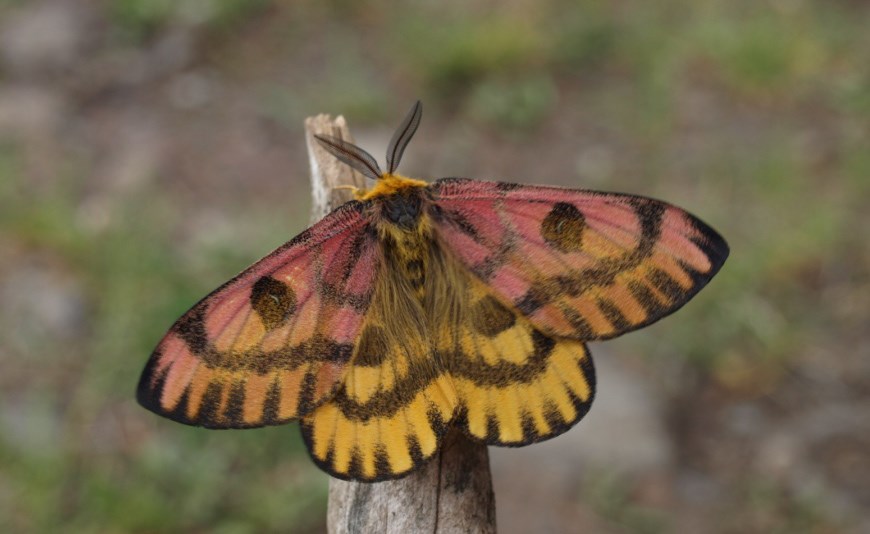
Western sheep moth (Hemileuca eglanterina) NPS / Sarah Whipple
On the Northern Colorado Plateau, researchers from the University of Colorado–Boulder will lead bee and butterfly inventories at Dinosaur and Colorado national monuments. These inventories will address management questions about livestock grazing, invasive species removal, and habitat restoration. Beginning in 2025, researchers from the University of Wyoming will inventory bees at Fossil Butte National Monument (NM). They will investigate how trampling by native ungulates (such as elk and deer) impacts ground-nesting bees.
Two partners in the Great Lakes area will survey bumble bees and butterflies. The results will guide the management of plant life in the parks, including invasive plant removal, mowing, chemical treatment, and burning. The University of Minnesota will do preliminary work at Apostle Islands National Lakeshore (NL), Mississippi National River & Recreation Area, and Saint Croix National Scenic Riverway in 2024, with the full project starting in 2025. The Michigan Natural Features Inventory at Michigan State University will survey Isle Royale National Park, Pictured Rocks NL, and Sleeping Bear Dunes NL beginning in summer 2024. These surveys will emphasize petitioned, threatened, and endangered species, including monarch butterflies and rusty patched bumblebees.
A monarch and milkweed inventory project is being developed for San Antonio Missions NHP and Padre Island National Seashore, on the Gulf Coast. This project will be co-led by the University of Texas–San Antonio and Monarch Joint Venture. They will conduct fall surveys in 2024 and spring surveys in 2025, to document monarch breeding and milkweed life cycles during the annual migration.
Finally, in the Northern Great Plains, four parks (Devils Tower NM, Mount Rushmore National Memorial, and Wind Cave and Jewel Cave national parks) will be surveyed for threatened and endangered pollinators. Results will inform invasive plant management, including herbicide application, burning, and mowing.
Where this belongs
- Apostle Islands National Lakeshore
- Boston Harbor Islands National Recreation Area
- Colorado National Monument
- Devils Tower National Monument
- Dinosaur National Monument
- Fossil Butte National Monument
Where this page came from
This page was imported from National Park Service. Produced by the U.S. National Park Service and, as a work of the United States government, in the public domain.
Nobody has written it yet — it is the source material at a new address, which is why search engines are asked to skip it and why no one earns from it. It is up for grabs: take it on, and it is yours to rewrite and to earn from.
I dessa samlingarBoston Harbor Islands National Recreation AreaApostle Islands National LakeshoreDevils Tower National MonumentDinosaur National MonumentColorado National MonumentFossil Butte National Monument
Licens: CC0 1.0 (allmän egendom) · Bearbetat efter www.nps.gov
1
0
0
0

Kommentarer
Läs härnäst


