Ser du något att förbättra? Föreslå en ändring.

Life-Saving Naloxone from Pharmacies
More dispensing needed despite progress

Life-Saving Naloxone from Pharmacies
More dispensing needed despite progress


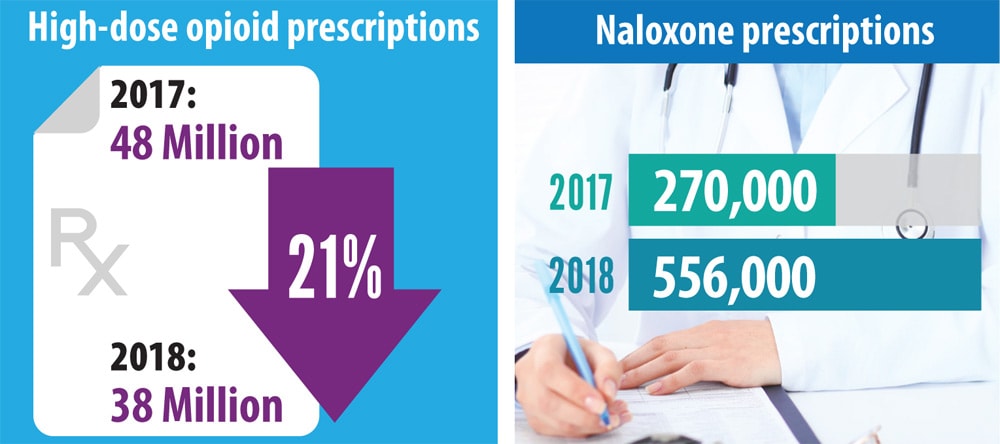
The number of prescriptions for naloxone doubled from 2017 to 2018.

Only 1 naloxone prescription is dispensed for every 70 high-dose opioid prescriptions.


Rural counties are nearly 3 times more likely to be ranked low dispensing than metropolitan counties.
Highlights
Emergency Physicians and Opioid Overdoses: A Call to Aidexternal icon (Annals of Emergency Medicine) – Commentary by Dr. Debra Houry, Director of CDC’s National Center for Injury Prevention and Control; and Dr. Jerome Adams, US Surgeon General
Naloxone Co-prescribing to Patients Receiving Prescription Opioids in the Medicare Part D Program, United States, 2016-2017external icon (JAMA) – Research Letter by Dr. Christopher M. Jones et al. (CDC, NIH, DHHS)
FREE webinar featuring the U.S. Surgeon General and a CDC opioid expert
HHS and CDC Recommendations to Expand the Use of Naloxone—A Life-saving, yet Underutilized Drug for Reversing Opioid Overdose
Date: Tuesday, September 17, 2019
Time: 2:00 pm-3:00 pm (Eastern Time)
FREE Continuing Education

Vice Admiral Jerome M. Adams, MD, MPH (USPHS)
20th US Surgeon General

CAPT Christopher M. Jones, PharmD, DrPH, MPH (USPHS)
National Center for Injury Prevention and Control, CDC
Increased use of naloxone can help end the opioid overdose epidemic.
View Transcript Low Resolution Video
Overview
About 48,000 US drug overdose deaths involved opioids in 2017. Naloxone is a life-saving medication that can reverse the effects of an opioid overdose. Pharmacists and other healthcare providers play a critical role in ensuring patients receive naloxone. Many states have laws that allow pharmacists to dispense naloxone without a prescription (called standing orders), which have contributed to lowering deaths. Dispensing has increased in recent years, but more work needs to be done, particularly in rural counties.
Improvements could be made by:
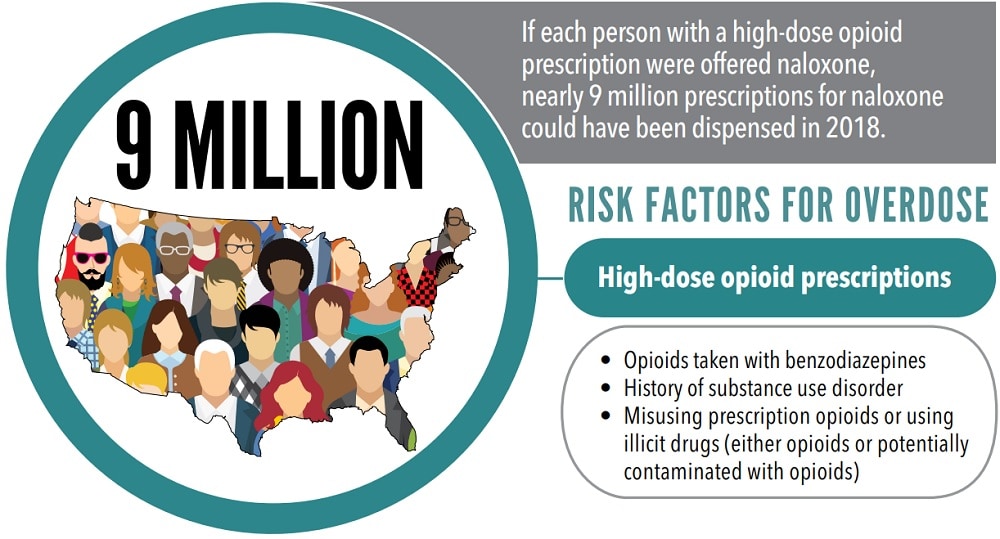
- Following the CDC Guideline for Prescribing Opioids for Chronic Pain to consider offering naloxone to patients receiving high opioid dosages (greater than or equal to 50 morphine milligram equivalents per day).
- Keeping naloxone in stock in pharmacies.
- Educating patients, caregivers, and the community about the benefits of having naloxone readily available to more people.
Major changes in opioid and naloxone dispensing occurred from 2017 to 2018.

Close
Download Image[JPG]
SOURCE: Vital Signs MMWR, August 2019
Co-prescribing naloxone is recommended for patients at risk for opioid overdose.

Close
Download Image[JPG]
SOURCE: Vital Signs MMWR, August 2019
Problem
People who may need naloxone are not all getting it.
There is wide variation in prescribing and dispensing across the US despite consistent state laws and recommendations. Dispensing naloxone in areas hardest hit by the opioid overdose epidemic can increase the number of overdose reversals and the opportunity to link overdose survivors into treatment.
Actions needed to improve access locally.
Examples include:
- Reducing insurance co-pay for patients.
- Increasing provider training and education.
- Targeting distribution especially in rural areas.
The Way Forward
Pharmacists and Other Healthcare Providers Can:
- Monitor patients for risk of overdose, prescribe or dispense naloxone when overdose risk factors are present, and counsel patients on how to use it.
- Ensure naloxone is always available in pharmacies.
- Participate in and offer naloxone training and education.
Health Insurers Can:
- Reduce patient out-of-pocket costs.
- Cover naloxone prescriptions without prior approval.
States and Communities Can:
- Work with healthcare providers to expand naloxone access, especially in rural areas.
- Promote the benefits of prescribing, dispensing, and carrying naloxone.
- Create harm reduction programs and improve access to medication-assisted treatment for opioid use disorder.
Everyone Can:
- Ask your doctor or pharmacist for a naloxone prescription if you or a loved one are taking high-dose opioids or have a substance use disorder.
Many factors contribute to the problem.

- Most (71%) of Medicare prescriptions for naloxone required a copay compared to 42% for commercial insurance.
- Primary care providers only prescribed about 2 naloxone prescriptions for every 100 high-dose opioid prescriptions.
- Naloxone dispensing is 25 times greater in the highest-dispensing counties than the lowest.
Issue Details
Related Pages and Resources
- Vital Signs: Press Release – Todavía no hay suficiente naloxona donde más se necesita [Spanish]
- Morbidity and Mortality Weekly Report (MMWR): Vital Signs: Pharmacy-Based Naloxone Dispensing —United States, 2012–2018
- Vital Signs, 2018: Vital Signs: Opioid Overdoses Treated in Emergency Departments: Identify Opportunities for Action
- Vital Signs, 2017: Opioid Prescribing: Where You Live Matters
- Vital Signs, 2015: Today’s Heroin Epidemic: More People at Risk, Multiple Drugs Abused
- CDC Opioid Overdose WebsiteOpioid Basics
- Data Overview
- State Information
- Publications
- CDC’s Rx Awareness Campaign
- CDC Guideline for Prescribing Opioids for Chronic Pain — United States, 2016
- Healthcare Provider Resources
- CDC Clinical Practice Guideline for Prescribing Opioids for Pain — United States, 2022
- CDC Opioid Prescribing Guideline Mobile App
- Factsheet: Prescription Drug Monitoring Programs (PDMPs) [7.8 MB, 2 pages]
- Nonopioid Therapies for Pain Management
- Resource Center
Other Sites
- U.S. Department of Health & Human Services Guidance on Naloxone Co-Prescribing [683 KB, 2 pages]
- U.S. Surgeon General’s Advisory on Naloxone and Opioid Overdose
- U.S. Department of Health & Human Services Strategy for National Opioid CrisisSubstance Abuse and Mental Health Services Administration (SAMHSA) Naloxone
- Buprenorphine Waiver Management
- National Institute on Drug Abuse
- U.S. Food and Drug Administration – Drugs Information
- Drug Enforcement Administration – Office of Diversion Control
- Centers for Medicare & Medicaid Services
- Office of National Drug Control Policy
- Journal of the American Medical Association (JAMA): Naloxone Co-prescribing to Patients Receiving Prescription Opioids in the Medicare Part D Program, United States, 2016-2017
- Office of the U.S. Surgeon General
- Providers’ Clinical Support System
- MedlinePlus – Prescription Drug Abuse
- Office of the National Coordinator for Health Information Technology (ONC) – Linking PDMPs to Health IT
- National Alliance for Model State Drug Laws
Science Behind the Issue
For More Information
1-800-CDC-INFO (232-4636)
TTY: 1-888-232-6348
Web: www.cdc.gov
Centers for Disease Control and Prevention
1600 Clifton Road NE
Atlanta, GA 30333
Publication date: August 6, 2019
Content provided and maintained by the US Centers for Disease Control and Prevention (CDC). Please see our system usage guidelines and disclaimer.
Where this page came from
This page was imported from Centers for Disease Control and Prevention. Material produced by the Centers for Disease Control and Prevention is a work of the United States government and is in the public domain.
Nobody has written it yet — it is the source material at a new address, which is why search engines are asked to skip it and why no one earns from it. It is up for grabs: take it on, and it is yours to rewrite and to earn from.
Licens: CC0 1.0 (allmän egendom) · Bearbetat efter www.cdc.gov
1
0
0
0

Kommentarer